
In December 2016, in one of Mexico’s most dangerous states, a woman looked straight into a camera and delivered a message that would soon be reported by news outlets around the world.
She wasn’t pleading for mercy.
She wasn’t making threats.
She simply wanted her husband back.
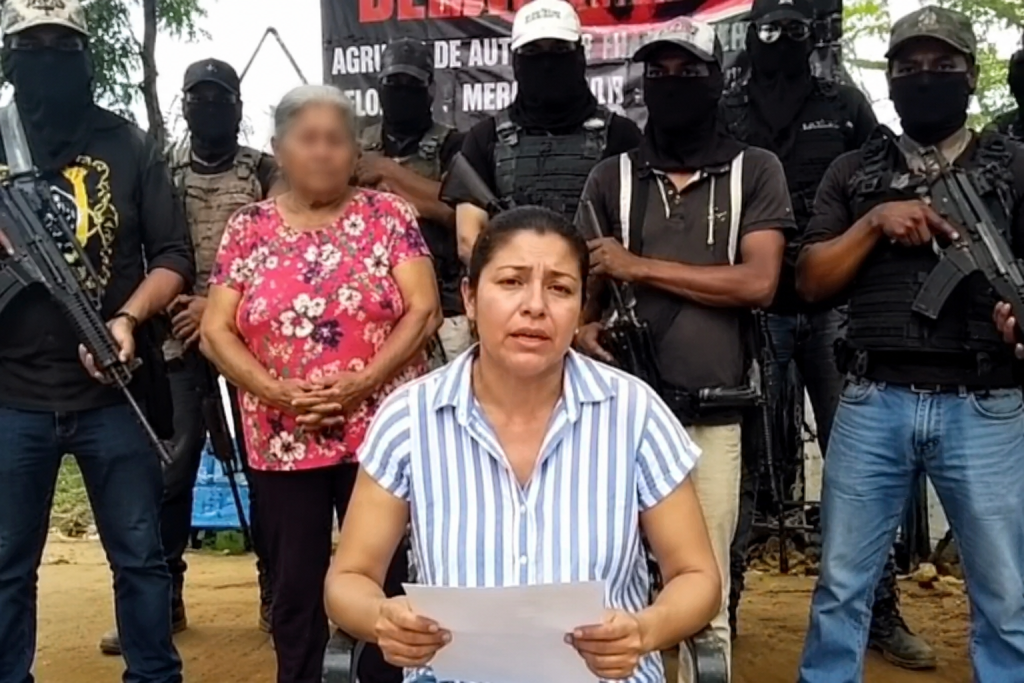
Standing behind her were armed members of a local civilian self-defense group. In their custody was an unexpected bargaining chip—the mother of the man believed to be responsible for her husband’s kidnapping.
Years later, social media would reduce the entire story to a single dramatic sentence: “A woman kidnapped a cartel boss’s mother to get her husband back.”
It is an attention-grabbing claim, but it tells only part of the story. The real events were far more complex, revealing not only a family’s desperation but also what can happen when organized crime becomes more powerful than the institutions meant to stop it.
A Place Where Criminal Groups Held More Power Than the Law
The story unfolded in the Mexican state of Guerrero, a region famous for its Pacific coastline and the resort city of Acapulco. Yet behind its tourist attractions lies a much darker reality.
For years, Guerrero has been one of the country’s most violent states, with criminal organizations fighting over territory and illegal businesses. Drug trafficking was only one part of their operations. Kidnappings, extortion, and intimidation became everyday tools used to control local communities and generate enormous profits.
Many residents eventually lost confidence in the authorities’ ability to protect them. In response, some communities created armed civilian self-defense groups—known in Mexico as autodefensas—made up of ordinary citizens determined to defend their towns when they believed the state could not.
To some, they became heroes.
To others, they represented a troubling sign that public institutions had lost control.
A Family’s Worst Nightmare
Against this backdrop, engineer Isauro de Paz Duque disappeared.
According to multiple reports, he had been abducted by members of Los Tequileros, a criminal organization led by Raybel Jacobo de Almonte, better known by the nickname “El Tequilero.”
For his family, every passing hour brought more uncertainty.
Kidnappings linked to organized crime in Mexico rarely end predictably. Some victims are released after ransom payments, while others are never seen again.
His wife, Yadira Guillermo García, had no way of knowing which fate awaited her husband.
An Unusual Response
As relatives searched desperately for information, local self-defense groups decided to increase the pressure on the cartel.
During an operation in the region, they detained around twenty people believed to have connections to Los Tequileros. Among them was the mother of the cartel’s alleged leader.
This is the part of the story that has been widely distorted online.
Contrary to countless viral posts, there is no evidence that Yadira personally organized the woman’s capture or took part in the operation. That action was carried out by members of the local self-defense movement.
Yadira’s role was different.
She became the public face of the family’s appeal.
The Video That Captured International Attention
Soon afterward, Yadira appeared in a video message addressed directly to “El Tequilero.”
Despite the emotional circumstances, she spoke with remarkable composure.
Her request was straightforward.
She wanted her husband returned alive.
The message made it clear that once Isauro was safely released, the cartel leader’s mother would also be freed.
The footage spread rapidly across Mexican television before being picked up by international media outlets, turning a local crisis into a global news story.
For many viewers, it symbolized the desperation of a family trying to save a loved one.
For others, it exposed how deeply organized crime had eroded the authority of the state in parts of Mexico.
Negotiations With Lives at Stake
Authorities quickly realized that the situation could spiral into bloodshed.
Hundreds of police officers were deployed to prevent a violent confrontation between cartel members and the armed civilian groups.
Negotiations followed under intense pressure.
Eventually, an agreement was reached.
Isauro de Paz Duque was released alive.
Shortly afterward, the cartel leader’s mother and the other detainees held by the self-defense groups were also released unharmed.
Considering the potential for violence, the outcome was remarkably peaceful.
Who Was “El Tequilero”?
Raybel Jacobo de Almonte was regarded as one of Guerrero’s most feared criminal figures.
His organization, Los Tequileros, was linked by Mexican authorities to kidnappings, extortion, drug trafficking, and numerous violent crimes throughout the region.
For years, security forces attempted to capture him.
In February 2018, nearly two years after these events, he was killed during an operation carried out by Mexican authorities.
Although his death dealt a significant blow to Los Tequileros, security experts noted that removing one cartel leader rarely ends organized crime. Other groups often move quickly to fill the power vacuum.
How a True Story Became a Viral Legend
Today, images of Yadira Guillermo García continue to circulate online, usually accompanied by the claim that she kidnapped a cartel leader’s mother to rescue her husband.
The reality is both less sensational and more revealing.
The woman was detained by a local civilian self-defense group, not by Yadira herself. What Yadira did was publicly deliver the message that brought worldwide attention to her husband’s case and gave a human face to a desperate community struggling against organized crime.
That distinction matters.
It reminds us that the story was never about one woman defeating a cartel on her own. It was about ordinary people who believed they had run out of lawful options.
More Than a Viral Story
From the outside, the episode sounds like something from a crime thriller.
For many people living in Guerrero, however, it reflected a much harsher reality.
When citizens lose faith that the law can protect them, they sometimes turn to extraordinary—and deeply dangerous—measures in the hope of saving those they love.
That is why this case continues to attract attention nearly a decade later.
Not because it proves that a cartel was outsmarted, but because it highlights the devastating consequences of living in a place where fear has become stronger than trust in public institutions.