
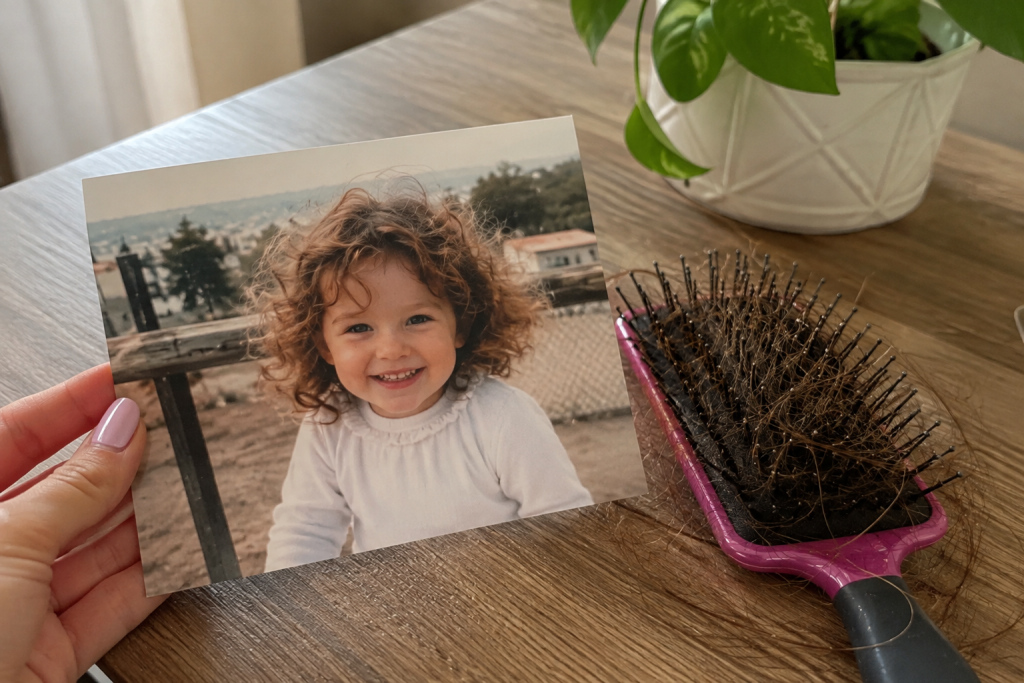
Many people look back at childhood photos and notice something surprising. The tight curls or soft waves they once had seem to have vanished, replaced by straight hair. Others experience the opposite. After years of having perfectly straight hair, they suddenly develop waves or curls during their teenage years or even later in adulthood.
Although it may seem unusual, these changes are well recognized by dermatologists and hair specialists. Hair texture is not always fixed for life. As the body grows and hormones change, the hair itself can change too.
Your Hair Isn’t Necessarily the Same Forever
The shape of each hair strand is determined by the follicle beneath the skin. A nearly round follicle usually produces straight hair, while a more oval or curved follicle creates wavy or curly strands.
Genetics play the biggest role in determining hair type, but the follicles continue to mature during childhood. Because of this ongoing development, the hair a toddler has may not look the same years later.
This is why many children naturally “grow out” of their curls, while others unexpectedly develop them later in life.
Why Some Children Lose Their Curls
Parents often notice that a child with beautiful ringlets at age three has noticeably straighter hair by the time they reach elementary school.
Several factors can explain this transformation.
The first is simple development. Baby hair is gradually replaced by mature hair, which tends to be thicker, stronger, and sometimes different in texture.
As hair follicles continue developing, even small structural changes can influence how each strand grows. A slight difference in follicle shape may be enough to soften curls into loose waves or make them disappear altogether.
Hair length also matters. Thick, dense, and long hair carries more weight, which can pull gentle curls downward. After a shorter haircut, some natural waves may become visible again simply because the hair is no longer being stretched by its own weight.
However, if the hair remains completely straight after being cut shorter, the underlying hair texture has most likely changed as part of normal development.
Why Straight Hair Can Become Curly During Puberty
The opposite change is just as common.
Some teenagers discover that hair which had always been straight gradually becomes wavy or curly during puberty.
Hormonal changes are the main reason.
During adolescence, the body undergoes significant hormonal shifts that influence many tissues, including hair follicles. In some people, these changes slightly alter the shape or activity of the follicles, producing hair with a different texture than before.
This is also why some adults notice changes in their hair after pregnancy, during menopause, or while experiencing other major hormonal changes.
Why Brothers and Sisters Can Have Completely Different Hair
Hair genetics are surprisingly complex.
Each child inherits a unique combination of genes from both parents. Those genes influence hair color, strand thickness, density, growth pattern, and follicle shape.
As a result, siblings can have dramatically different hair textures despite growing up in the same family. One may have straight hair, another loose waves, and another tight curls.
Some inherited traits also become more noticeable as the body develops, meaning hair texture can continue evolving over time.
Can Heavy Hair Make Curls Disappear?
In many cases, yes.
Hair weight cannot change the follicle itself, but it can affect how curls appear.
Long, thick hair naturally pulls downward under its own weight. If the curls are loose rather than tightly coiled, they may appear almost straight once the hair becomes long enough.
This explains why many people notice more movement and wave after cutting several inches off their hair.
Can Hair Products Bring Natural Curls Back?
Hair care products can improve the appearance of existing curls, but they cannot permanently change the natural texture of the hair.
Shampoos, conditioners, curl creams, and styling products help reduce frizz, improve moisture, and define curls that are already present.
They cannot transform naturally straight hair into permanently curly hair because they do not change the structure of the follicle where the hair is produced.
Does Cutting Hair Make It Curlier?
This is one of the oldest hair myths.
A haircut does not alter the follicle or change the type of hair that will grow afterward.
What it can do is remove enough weight for existing waves or curls to become more noticeable. The haircut reveals the hair’s natural texture rather than creating a new one.
When Should Hair Texture Changes Be Checked by a Doctor?
Most gradual changes during childhood, puberty, pregnancy, or aging are completely normal.
However, if hair texture changes suddenly and is accompanied by excessive shedding, bald patches, unusually fragile hair, or other symptoms such as fatigue or hormonal irregularities, it is worth consulting a dermatologist or healthcare professional. In some cases, thyroid disorders, nutritional deficiencies, or hormonal conditions may affect hair growth.
The Bottom Line
Hair is much more dynamic than most people realize. The curls seen in early childhood may gradually disappear as hair follicles mature, while hormonal changes later in life can give naturally straight hair a completely different appearance.
In the end, our hair evolves alongside the rest of our body. Childhood photographs are not misleading—the curls were real. They simply belonged to a different stage of life, reflecting the remarkable way our bodies continue to change as we grow.