
Sunday Mass can be one of the most familiar rhythms of Catholic life. We enter the church, find a place, listen to the readings, respond to the prayers, receive Holy Communion and eventually return to everything waiting for us outside.
Yet familiarity has a curious effect. Something can remain deeply important to us while gradually becoming automatic.
We may be sitting in the pew while mentally planning lunch. We may hear the Gospel while thinking about work, family problems or something that happened earlier that morning. A notification appears on the phone, a child needs our attention, or we suddenly realize that several minutes have passed and we cannot remember what was just read.
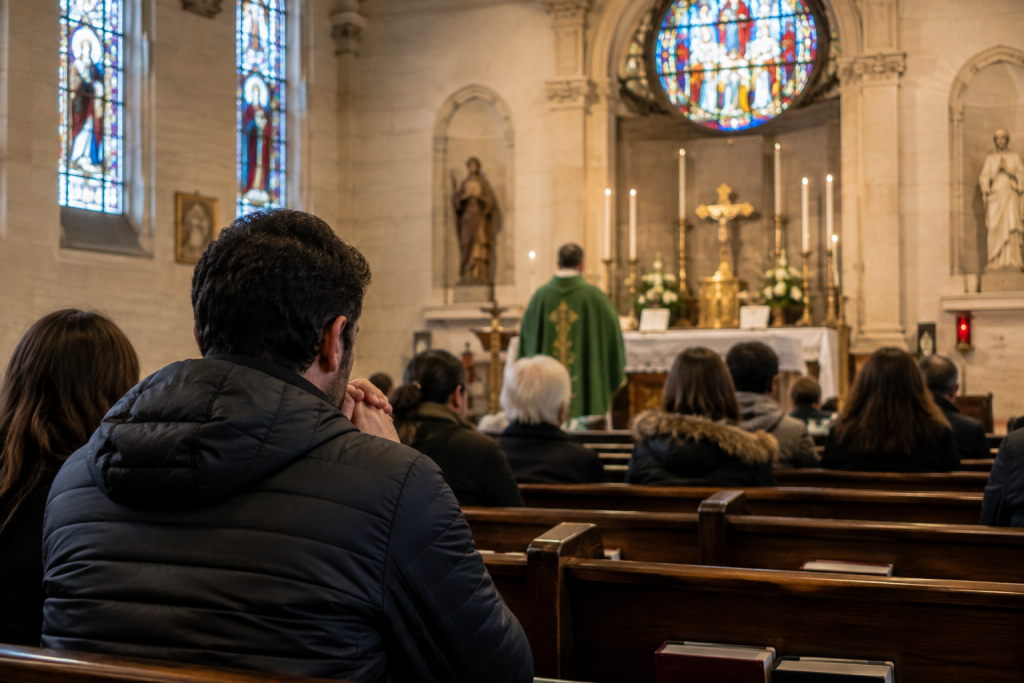
Physical presence does not always mean interior presence.
Father Mark-Mary Ames of the Franciscan Friars of the Renewal has addressed this very ordinary struggle by proposing several practical challenges for Catholics who want to become more intentional about Mass. His suggestions are remarkably uncomplicated: arrive early, put away the phone, read the Scripture passages beforehand, protect the moments following Communion, remain briefly after Mass and connect with another person before leaving.
None of these practices is a new Church requirement. Their value lies somewhere deeper. Together, they raise a question worth considering: When we attend Mass, how much of ourselves actually arrives?
Why the Eucharist stands at the heart of Catholic life
The importance Catholics give to Mass cannot be understood simply as a Sunday tradition.
The Catechism of the Catholic Church describes the Eucharist as the “source and summit of the Christian life.” During Mass, Scripture is proclaimed and the Eucharist is celebrated. Catholic teaching holds that Christ is truly present in the Eucharist and that Holy Communion brings the faithful into an intimate union with him.
This is why Catholic liturgy is not intended to be something an audience merely watches.
The Second Vatican Council, in Sacrosanctum Concilium, famously called for the faithful to participate in the liturgy fully, consciously and actively.
That phrase can easily be misunderstood.
Active participation does not simply mean singing louder, saying every response or having a visible role during Mass. Pope Benedict XVI addressed precisely this point in Sacramentum Caritatis, warning against reducing participation to external activity. Authentic participation also involves interior disposition, understanding what is being celebrated and allowing the mystery encountered in worship to influence everyday life.
Seen from this perspective, Father Mark-Mary’s suggestions are less about perfect church etiquette and more about recovering attention.
Arrive before Mass begins — and allow your mind to arrive too
Imagine going directly from traffic, parking problems and unanswered messages into the opening hymn.
Your body may reach the church on time, but your thoughts may still be several streets away.
Father Mark-Mary suggests arriving roughly ten minutes early. Ten minutes is his practical recommendation, not a requirement established by the Catholic Church. The underlying principle, however, fits comfortably within Catholic spirituality.
In Sacramentum Caritatis, Benedict XVI specifically encouraged personal preparation for the liturgy, including recollection and silence for at least a few moments before Mass begins.
Those quiet minutes can become a threshold between ordinary busyness and worship.
There is no need to fill them with elaborate prayers. A person might bring to God the people who need prayer, the difficulties of the past week, something for which they are grateful or a decision they are struggling to make.
Sometimes preparation can consist simply of being quiet.
Give your attention a break from the phone
A modern smartphone can contain almost everything: work emails, family conversations, news, entertainment, photographs, social media and even the Bible.
That makes the problem more complicated than simply declaring phones inappropriate in church.
Many Catholics legitimately use their devices to follow the daily readings or access prayers. Others may need to remain reachable because of family responsibilities, medical work or an urgent situation.
The more useful question is what the device does to our attention.
One notification can be enough to move the mind somewhere else. A quick look at a message can lead to another message, then an email, then something entirely unrelated to the reason we entered the church.
Father Mark-Mary’s challenge is intentionally simple: when circumstances permit, separate yourself from the phone for the duration of Mass.
For someone who cannot leave it behind, silencing notifications and resisting unnecessary checking can accomplish much of the same purpose.
The goal is not to prove that we can survive without technology for an hour. It is to decide what deserves our undivided attention.
Encounter the Sunday readings before hearing them proclaimed
Scripture can be difficult to absorb when we encounter a passage for the first time while it is being read aloud.
A name is unfamiliar. The historical setting is unclear. We are still trying to understand the first few sentences when the lector reaches the end.
Reading the passages beforehand changes that experience.
Even five quiet minutes with the Gospel before leaving home can make certain words more recognizable when they are proclaimed at Mass. Connections between the readings may become easier to notice, and the homily can be heard against a richer background.
This is not about turning Sunday morning into a theology class.
The Catechism presents the Liturgy of the Word and the Liturgy of the Eucharist as parts of one act of worship. Scripture is therefore not simply preliminary material to get through before reaching the “important” part of Mass.
Listening is itself part of participation.
Reading beforehand can help us listen rather than merely hear.
Protect the quiet after receiving Holy Communion
There is a particular temptation after returning to the pew following Communion: to immediately become aware of everything happening around us.
Who is still in line? Where are the children? Has someone taken our place? What is the choir singing? How long until Mass ends?
Father Mark-Mary encourages Catholics, when circumstances allow, to resist that outward pull for a little while.
For Catholics receiving Holy Communion, these moments carry profound significance. The Church teaches the Real Presence of Christ in the Eucharist and speaks of the deep union with Christ brought about through receiving the sacrament.
Thanksgiving is therefore a natural response.
There is no universal formula for what those minutes must look like. Someone may pray silently, use a familiar prayer or simply speak to God internally. Even the word “Eucharist” is rooted in thanksgiving.
And this advice needs an important dose of reality.
A parent attending Mass with small children may spend the moments after Communion retrieving a dropped toy, whispering to an impatient child or preventing a sibling argument from developing in the pew.
That does not make the parent’s presence before God somehow inferior.
Interior prayer does not always arrive wrapped in exterior silence.
Resist treating the final blessing like a starting signal
The closing moments of Mass can sometimes trigger an almost immediate transition back into ordinary life.
Coats appear. Bags are collected. Keys come out. Thoughts turn toward the parking lot and whatever comes next.
Father Mark-Mary suggests doing something different when time allows: remain for a few moments.
There is no prescribed number of minutes. The point is not to remain in the church long enough to prove devotion.
It is to allow some space between worship and hurry.
A brief prayer of gratitude may be enough. Another possibility is to recall one sentence from the Gospel, one thought from the homily or one intention that became especially important during Mass.
Perhaps the most useful question before leaving is not simply, “What do I need to do next?” but, “What am I taking from this Mass into the rest of my life?”
Christian worship is not meant to remain confined within church walls. Its fruits are supposed to appear in relationships, decisions, work, generosity and the way we treat other people.
Before going home, notice the people around you
The final challenge moves in an unexpected direction.
After encouraging silence, recollection and interior prayer, Father Mark-Mary asks Catholics to speak to someone.
That is not a contradiction.
Christian faith is intensely personal, but it was never designed to be entirely private. From the earliest Christian communities described in the Acts of the Apostles, believers gathered, prayed and lived their faith in relationship with others.
A parish can be full every Sunday and still feel lonely.
Changing that does not necessarily require a major parish program. It may begin with learning someone’s name, greeting an older parishioner, welcoming a family we have never met or speaking for a few minutes with the person we have seen in the same pew for months.
To someone who regularly arrives and leaves church alone, a small conversation may mean far more than the other person realizes.
A collection of people occupying the same building is not automatically a community. Community grows when people begin to see one another.
These are spiritual practices, not six additional Catholic rules
This distinction matters.
Catholics are not required to arrive exactly ten minutes before Mass. The Church does not command everyone to leave a smartphone in the car. There is no universal rule requiring the faithful to remain inside the church for a specific number of minutes afterward, nor is there an obligation to start a conversation before going home.
Father Mark-Mary’s challenges are pastoral suggestions intended to help people become more attentive to what they are celebrating.
They should certainly not become six new standards by which we judge everyone else.
We do not know why someone arrived late.
We do not know why the woman two pews ahead looked at her phone. Perhaps she was following the readings. Perhaps she was waiting for an urgent message. We do not know why a man left quickly after Mass or why a parent seemed distracted throughout the homily.
From a church pew, we can see someone’s behavior. We rarely see the circumstances surrounding it.
The purpose of these practices is therefore not to give us additional reasons to evaluate other Catholics.
They are questions to ask ourselves.
Perhaps the real challenge is relearning how to be present
Attention has become one of the most contested resources of modern life.
There is always another notification, another message, another headline, another task and another reason for the mind to move somewhere else. Even when our bodies stop moving, our thoughts often continue racing.
That may explain why such ordinary suggestions can feel surprisingly relevant.
Arriving early will not guarantee a profound spiritual experience. Turning off a phone will not automatically eliminate distraction. Reading the Gospel beforehand does not mean every homily will suddenly feel personally transformative.
Faith does not work according to such formulas.
What these practices can provide is something much simpler: space.
Space between traffic and prayer.
Space to hear Scripture before another notification demands attention.
Space for gratitude after Communion.
Space between the final blessing and the next obligation.
And finally, space to notice the human being sitting nearby.
Perhaps we do not need to master all six practices at once.
The more useful question may be the one we carry with us the next time we enter a church:
What is one small thing I could change so that I am not merely attending Mass, but truly present for it?