
More than two centuries ago, an ordinary window in a small Alpine village became the center of an extraordinary story.
It began with an 18-year-old woman, a pane of glass and an image that seemed to have appeared without anyone putting it there. Before long, villagers were gathering to see it, pilgrims were arriving from farther away, and specialists were being asked to determine how the strange figure had formed.
Today, the story of the so-called Our Lady of Absam has found a new audience on social media. Viral videos describe a portrait of the Virgin Mary that supposedly resisted every attempt to remove it. Some go even further, claiming that acids, scraping and scientific examinations failed to explain or destroy the mysterious image.
The historical record tells a more complicated story.
There really was an unusual image. The glass really was examined. And the devotion that developed around it has survived for more than 200 years.
But some of the most dramatic claims circulating online leave out details that significantly change the story.
A Winter Day That Changed a Tyrolean Village
The story begins on January 17, 1797, in Absam, a village in Tyrol, in what is now Austria.
Life there at the end of the 18th century would have been shaped by the surrounding mountains, harsh winters, close-knit communities and a deeply rooted Catholic tradition. News traveled very differently from the way it does today, yet an unusual event could still spread remarkably quickly from one household to another.
On that January day, 18-year-old Rosina Bucher noticed something strange on a window in her family’s home.
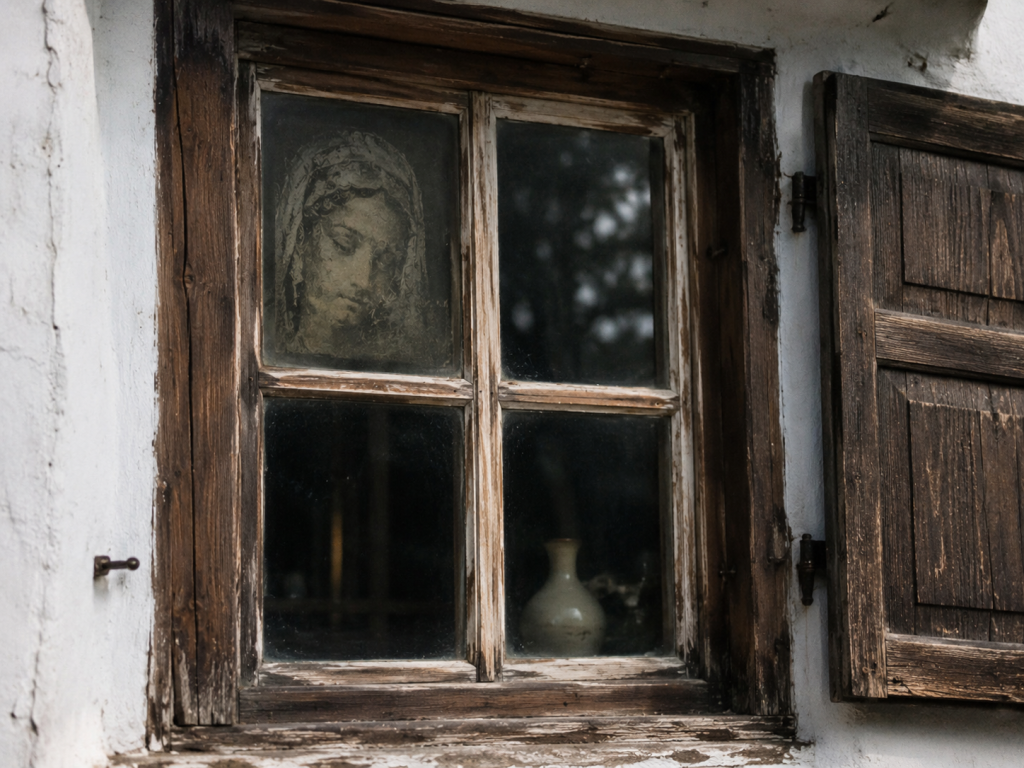
There appeared to be the outline of a woman’s face.
To those who saw it, the features resembled familiar Catholic representations of the Virgin Mary. The figure appeared veiled, and there was no obvious conventional painting on the glass that could immediately explain what people were seeing.
For Rosina and those who came to look afterward, it was far more than an unusual stain on an old window.
Something remarkable seemed to have appeared in their village.
Curiosity Soon Turned Into Pilgrimage
At first, people from the surrounding community came to see the window.
Then the story traveled beyond Absam.
In the religious culture of the period, the possibility that an image of Mary had appeared unexpectedly was enormously significant. People wanted to judge the phenomenon for themselves, and the Bucher family’s window gradually became the focus of intense attention.
Some visitors interpreted what they saw as a heavenly sign. Prayer and devotion began to surround the image, establishing a religious tradition that would eventually outlive everyone who had witnessed those first days.
Yet there was another question that could not easily be ignored.
If nobody had painted the image, what had produced it?
That question eventually moved the story beyond faith alone.
Experts Were Asked to Examine the Glass
One of the most interesting aspects of the Absam story is that attempts were made to investigate the object rather than relying solely on testimony.
In 1797, the glass was examined by a commission involving people with expertise in several fields, reportedly including professors, chemists, a mathematician, a painter and specialists familiar with glassmaking.
Their task was not to decide what the image meant spiritually.
They wanted to understand what was physically present on the window and whether there was an identifiable explanation for it.
For an investigation conducted at the end of the 18th century, this interdisciplinary approach is particularly noteworthy.
And the glass did not provide an easy answer.
It Wasn’t Simply a Conventional Painting
The investigators did not find an obvious painted portrait sitting on the surface of the window in the way one might expect from a deliberate artwork.
Different procedures were reportedly tried on the glass, and the appearance of the image could vary depending on how the surface was treated and observed.
That unusual behavior helped create the mystery that would eventually surround the object.
Had investigators discovered a straightforward layer of paint, the story might have ended there.
Instead, the question of how the pattern had originally formed remained unresolved.
Over time, however, that uncertainty became something much more dramatic in popular retellings.
The Detail Often Missing From Viral Versions of the Story
Modern accounts sometimes claim that nothing could remove the image. Videos may describe increasingly aggressive attempts to erase it, creating the impression of a portrait physically immune to ordinary methods.
The historical account is not quite so spectacular.
Some treatments apparently failed to eliminate the visible figure as one might expect if it were merely a superficial deposit.
But another experiment produced a very different result.
When a glass specialist used an abrasive treatment strong enough to affect the actual surface of the pane, the image could reportedly be removed from the treated area.
That matters.
It means that the popular claim that the image was literally impossible to erase is misleading.
At the same time, removing part of the image does not automatically answer the original question. Showing that a mark disappears when the glass itself is abraded is not the same as establishing exactly how that mark formed in the first place.
And this is where the historical story becomes considerably more interesting than the viral version.
The Investigation Did Not Declare a Proven Miracle
The conclusions reached at the time are also frequently misunderstood.
The investigators did not announce that science had established a supernatural origin for the image.
They also did not claim to have discovered precisely how it had formed.
Instead, the available historical accounts indicate that the investigators were unable to establish its exact origin while still considering a natural cause the appropriate assumption.
That distinction is crucial.
There is an enormous difference between saying “we cannot currently identify the cause” and saying “no natural cause is possible.”
The first acknowledges the limits of available knowledge.
The second makes a much stronger claim that the investigation did not establish.
More than two centuries later, that distinction is easily lost when an old story has to fit into a short, dramatic social-media video.
Could Old Glass Produce an Image Like This?
Glass may look inert and permanent, but historic glass can undergo complex changes.
Its composition was not necessarily as uniform as that of modern industrial glass. Manufacturing impurities, moisture, temperature changes, surface weathering and chemical reactions can alter its appearance over long periods.
Such processes can produce unexpected patterns.
There is also another factor worth considering: the way the human brain interprets visual information.
Humans are exceptionally good at detecting faces. We can identify something resembling two eyes and a mouth from remarkably little information. Sometimes this ability causes us to perceive recognizable faces in ambiguous or random patterns.
The phenomenon is known as pareidolia.
It is why people see faces in clouds, rocks, tree bark, buildings and countless everyday objects.
Pareidolia could help explain why an irregular pattern was interpreted specifically as a human face or a familiar religious figure. It does not, however, tell us exactly what physical process produced the original markings on the Absam glass.
The surviving historical accounts do not provide a definitive mechanism for the formation of the image, and there does not appear to be extensive modern scientific research establishing precisely how it originated.
So describing the window as a mystery that modern scientists are still actively struggling to solve would go beyond the available evidence.
The Scientific Questions Did Not End the Religious Meaning
For those who considered the image sacred, uncertainty about its physical origin did not make it spiritually meaningless.
Devotion surrounding the image continued and became deeply connected with Absam’s religious identity.
The image became known as Our Lady of Absam, and the glass eventually found a permanent place in the local church of St. Michael, now a minor basilica.
Pilgrims still visit Absam today.
For many of them, the importance of the image is not dependent on laboratory proof that something supernatural occurred in 1797. Religious devotion and scientific verification are two different questions, even though modern retellings often blur the boundary between them.
A church permitting devotion to an image is not the same thing as science demonstrating that the image could only have been produced by supernatural means.
The Real Story Is Strong Enough Without Internet Embellishment
It is easy to understand why the Absam story works so well online.
It contains almost every ingredient of a compelling mystery: a young woman, a remote Alpine village, an unexpected religious image, an old pane of glass and specialists attempting to discover where the strange figure came from.
Then there is the unanswered question at the center of everything.
What produced the original pattern?
The problem begins when uncertainty is converted into certainty for the sake of a dramatic headline.
“Investigators could not determine the precise cause” becomes “science proved it was impossible.”
“Some cleaning methods failed to remove the image” becomes “nothing could destroy it.”
A genuinely intriguing historical episode is transformed into a supposed scientific showdown between experts and an object that defies the laws of nature.
It doesn’t need that embellishment.
The documented story is compelling on its own.
One Window, Seen Through Different Eyes for More Than 200 Years
The Absam image remains recognizable enough for its story to fascinate pilgrims, visitors and people interested in religious history more than two centuries after its appearance.
A believer may look at the glass and see a sign associated with Mary and generations of prayer.
A historian may see a remarkable example of how religion, community life and early attempts at empirical investigation intersected in late-18th-century Europe.
Someone approaching the case scientifically may emphasize a different principle: an unexplained phenomenon is not automatically evidence of a supernatural cause.
Those perspectives do not necessarily have to become enemies.
More than 200 years after Rosina Bucher first noticed something unusual on her family’s window, the glass survives and people continue to look at it.
Perhaps that is part of the reason the story has endured.
There is a real object behind the legend. There are historical accounts of an investigation. There is a centuries-old religious tradition. And there are questions that the surviving records cannot answer with absolute certainty.
Between what history can establish and what an individual chooses to believe remains a space that neither a viral video nor an overly simple explanation can completely close.
And so a pane of glass from a small village beneath the Austrian Alps continues to do something remarkable more than two centuries later: it makes people stop, look closely and ask themselves what, exactly, they are seeing.