
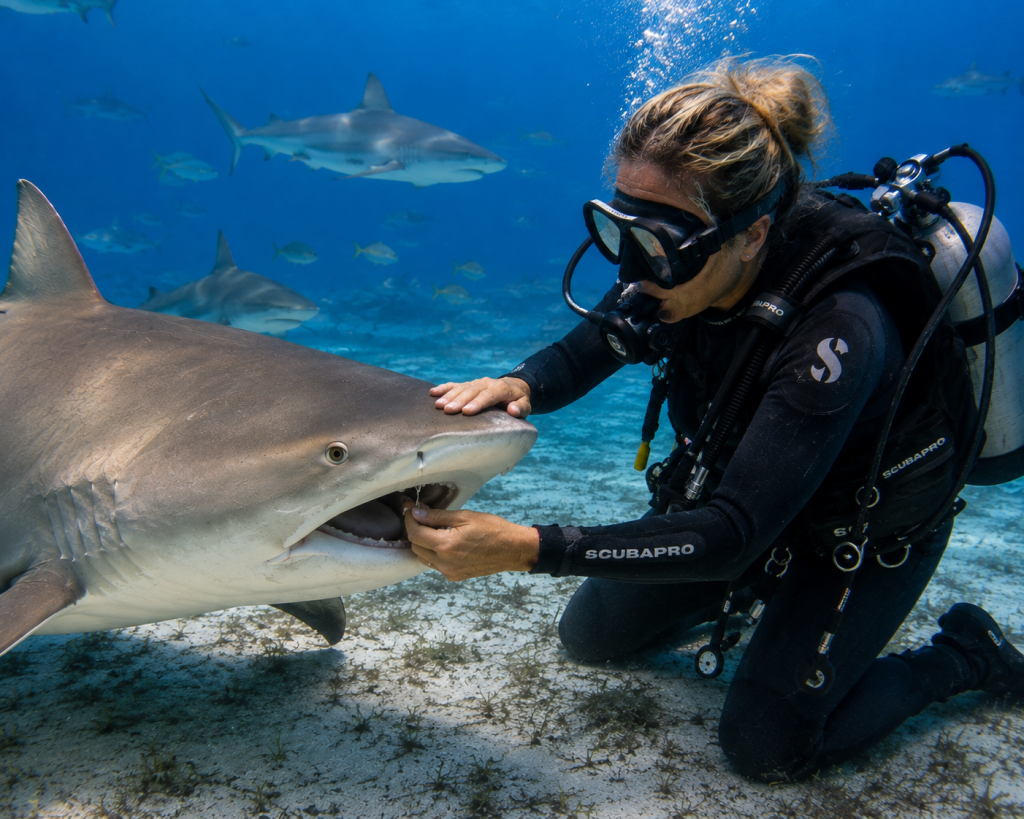
A shark moves slowly toward a diver resting on the ocean floor. There is no aquarium glass separating them, no enclosure keeping the animal nearby and no guarantee that it will remain calm. The shark is completely free to swim away.
Instead, it comes closer.
The diver reaches toward its head. In encounters that have fascinated millions of people, sharks have remained close enough for her to examine them and, when necessary, remove fishing hooks lodged in their mouths.
The woman behind those extraordinary scenes is Cristina Zenato, a diver, shark behavior specialist and conservationist whose life in the Bahamas has challenged some of our most persistent assumptions about these animals.
Social media has turned her story into something resembling a legend. Posts claim that sharks seek her out for help and that an entire generation of them is alive because of her work.
The reality is more nuanced. It is also far more interesting.
A trip to the Bahamas that became a new life
Zenato’s connection with wildlife began long before she became known for sharks. Born in Italy and raised partly in what was then Zaire, now the Democratic Republic of the Congo, she grew up surrounded by environments that encouraged a fascination with the natural world.
Her path eventually took her to the Bahamas, where she began diving professionally in the 1990s. What started as an adventure became a career spanning decades.
Over the years, Zenato developed extensive experience with sharks, particularly Caribbean reef sharks. Her work expanded far beyond recreational diving to include shark behavior, conservation, education and underwater cave exploration.
Yet the images that eventually made her internationally recognizable began with something surprisingly simple: she noticed that some of the sharks she encountered were carrying evidence of their interactions with humans.
Fishing hooks.
The hooks that changed her relationship with sharks
A shark that escapes from fishing gear does not necessarily escape unharmed.
Hooks can remain embedded in the mouth or surrounding tissue after fishing line breaks or an animal manages to free itself. The consequences vary considerably. Some injuries may heal, while others can cause persistent trauma or complications.
Zenato began removing hooks from sharks when circumstances allowed her to do so safely.
Over many years, that practice resulted in hundreds of hooks reportedly being removed.
It is tempting to describe every removal as a life saved, but scientifically that would be impossible to establish. A retained hook does not automatically mean that a shark would otherwise die.
The significance of her work nevertheless extends beyond the fate of individual animals.
Fishing pressure is one of the greatest threats facing shark populations worldwide, and the hooks Zenato encounters offer a striking, visible example of how human activity can follow an animal even after it has escaped capture.
Why would a wild shark allow a human to get so close?
This is where Zenato’s story becomes particularly fascinating.
The sharks appearing beside her are not pets. They are wild animals living in the ocean, and they can leave whenever they choose.
Zenato has spent years repeatedly encountering sharks in the same area. Some individuals have become remarkably tolerant of her presence and physical contact.
That does not mean we should automatically interpret their behavior through human emotions.
Online descriptions often say the sharks “love” her, “trust her like a friend” or deliberately come to her because they know she can provide medical assistance. Such interpretations make compelling captions, but proving those motivations scientifically is another matter.
What can be observed is extraordinary enough: repeated interactions between an experienced diver and wild sharks have produced a level of familiarity and tolerance that allows encounters most people would never expect to witness.
The distinction matters.
These are not domesticated animals that have somehow stopped being sharks. They remain wild predators whose behavior deserves caution and respect.
The so-called “shark hypnosis”
Videos involving Zenato sometimes produce another sensational explanation: she can supposedly hypnotize sharks.
There is a biological phenomenon behind the dramatic description, but hypnosis is not the correct way to understand it.
Certain sharks and other animals can display a temporary state known as tonic immobility, during which movement and responsiveness become greatly reduced. Researchers have long documented the phenomenon, although responses and methods of inducing it differ between species.
It is not mind control, nor does it turn a shark into a harmless animal.
This distinction is particularly important because videos can make highly specialized interactions appear deceptively easy. Zenato’s ability to work at close range comes after decades spent studying and observing these animals.
Her encounters should never be interpreted as instructions for swimmers or inexperienced divers to approach, touch or restrain sharks.
The bigger story is what is happening to sharks worldwide
One of the reasons Zenato’s conservation message matters becomes clear when her individual encounters are placed against global population trends.
A major study published in Nature in 2021 reported an estimated 71% decline in the global abundance of oceanic sharks and rays since 1970 among the populations analyzed. Researchers identified increasing fishing pressure as the principal driver of that decline.
The situation is troubling around coral reefs as well.
A global assessment of reef-associated sharks and rays found that nearly two-thirds of the 134 species assessed were threatened with extinction, with overfishing again identified as the primary threat.
Another enormous international research effort, Global FinPrint, deployed more than 15,000 baited underwater video stations across 371 reefs in 58 countries. Sharks were not observed on roughly 20% of the reefs surveyed.
The same research also offered an important reason for hope: places with stronger management measures, including shark sanctuaries and fishing restrictions, could have substantially better outcomes.
The message is therefore not simply that sharks are disappearing.
Human decisions can contribute to their decline, but human decisions can also help populations recover.
Her conservation work goes far beyond removing hooks
The viral videos show only the most visually dramatic part of Zenato’s career.
Her broader work has included public education, shark conservation and efforts to change perceptions of animals that have historically been portrayed primarily as threats to humans.
She was also involved in the conservation movement surrounding shark protection in the Bahamas, which became a shark sanctuary in 2011. Commercial shark fishing was prohibited within the country’s waters, creating one of the world’s major protected areas for these animals.
Zenato later founded People of the Water, a nonprofit organization focused on conservation, exploration, education and research related to aquatic environments.
Seen in that context, removing hooks is only one chapter of a much larger story.
Did she really save “an entire generation” of sharks?
This is one of the most widely shared claims about Zenato, and it illustrates how easily a remarkable true story can acquire an unsupported addition online.
There is no scientific basis for calculating that an entire generation of sharks exists because of her interventions.
We cannot know how many animals would have died had their hooks remained in place. We certainly cannot determine how many descendants those particular sharks subsequently produced and attribute an entire generation to one person.
The statement works as an emotional metaphor.
It should not be presented as a measurable biological fact.
And it is unnecessary. Zenato’s documented contribution to shark conservation is compelling without embellishment.
Perhaps the sharks were never the monsters in this story
For generations, popular culture has taught us to recognize a familiar sequence: a dark shape beneath the surface, a dorsal fin cutting through the water and music warning us that something terrible is about to happen.
Zenato’s underwater encounters create almost the opposite image.
There is still a shark.
There is still a human.
But sometimes the object being removed from the predator’s mouth is a fishing hook left behind by our own species.
None of this means sharks are harmless, nor does it mean that people should seek physical contact with them. They are powerful wild animals, and responsible encounters require expertise, appropriate procedures and respect for their space.
What Zenato’s career demonstrates is something subtler.
Understanding an animal does not require pretending that it poses no danger. Respecting it does not require turning it into a pet. And protecting it does not require making it lovable by human standards.
After decades spent beneath the surface, Cristina Zenato may have accomplished something more lasting than teaching certain sharks to tolerate her presence.
She has helped teach people to look at sharks differently.