
A summer storm can expose one of the strangest contradictions of modern cities. Within minutes, streets can be covered in water, drains can struggle to cope and intersections can become temporarily impassable. A few weeks later, the same city may be dealing with dry soil, stressed trees and prolonged heat.
For decades, the basic urban response to rain was straightforward: collect it and move it away as quickly as possible.
That approach is changing.
Across the United States, Australia and Europe, cities are increasingly experimenting with a different idea: instead of treating every drop of rain as something that must immediately disappear underground, they are creating places where some of that water can slow down, spread out and soak into the landscape.
One of the simplest examples is the rain garden.
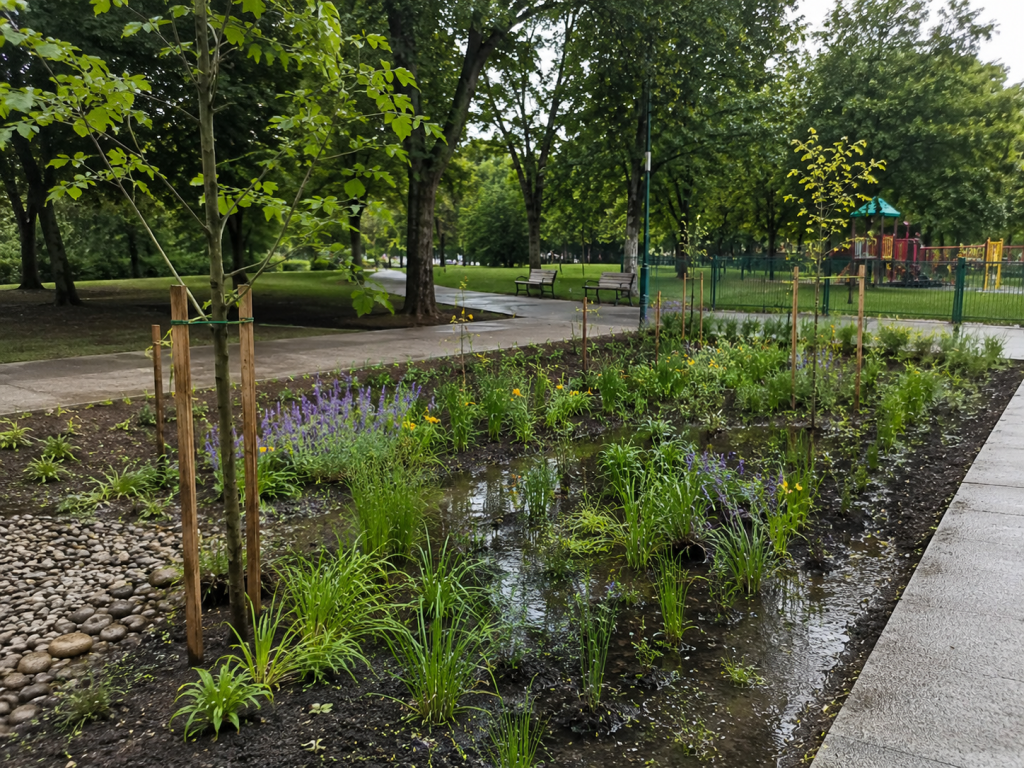
The concept has recently attracted attention in Bucharest as well, after a rain garden installed in Tineretului Park was put to the test during heavy rainfall. But Romania is far from alone. In some cities, similar systems have already become part of large-scale stormwater strategies involving thousands of individual installations.
And the international experience reveals something important: rain gardens are useful, but they are not miniature flood-control miracles. Their real power appears when many small interventions work together.
What exactly is a rain garden?
Despite the name, a rain garden is not simply a flower bed that happens to enjoy wet weather.
It is usually a shallow landscaped depression designed to receive runoff from hard surfaces such as roofs, streets, sidewalks, parking areas or driveways.
Instead of rushing directly toward a drain, rainwater is temporarily collected in the planted area. It then passes through soil and other filtering materials, is used by vegetation, evaporates or infiltrates into the ground.
The U.S. Environmental Protection Agency describes rain gardens as depressed areas that collect rainwater from surfaces such as roofs, driveways and streets and allow it to soak into the ground. They can also help filter pollutants from runoff and provide habitat for wildlife. (US EPA)
This puts them within a much broader family of techniques known as green infrastructure.
Green roofs, permeable pavement, urban trees, vegetated swales and infiltration basins all work on variations of the same principle: manage at least some rainwater where it falls instead of immediately transferring the entire burden to pipes and sewers. (US EPA)
Why concrete changes what happens during a storm
Rain behaves very differently in a forest than it does in a densely built neighborhood.
On relatively undisturbed land, water encounters vegetation, leaf litter and permeable soil. Some evaporates, some is taken up by plants and some gradually infiltrates underground.
A paved city interrupts much of that process.
Roads, roofs, sidewalks and parking lots are largely impermeable, so water begins moving across the surface almost immediately. That can send a large volume of runoff toward storm drains within a very short period.
This is why urban flooding cannot always be reduced to whether drains were properly cleaned. Blocked drains certainly matter, but so does the sheer amount of impermeable surface feeding water into the drainage system at once.
Rain gardens try to restore a small part of the hydrological behavior that existed before the land was heavily developed.
They do not eliminate runoff. They alter its journey.
New York has moved far beyond the experimental stage
Perhaps one of the clearest demonstrations of the concept can be found in New York City.
The city’s Department of Environmental Protection says it has constructed thousands of green infrastructure installations along streets and sidewalks, including rain gardens, infiltration basins and green medians. The city notes that streets, sidewalks and parking lanes account for roughly 30% of New York’s impervious surface, making public rights-of-way an obvious place to intercept stormwater. (nyc.gov)
In April 2026, New York City reported that it had installed more than 16,000 green infrastructure assets, including rain gardens, permeable pavement and green roofs. According to the city, some curbside rain gardens can hold as much as 2,500 gallons — approximately 9,460 liters — of rainwater before it filters into the ground. (nyc.gov)
One rain garden holding several thousand liters will obviously not protect New York from an extreme storm.
Thousands of them begin to tell a very different story.
The goal is to prevent some water from ever reaching the sewer at peak flow.
New York’s environmental authorities specifically describe green infrastructure as a way of collecting runoff from streets and other hard surfaces before it can contribute to local flooding or enter the sewer system. Reducing that flow also helps limit combined sewer overflows into surrounding waterways. (nyc.gov)
That is an important distinction: these installations are not being treated primarily as decoration. They are part of water infrastructure.
In one part of Queens, thousands of installations were designed to capture hundreds of millions of gallons
The scale becomes easier to understand through one New York project.
In 2022, the city reported that 1,811 rain gardens and infiltration basins had been installed across several Queens neighborhoods, including Fresh Meadows, Flushing and Kew Gardens Hills.
Together, those installations were estimated to capture more than 264 million gallons of stormwater each year — close to one billion liters — while helping reduce local flood risk and protecting Flushing Creek and Flushing Bay from polluted runoff. (nyc.gov)
This is precisely why evaluating rain gardens one at a time can be misleading.
A tiny planted depression beside a sidewalk may seem almost irrelevant next to the scale of a thunderstorm.
A network of hundreds or thousands of them creates distributed storage throughout an urban catchment.
Instead of asking one sewer pipe to receive everything immediately, the city effectively creates thousands of small places where water can be delayed.
Philadelphia made green stormwater infrastructure part of a citywide strategy
Philadelphia provides another important American example.
Its long-running Green City, Clean Waters program was developed specifically to reduce the amount of stormwater and pollution entering the sewer system while simultaneously improving urban neighborhoods. (water.phila.gov)
The city uses several types of installations rather than relying on one technology. Rain gardens are combined with tree trenches, vegetated basins, stormwater curb extensions and other systems that store, infiltrate or filter runoff.
A Philadelphia stormwater tree trench, for example, can look like an ordinary row of street trees above ground. Beneath the sidewalk is an engineered trench containing stone or gravel and permeable materials designed to receive runoff. (water.phila.gov)
Other installations extend planted areas into the street so water can be directed below the surface, stored temporarily, absorbed by plants and allowed to infiltrate. (water.phila.gov)
This illustrates how far the idea has progressed.
What began in many places as something resembling sustainable gardening has become part of professional civil and environmental engineering.
Melbourne treats stormwater as a resource rather than simply waste
Australia provides another useful perspective because its cities must manage both intense rainfall and long dry periods.
Melbourne Water describes rain gardens as specially designed garden beds that filter stormwater using soil, vegetation and microorganisms. They can receive runoff directly from surrounding surfaces or from stormwater pipes. (melbournewater.com.au)
The agency has also promoted rain gardens at household scale, describing them as relatively low-maintenance, partly self-watering systems that capture runoff from hard surfaces while helping protect rivers and creeks. (melbournewater.com.au)
Melbourne’s broader approach is known as water-sensitive urban design. Instead of seeing stormwater purely as waste that must be removed, planners consider how it can be captured, treated, reused or allowed to move through landscapes more naturally. (melbournewater.com.au)
That philosophy is especially relevant in places where drought and flash flooding can occur within the same climatic cycle.
Victoria’s government now explicitly describes stormwater as a potentially valuable water resource and notes that rain gardens and rainwater tanks can form part of the stormwater requirements for urban development. (Water and catchments)
Melbourne once set out to create 10,000 rain gardens
Melbourne has experimented with the idea on a particularly interesting scale.
A previous Melbourne Water strategy described a 10,000 Raingardens program, developed to encourage residents, councils and communities to install systems in homes, streets, parks and schools. At the time of that strategy, more than 5,000 rain gardens had already been registered. (melbournewater.com.au)
This highlights another advantage of decentralized stormwater management.
Not every intervention has to be enormous.
A school garden, a roadside planting strip, a redesigned parking lot and a residential rain garden may each capture only a fraction of the water generated across a city.
Together, however, they can change how much runoff enters drains and how quickly it gets there.
Copenhagen went even further: parks and streets can become part of the flood system
Copenhagen’s experience shows what happens when the same philosophy is applied at a much larger urban scale.
After severe cloudbursts exposed the city’s vulnerability to intense rainfall, Copenhagen began incorporating so-called blue-green infrastructure into its climate adaptation plans.
Instead of relying solely on larger underground pipes, parts of the city have been redesigned so streets, parks and landscaped areas can temporarily manage excess water.
At Scandiagade, for example, a system of eight basins was designed with a combined capacity of about 1,500 cubic meters of rainwater. During extreme rainfall, water can be directed away from buildings and roads toward these storage areas, helping delay the flow and reduce pressure on sewers. (State of Green)
Elsewhere, Copenhagen has modified streets with permeable surfaces and infiltration systems so rainfall can move below the roadway rather than simply running across it. (State of Green)
This is no longer simply a rain garden.
It is the same underlying principle expanded to neighborhood scale.
Can rain gardens actually prevent floods?
This is where the language needs to remain precise.
A rain garden can reduce runoff and contribute to lowering local flood risk.
It cannot guarantee that flooding will not occur.
The difference matters.
If an extreme storm drops more water than the soil, rain gardens, storage basins and sewer network can collectively handle, flooding may still happen.
Green infrastructure does not repeal hydrology.
Its purpose is to reduce the amount of water moving through the system at once, delay the peak flow and provide additional places for rainfall to go.
This is why serious city strategies generally combine green and traditional infrastructure rather than choosing between them.
Sewers, pumps, tunnels and storage tanks remain necessary.
Rain gardens, trees, permeable pavement and detention areas can make those systems work more effectively by reducing or delaying some of their incoming load.
Does the water really end up in groundwater?
Sometimes, but not necessarily all of it.
When water enters a rain garden, several things can happen.
Plants absorb some of it. Some returns to the atmosphere through evaporation and transpiration. Some remains within the upper soil layers. Depending on local geology and design, another fraction can infiltrate deeper and contribute to groundwater recharge.
This means claims that rain gardens simply “send water back into the water table” are somewhat oversimplified.
Groundwater recharge depends on soil permeability, groundwater depth, geology, existing contamination and the construction of the rain garden itself.
Some systems are intentionally designed with an underdrain because natural infiltration is inadequate.
Others allow considerably more water to move into the underlying soil.
The design must fit the location.
The plants are doing more than making the system attractive
Vegetation is an important engineering component of a rain garden.
Melbourne Water, for example, recommends perennial plants with extensive fibrous root systems that can survive relatively dry conditions as well as temporary periods of saturation. (melbournewater.com.au)
Those roots help stabilize the soil and maintain pathways through which water can move.
Plants also use some of the stored water and support biological processes within the soil.
This explains why a functioning rain garden may not look like a traditional ornamental flower bed.
Its plants are selected first for their ability to survive difficult hydrological conditions, although good landscape design can make these spaces attractive as well.
Why rain gardens sometimes look dry
The term “rain garden” can create another misconception: people expect to see water.
Most of the time, they should not.
A properly functioning rain garden is not intended to remain permanently flooded. It fills during or shortly after rainfall and then gradually drains.
During a prolonged dry period, it may look surprisingly ordinary — or even somewhat dry.
That is not necessarily a failure.
In fact, persistent standing water can signal a design or drainage problem, depending on the type of system.
The landscape must tolerate both ends of the cycle: temporary saturation and long periods without rain.
What about mosquitoes?
Rain gardens are sometimes criticized on the assumption that they will become mosquito breeding sites.
That concern makes sense only if water remains standing for prolonged periods.
A conventional rain garden is designed to drain rather than behave like a permanent pond. When infiltration and drainage are working correctly, the temporary accumulation of water should disappear rather than remain as a stagnant pool.
Design and maintenance therefore matter.
A clogged or poorly constructed system can perform badly, just as a blocked storm drain can.
“Green infrastructure” does not mean infrastructure that can be installed and forgotten.
Rainwater also carries pollution
Another reason cities are interested in rain gardens has little to do with flooding.
Water running across an urban surface can pick up sediment, nutrients, oil residues and other pollutants before entering waterways.
Rain gardens slow that water and pass it through layers of soil and vegetation.
The EPA notes that rain gardens can help filter pollutants from stormwater runoff, while bioretention systems are specifically designed to treat runoff from impermeable surfaces. (US EPA)
They are not universal purification systems, and contaminated sites require careful assessment.
But filtering runoff before it reaches streams and rivers can be an important secondary benefit.
Bucharest’s experiment belongs to a much larger international shift
Seen in isolation, a rain garden in a Bucharest park might look like a small environmental project.
Seen alongside New York, Philadelphia, Melbourne and Copenhagen, it becomes part of something much broader.
Cities are slowly reconsidering one of the fundamental assumptions of twentieth-century urban planning: that rainfall should be moved away from developed land as quickly as possible.
The alternative is not to abandon drainage systems.
It is to give water more than one possible destination.
Some can enter the sewer.
Some can be stored.
Some can infiltrate.
Some can support trees and vegetation.
And during exceptionally heavy storms, parks, streets and specially designed basins can temporarily hold water that would otherwise arrive at the same drainage pipes within minutes.
A rain garden will not save a city. Thousands of small interventions may change how that city floods
There is a temptation to describe nature-based solutions in dramatic terms.
One rain garden “stops floods.”
One green roof “solves climate change.”
One urban wetland “protects a city.”
Reality is less spectacular and more useful.
New York did not install thousands of green infrastructure assets because any single one was expected to prevent the next major flood. Philadelphia does not rely on one planted basin. Melbourne does not treat a backyard rain garden as an alternative to an urban drainage network. Copenhagen combines landscaped surfaces with major engineering projects.
The strength of the approach is cumulative.
A city containing thousands of places where water can slow down behaves differently from one in which virtually every roof, street and sidewalk sends rain immediately toward the nearest drain.
That may be the most important lesson for Bucharest as well.
The rain garden in Tineretului Park should not be judged by whether it can “stop a flood.” No small landscape feature can carry that responsibility.
The more meaningful question is whether cities can create enough places for water to go before it becomes a flood.
From New York’s thousands of curbside installations to Melbourne’s water-sensitive neighborhoods and Copenhagen’s floodable urban spaces, a growing number of cities have decided that the answer is worth pursuing.