
In March 1989, five-year-old Justin Lee Turner was supposed to begin an ordinary school day in Berkeley County, South Carolina.
Instead, he disappeared.
His family said he had been preparing to catch the school bus, but Justin never arrived at school. By that afternoon, he had been reported missing, and a search began across the area.
Two days later, the case took a devastating turn.
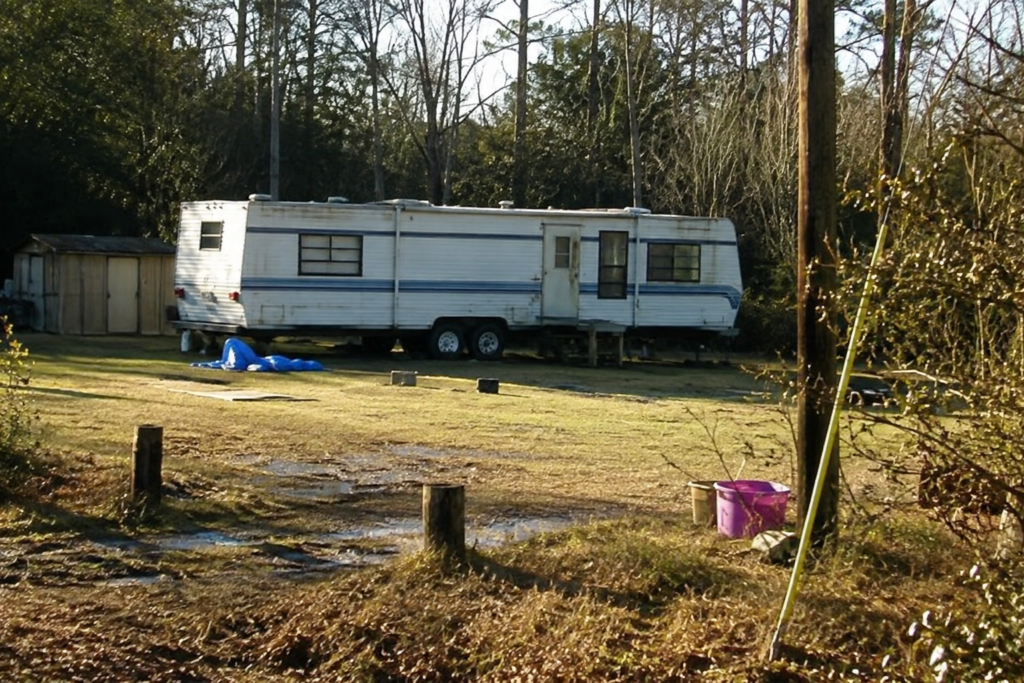
Justin’s body was discovered inside a cabinet in a camper located on the family’s property. Authorities determined that he had been strangled.
What followed was not a straightforward murder investigation with a clear ending. It became a case shaped by suspicion, lost evidence, changing theories, dead witnesses and, decades later, a legal decision that ensured no trial would ever determine the guilt of the two people eventually charged.
The discovery that immediately drew scrutiny
One of the most striking moments in the case was captured by television cameras.
Justin’s father, Victor Lee Turner, entered the camper during the search and, shortly afterward, announced that he had found his son’s body hidden inside a cabinet.
Investigators quickly began examining whether the circumstances surrounding Justin’s disappearance and discovery were consistent with the family’s account.
Attention eventually focused heavily on Victor Turner and Justin’s stepmother, then known as Pamela Turner and later as Megan Turner.
Authorities believed that parts of the story did not fit together, and investigators later argued that the crime scene may have been staged.
But suspicion is not the same as proof, and that distinction would become central to everything that happened afterward.
The first attempt to prosecute came in 1990
Megan Turner was charged with murder roughly a year after Justin’s death.
The case did not proceed to trial because a grand jury declined to indict her.
That decision did not erase investigators’ suspicions, but it meant prosecutors could not move forward at that time.
For years, Justin’s killing remained unresolved.
Like many cold cases, the investigation was periodically revisited in the hope that new forensic methods or a fresh review of old material could uncover something that had previously been missed.
Decades later, authorities reopened the file.
Old evidence returned to the center of the case
When investigators revisited Justin’s death, microscopic fibers became an important part of the renewed theory.
Authorities said fibers found on Justin’s clothing were consistent with material from an object they believed could have been used in the strangulation.
At different stages, investigators referred to a leash and later to a collar-and-leash combination.
That evolving theory would later become highly significant in court.
The defense argued that this was not truly new evidence discovered through modern technology, but rather a new interpretation of information that had existed for decades.
By then, the original collar was no longer available for examination.
That problem was one of many created by the passage of time.
Nearly 35 years later, two arrests changed everything
In January 2024, authorities arrested Victor Lee Turner and Megan Turner.
Both were charged in connection with Justin’s death.
For those who had followed the case for decades, the arrests appeared to signal that investigators had finally reached a breakthrough.
Authorities publicly stated that they believed the couple was responsible for Justin’s killing and for concealing his body in the camper.
But an arrest is not a conviction.
And before the case could ever reach a jury, the court had to answer a different question: could a fair trial still be held after more than three decades?
The passage of time had destroyed parts of the case
By 2024, many people connected to the original investigation were no longer available.
More than 20 potentially important witnesses had died or could no longer testify.
That mattered because some of the prosecution’s case depended on statements allegedly made to other people years earlier.
If those witnesses could not appear in court, the defense would have no meaningful opportunity to question them, challenge their memories or test the reliability of what they had reportedly heard.
Physical evidence had also been lost, discarded or had become impossible to examine in the same way it could have been in 1989.
The defense argued that these losses placed the accused at an irreversible disadvantage.
The judge agreed.
Why the murder charges were dismissed
In June 2024, Judge Roger Young dismissed the charges against Victor and Megan Turner.
His decision was not a declaration that another person had committed the crime.
It was also not a finding that investigators had fabricated the case.
Instead, the ruling centered on the constitutional right to a fair trial.
The judge concluded that the extraordinary delay, combined with unavailable witnesses, missing evidence and changes in the prosecution’s theory, had made it impossible for the defendants to properly defend themselves.
The charges were dismissed “with prejudice.”
That phrase carries major legal significance.
It means prosecutors are barred from bringing the same charges against Victor and Megan Turner again.
As a result, the 2024 prosecution ended before a jury ever heard the case.
Dismissal is not the same as a verdict
This is where the Justin Turner case is frequently oversimplified online.
It is inaccurate to say that a court proved Victor and Megan Turner killed Justin.
They were never convicted.
It is equally inaccurate to say the 2024 ruling established who really killed him.
It did not.
The court determined that the criminal case could no longer be tried fairly after so much time had passed.
That is a procedural and constitutional conclusion, not a factual determination of who committed the murder.
Another name entered the discussion
During the renewed proceedings, the defense also pointed to serial killer Richard Evonitz as a possible alternative suspect.
Evonitz was later linked to the abduction and murder of several girls in Virginia, and records placed him in the Charleston area while serving in the U.S. Navy around the time Justin was killed.
The defense argued that certain aspects of Justin’s case deserved comparison with Evonitz’s known crimes.
However, no court established that Evonitz killed Justin.
The idea remains an alternative theory, not a proven explanation.
Evonitz died by suicide in 2002 while authorities were attempting to capture him, making any later investigation into his potential involvement more difficult.
One family, two completely different views of what happened
After the charges were dismissed, Victor Turner maintained that law enforcement had focused on the wrong people from the beginning.
Other relatives of Justin publicly expressed a very different belief and remained convinced investigators had identified those responsible.
That divide reflects one of the most difficult features of unresolved homicide cases.
Legal proceedings may end without resolving the underlying factual question.
A prosecution can fail because evidence is insufficient, inadmissible or no longer testable, even when investigators remain convinced of their theory.
Likewise, an accusation can remain deeply damaging even when no conviction ever follows.
The question that has survived since 1989
Behind the courtroom arguments, forensic disputes and decades of suspicion is a much simpler and more painful reality.
Justin Lee Turner was five years old.
On March 3, 1989, he was expected to go to school.
He never arrived.
Two days later, his body was found hidden on the family’s property.
More than three decades later, two people were arrested for his murder, only for the case against them to collapse before trial because too much evidence and too many witnesses had been lost to time.
No one has been convicted of killing Justin Lee Turner.
And despite decades of investigation, arrests and renewed attention, the central question remains unanswered:
Who killed Justin?
Sources
Associated Press reporting on the dismissal of the 2024 murder charges and the history of the investigation.
South Carolina Public Radio coverage of Judge Roger Young’s ruling and the fair-trial issues raised by the decades-long delay.
Berkeley County law-enforcement statements and contemporary media coverage concerning the January 2024 arrests.