
Baby carrots have become one of those foods that periodically attract alarming claims online. Videos often show large carrots being cut down by machinery, followed by warnings that the small, smooth carrots sold in bags are made from “scraps” and soaked in chlorine before reaching supermarket shelves.
Like many viral food stories, the claim works because it starts with a few facts that are true.
Most of the perfectly shaped baby carrots sold in bags are not miniature carrots harvested young. They are usually made from larger, mature carrots that are cut, peeled, and shaped into smaller pieces.
But that does not mean they are made from spoiled waste, nor does it mean they are being “bleached” to make them safe to eat.
The real story is far less dramatic and, in some ways, much more interesting.
There Are Two Different Products Commonly Called Baby Carrots
The term “baby carrot” can refer to two very different things.
True baby carrots are simply carrots harvested before they reach full maturity. They tend to look like smaller versions of ordinary carrots, often with a tapered end, some natural irregularity, and occasionally the green tops still attached.
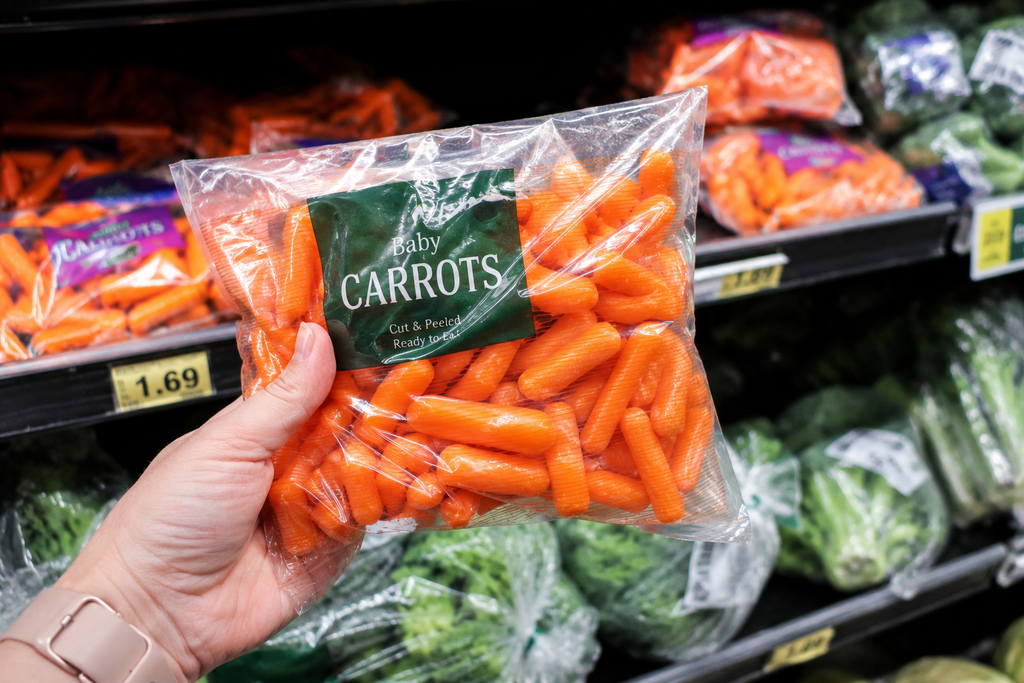
The smooth, rounded carrots commonly sold in plastic bags are different. These are usually known as baby-cut carrots.
They begin as fully grown carrots. The carrots are then trimmed into shorter sections and mechanically peeled and shaped until they reach the familiar uniform size.
USDA specifications for baby-cut carrots describe a fresh carrot product that has been peeled and cut into pieces around two inches long, or roughly five centimeters.
In other words, those perfectly rounded carrots do not usually grow in the ground looking that way.
Their final shape is created during processing.
Baby-Cut Carrots Started as a Clever Way to Reduce Waste
The modern baby-cut carrot is closely associated with California carrot farmer Mike Yurosek.
During the 1980s, growers faced a frustrating problem. Large quantities of perfectly edible carrots were being rejected because they did not look attractive enough for retail shelves.
Some were twisted. Others were too large, broken, misshapen, or simply did not match the appearance shoppers had come to expect.
These carrots were not necessarily unsafe or spoiled. They were often rejected for cosmetic reasons.
In 1986, Yurosek began experimenting with ways to turn those carrots into a product consumers would actually buy. He cut them into smaller sections and shaped them into neat, bite-sized pieces.
The idea worked remarkably well.
What began partly as an attempt to make better use of cosmetically imperfect produce eventually helped create an entirely new food category.
That origin is important because it explains why the viral description of baby carrots as “scraps” is misleading.
A crooked carrot is not the same thing as food waste.
How a Full-Size Carrot Becomes a Baby-Cut Carrot
The exact production process can vary, but the general principle is straightforward.
Carrots are washed and sorted before being cut into shorter sections. Their outer surface is then removed through mechanical peeling or abrasion, and the pieces are shaped so that the edges become smooth and rounded.
Depending on its length, one large carrot can produce several baby-cut pieces.
Nothing is being ground into a paste and reshaped into a carrot.
Each baby-cut carrot is still a solid piece of the original root.
That distinction matters because some viral posts create the impression that these products are manufactured from leftover fragments in the same way that certain highly processed foods are formed from minced ingredients.
That is not how baby-cut carrots are made.
Why the Chlorine Story Sounds So Convincing
The chlorine claim is where the story becomes more complicated, because it contains another piece of truth presented without context.
Water used to wash and process fresh produce needs to be carefully managed.
If large amounts of vegetables move through the same water, microorganisms from one item can potentially spread to another. For that reason, food-processing facilities may use antimicrobial treatments in wash water.
Some of those treatments can include chlorine-based compounds.
Food safety guidance from the U.S. Food and Drug Administration discusses the controlled use of antimicrobial substances in water used during fresh-produce processing. Factors such as concentration, pH, contact time, and water quality need to be monitored.
That is very different from the popular claim that carrots are “soaked in bleach.”
Food-Processing Chlorine Is Not the Same as Pouring Household Bleach on Vegetables
The word “chlorine” immediately makes many people think of a strong household cleaning product.
That association makes for an effective social-media scare, but it is not an accurate description of how antimicrobial treatments are used in regulated food processing.
When chlorine-based agents are used, they are used under controlled conditions and for a specific food-safety purpose: helping manage microorganisms in processing water and reducing the risk of cross-contamination.
The goal is not to whiten carrots, disguise spoiled produce, or chemically transform them.
The FDA also makes an important distinction between commercial food-processing practices and what consumers should do at home.
People should not wash fruits and vegetables with household soap, detergent, or bleach solutions. Produce that needs washing at home should generally be rinsed under clean running water.
Industrial processing and washing vegetables in your kitchen are two completely different situations.
The White Coating on Baby Carrots Is Not Chlorine Residue
One of the strongest arguments used in viral posts is something many people have noticed themselves.
Leave baby carrots in the refrigerator for a while and they may begin developing a pale, dry-looking film on the surface.
It is easy to look at that coating after hearing the chlorine story and assume the two must be connected.
They are not.
The phenomenon is commonly known as white blush.
Postharvest researchers at the University of California, Davis have described white blush as a change associated largely with dehydration of the carrot’s cut or mechanically abraded surface.
When the outer protective layer is removed, the underlying tissue is more exposed to air. As moisture is lost, the microscopic structure of the surface changes and begins reflecting light differently.
That makes the carrot appear chalky or whitish.
What looks like a chemical coating is usually a physical change in the carrot tissue itself.
Why Processed Carrots Lose Moisture More Easily
A whole carrot still has its natural external surface protecting the tissue underneath.
Baby-cut carrots have been peeled and mechanically shaped. That leaves considerably more exposed tissue.
As a result, they can lose moisture more readily than whole, unpeeled carrots. They are also more dependent on proper refrigeration and packaging to maintain their texture and appearance.
This helps explain both their shorter shelf life once opened and the white blush that can develop over time.
It is not evidence that something dangerous is appearing on the surface.
Are Baby Carrots Less Nutritious Than Regular Carrots?
Baby-cut carrots are still carrots.
They provide fiber and carotenoids, including beta-carotene, the orange pigment the body can convert into vitamin A.
Processing does change the product to some extent. Peeling removes the outermost tissue, while cutting increases the amount of surface exposed to oxygen and moisture loss.
Fresh-cut vegetables are therefore generally more perishable than the same vegetables left whole.
But none of this turns baby carrots into an unhealthy or artificial food.
Their main difference is convenience.
They are already washed, peeled, portioned, and ready to eat, which makes them particularly easy to include in lunches, snacks, or meals.
Are Modern Baby Carrots Still Made Only From “Ugly” Carrots?
Not necessarily.
The product may have started partly as a way to make use of cosmetically imperfect carrots, but baby-cut carrots became so popular that they eventually developed into a major commercial category of their own.
Modern producers grow and select carrots with processing in mind, and commercial baby-cut carrots are subject to standards involving size, quality, storage, and food safety.
So while the history of the product is strongly connected to reducing waste, it would be inaccurate to imagine today’s industry as simply collecting random discarded carrots and turning them into packaged baby carrots.
The market has evolved considerably since the 1980s.
Why Viral Food Claims Often Feel More Shocking Than the Reality
Baby carrots are a particularly good example of how food misinformation can develop.
The process usually begins with something true.
Baby-cut carrots are made from larger carrots.
True.
The product originally helped growers use carrots that might otherwise have been rejected for cosmetic reasons.
Also true.
Chlorine-based antimicrobial treatments may be used in some fresh-produce processing systems.
Again, true.
But then the context disappears.
Cosmetically imperfect vegetables become “industrial waste.”
Controlled antimicrobial treatment becomes “soaking food in bleach.”
And a normal dehydration effect on the carrot surface becomes supposed evidence that chemicals are leaking out of the product.
The individual facts may sound familiar, but the conclusion created from them is no longer accurate.
So, Should You Be Worried About Baby Carrots?
For most people, there is no scientific reason to fear baby-cut carrots simply because they have been mechanically processed.
The small, smooth carrots in a supermarket bag are usually pieces of mature carrots that have been cut, peeled, and shaped into a convenient snack.
Their history is actually rooted partly in an effort to make better use of edible produce that did not meet cosmetic retail standards.
Commercial fresh-produce processing may involve carefully controlled antimicrobial treatments, including chlorine-based compounds in some systems, but describing that as carrots being “bleached” is misleading.
And the white film that sometimes develops on baby carrots is not proof of chlorine residue. It is generally associated with moisture loss from their exposed surface.
The truth is considerably simpler than the viral version: baby carrots are not fake carrots, they are not reconstructed from spoiled waste, and they do not need a frightening chemical explanation. In most cases, they are simply full-size carrots transformed into smaller, more convenient pieces.