
On the night of December 27, 1986, Cara Knott was driving home through San Diego County.
She was 20 years old, a student at San Diego State University, and traveling alone on Interstate 15.
At some point during that drive, flashing police lights appeared behind her.
Cara did what drivers are expected to do.
She stopped.
The man who approached her car was not pretending to be a police officer. Craig Peyer was a veteran California Highway Patrol officer with 13 years of service, and he was on duty that night.
By the following morning, Cara was dead.
Her body had been found beneath an old bridge near the Mercy Road exit.
Years later, the case would still be remembered for one deeply disturbing reason: the person who used the authority of a police uniform to stop Cara was ultimately convicted of murdering her.
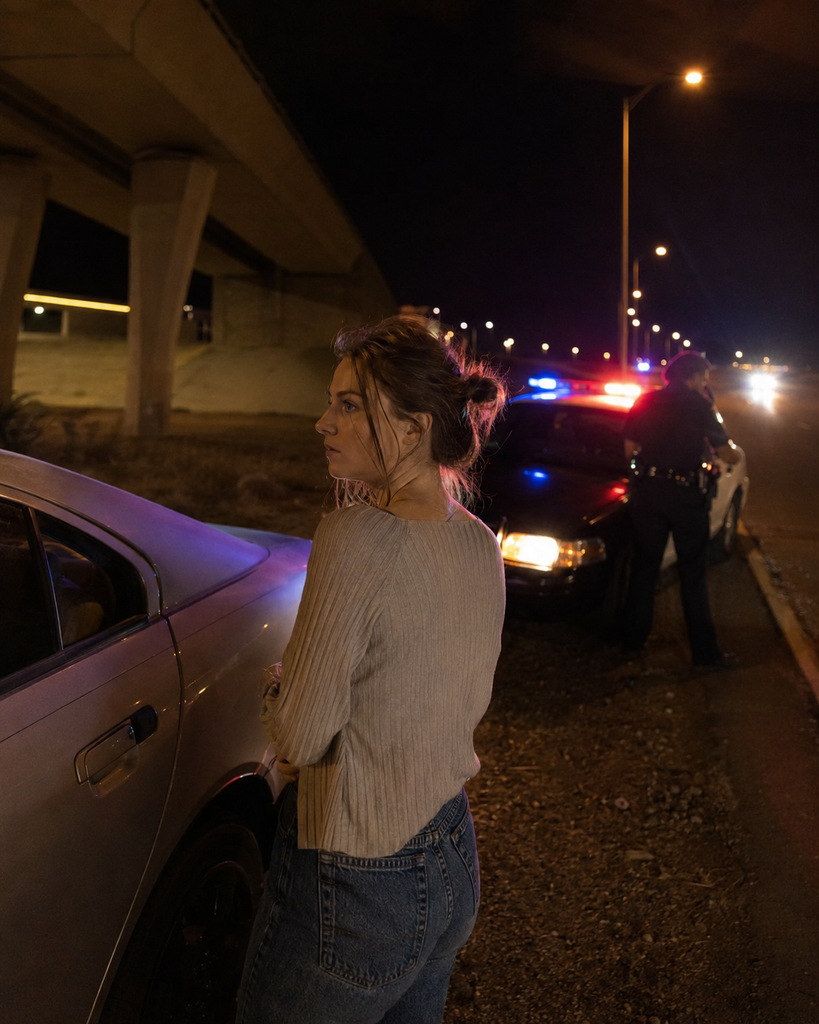
A routine drive that ended at an isolated highway exit
Cara had spent the evening visiting her boyfriend in Escondido and was heading back to her family home in El Cajon.
She was driving a white Volkswagen when Peyer stopped her on Interstate 15.
Prosecutors later argued that he directed her toward the Mercy Road exit, an isolated area away from the normal flow of highway traffic.
The exact conversation between them will never be known.
There were no eyewitnesses to Cara’s final confrontation with Peyer.
What investigators did know was that her Volkswagen was later found near the area with the keys still inside and the driver’s window partly open.
Her body was discovered below the old U.S. 395 bridge in a dry creek bed.
An autopsy determined that Cara had been strangled.
She had also suffered a significant injury above her right eye.
Prosecutors would later argue that the injury may have been caused by Peyer’s flashlight, although that remained part of their reconstruction of the crime rather than something witnessed directly.
The officer appeared on television the next day
One of the strangest details in the case happened almost immediately after Cara’s body was found.
A local television reporter was preparing a story about women driving alone at night and asked the California Highway Patrol to provide an officer who could discuss safety.
The officer selected for the interview was Craig Peyer.
At that point, he had not yet been publicly identified as a suspect.
The man who would later be convicted of Cara Knott’s murder therefore appeared on television discussing safety with women drivers.
There was another detail visible during the interview.
Peyer had scratches on his face.
Other witnesses also recalled seeing marks on him around the time of the murder.
A gas station employee testified that Peyer arrived at the station later that night looking unusually disheveled and with scratches on his face, including one that appeared to be bleeding.
A CHP sergeant also noticed the injuries when Peyer returned to the station.
Peyer said he had been scratched by a fence.
Prosecutors believed Cara had scratched him while fighting for her life.
Because no one witnessed the attack, the origin of the marks could not be proven through direct observation, but they became one element in the larger body of circumstantial evidence presented at trial.
Other women began telling investigators similar stories
As the investigation expanded, authorities discovered that Cara was not the first young woman Peyer had stopped near Mercy Road.
More than 20 women eventually testified about encounters with him.
Their accounts were not identical, but they contained striking similarities.
Peyer had stopped women traveling alone at night on Interstate 15 and had sometimes directed them toward the isolated Mercy Road area.
Some said the traffic stops lasted far longer than seemed necessary.
Several described conversations that became unusually personal.
According to reporting from the time, two women even testified that after passing the Mercy Road exit, Peyer instructed them to back their vehicles along the shoulder so they could reach it.
Internal California Highway Patrol records later referred to multiple incidents between May and December 1986 in which Peyer allegedly detained women for excessive periods or behaved in an overly familiar manner.
Some stops reportedly lasted as long as 90 minutes.
One particularly troubling incident happened only 16 days before Cara was killed, when Peyer took another woman on a nighttime drive through the same isolated area.
Individually, some of those encounters might have appeared merely strange.
After Cara’s death, they looked very different.
Together, they suggested a pattern.
The case depended on a combination of evidence
There was no confession.
There was no eyewitness who saw Peyer kill Cara.
And there was no surveillance video capturing what happened.
The prosecution instead built its case from physical evidence, witness testimony and the circumstances surrounding Peyer’s conduct.
One significant piece of evidence was blood found on Cara’s boot.
Testing available at the time showed characteristics consistent with Peyer’s blood.
Experts testified that the combination of markers was relatively uncommon in the local population.
This was not modern DNA profiling, and it could not identify Peyer with the degree of certainty associated with today’s genetic testing.
But it was one piece of a much larger case.
Investigators also found microscopic fibers on Cara’s clothing that were consistent with fibers from Peyer’s CHP uniform.
Among them was an unusual gold-colored fiber similar to material used in the shoulder insignia on his jacket.
Police also discovered a roughly four-foot length of rope in the trunk of Peyer’s patrol vehicle.
A medical examiner testified that its dimensions were consistent with the ligature marks found on Cara’s neck.
The rope was not standard CHP equipment.
Tire impressions found near the crime scene were also consistent with the dimensions of Peyer’s patrol car, although they were not detailed enough to identify a specific tire.
None of these pieces of evidence existed in isolation.
Their importance came from the way they reinforced one another.
A gas station employee described seeing Peyer after the suspected attack
One witness provided particularly important testimony about Peyer’s appearance that night.
Karen Anderson, who worked at a gas station, said Peyer arrived at approximately 9:45 p.m.
She described him as looking as though he had been involved in some kind of struggle.
His uniform appeared less orderly than usual, and there were visible scratches on his face.
Anderson also testified that she saw him open the trunk of his patrol car and rearrange items inside.
She recalled seeing him handle or wipe down a long flashlight.
Again, this testimony did not prove the murder by itself.
But when combined with the facial scratches, the physical evidence, the prior traffic stops and the timeline of the night, it strengthened the prosecution’s reconstruction of what had happened.
The first jury could not agree
The first trial ended without a verdict.
In February 1988, jurors were divided.
Seven reportedly favored conviction while five did not believe the prosecution had proved the case beyond a reasonable doubt.
A mistrial was declared.
Prosecutors chose to try Peyer again.
During the second trial, the state reorganized its presentation and emphasized the timeline, the forensic evidence and testimony from women who described previous encounters with the officer.
This time, the jury reached a unanimous decision.
On June 22, 1988, Craig Peyer was convicted of first-degree murder.
A sentence of 25 years to life
In August 1988, Peyer received a sentence of 25 years to life in prison.
At sentencing, Judge Richard Huffman also criticized the way earlier complaints about Peyer’s conduct had been handled.
That criticism became another lasting part of the case.
By the time Cara was murdered, warning signs about Peyer’s interactions with women had already existed.
The tragedy therefore raised a question that extended beyond one criminal defendant: what responsibility does an institution have when repeated complaints begin to reveal a pattern involving someone with substantial authority over the public?
Peyer later appealed his conviction, but the appeal was rejected.
He remains incarcerated decades later
Craig Peyer eventually became eligible for parole consideration, but he was not released.
In 2012, the California Board of Parole Hearings again denied parole and imposed a lengthy period before his next hearing.
As of August 2026, Peyer remains incarcerated.
California’s official parole hearing calendar lists Craig Allen Peyer, inmate D93018, for another parole suitability hearing on January 14, 2027, at California Men’s Colony.
Nearly four decades after Cara Knott’s murder, the man convicted of killing her is still in prison.
Cara did not make the mistake of trusting a stranger
This is one of the reasons the case remains so unsettling.
True-crime stories are sometimes discussed through hindsight.
Why did the victim go there?
Why did she trust that person?
Why did she stop?
Those questions make little sense in Cara Knott’s case.
She did not stop for a stranger impersonating a police officer.
She stopped for a real California Highway Patrol officer.
He wore a uniform.
He drove an official patrol car.
He had the legal authority to signal motorists to pull over.
Modern society depends on drivers responding to that authority.
Cara behaved exactly as she had been expected to behave.
The danger came from the person who was supposed to represent safety.
The warning signs came before the murder
Perhaps the most important part of Cara’s story is not a blood test, a fiber or even the scratches seen on Peyer’s face.
It is what investigators learned about the months before her death.
Women had already described unusually long traffic stops.
Peyer had repeatedly brought female motorists to an isolated exit.
Some conversations became personal.
Some encounters lasted far longer than a normal traffic stop should have.
Concerns had already been raised.
After Cara was killed, those separate incidents could finally be seen together.
By then, the cost of recognizing the pattern was irreversible.
Why the case is still remembered
Cara Knott was only 20 years old.
She was driving home on an ordinary December night when she encountered a police officer and followed his instructions.
Her case remains disturbing not because she ignored an obvious warning, but because she had every reason to believe she was dealing with legitimate authority.
The same uniform that normally tells a motorist that the law is present and help is nearby became, in Cara’s case, the mechanism that placed her in danger.
That is what makes her story larger than a decades-old murder case.
It is also a story about institutional responsibility, the importance of recognizing patterns in complaints and the enormous trust society places in people who are given authority over others.
Cara Knott did what most people would have done when a police officer signaled her to stop.
She pulled over.
And that simple fact may be the most haunting part of the entire case.
Sources
This article was researched using contemporary and retrospective reporting from the Los Angeles Times on the investigation, forensic evidence, witness testimony, both trials and sentencing; California court records related to the case; San Diego County reporting on Peyer’s parole proceedings; and the California Board of Parole Hearings’ official 2027 hearing calendar.