
For years, Lynette and Brian Hooker appeared to be living the kind of life many people dream about. They sailed through tropical waters, explored islands, and documented parts of their journey online. Their sailboat, Soulmate, was not just a means of transportation but a central part of the adventurous lifestyle they had built together.
Then, on the evening of April 4, 2026, Lynette disappeared in the Bahamas.
Her husband told investigators that she had fallen from their small dinghy during a nighttime trip and had been swept away before he could reach her. At first, the story appeared to describe a devastating accident at sea.
But the investigation did not end there.
Over the following weeks, authorities seized the couple’s sailboat, examined electronic devices, returned to the waters near Abaco with specialized search teams, and reportedly uncovered GPS information that did not fully match the account Brian Hooker had given investigators.
By June, a U.S. official confirmed to CBS News that authorities were examining the disappearance under a federal statute involving the possible murder of an American citizen abroad.
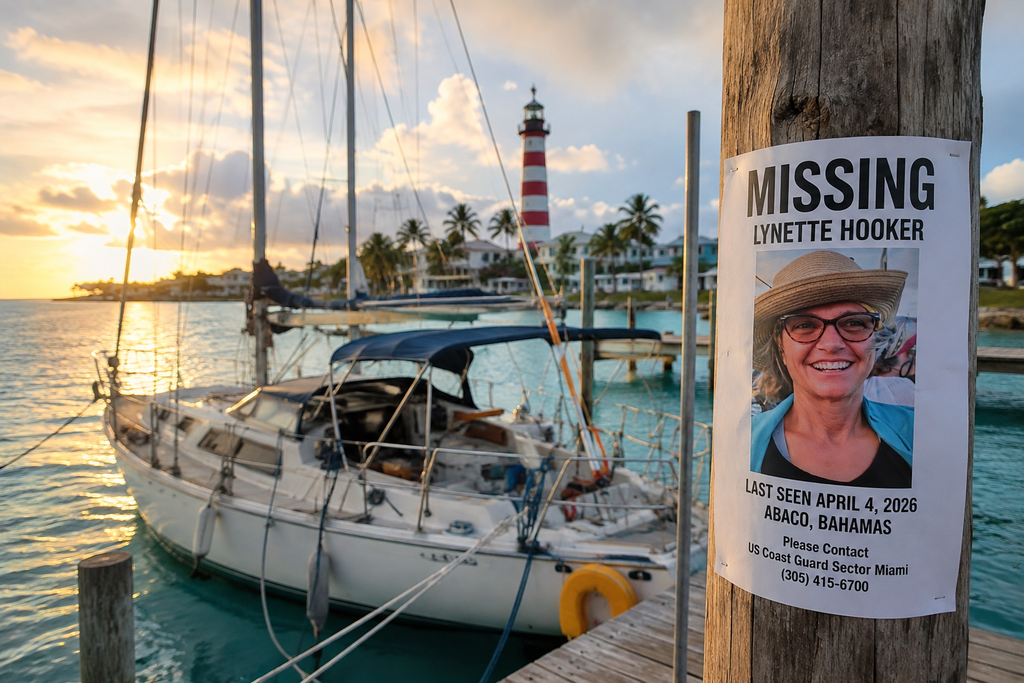
That does not mean investigators have concluded that Lynette was murdered, and Brian Hooker has not been charged with causing her disappearance. But the case has clearly moved far beyond a routine missing-person investigation.
The Last Known Evening of Lynette Hooker
Lynette Hooker was 55 years old when she disappeared near the Abaco Islands.
On April 4, she and Brian had spent time in the Hope Town and Elbow Cay area. According to reporting by CBS News, they had visited Tahiti Beach and the Abaco Inn before leaving Hope Town later that evening.
At approximately 7:30 p.m., they reportedly set out in their small rigid dinghy toward Soulmate, which was anchored nearby.
Weather conditions were far from calm. Reports indicated sustained winds of around 15 to 25 knots, with stronger gusts possible in the area.
Brian later told authorities that rough conditions caused Lynette to fall overboard.
According to his account, she had the key or safety device connected to the dinghy’s engine. Once she went into the water, he said he was unable to restart the motor.
He claimed Lynette quickly disappeared from sight.
Brian said he then spent several hours rowing before eventually reaching the Marsh Harbour Boat Yards area at approximately 4 a.m.
By then, Lynette was gone.
What Began as a Search Quickly Became More Complicated
Authorities launched an extensive effort to locate Lynette.
Search operations reportedly included marine patrols, aerial surveillance, drones and underwater equipment. Yet no confirmed trace of her was found.
At the same time, investigators began examining the circumstances surrounding her disappearance rather than treating the incident exclusively as an accident.
On April 8, Brian Hooker was taken into custody by police in the Bahamas and questioned about the case.
He remained in custody for several days before being released without charges.
His attorney said Brian denied wrongdoing and maintained that he had cooperated with investigators.
That legal distinction remains important. Being questioned, detained or investigated does not establish criminal responsibility.
As of early September 2026, Brian Hooker had not been charged in connection with Lynette’s disappearance.
Investigators Started Looking Beyond Brian’s Account
In May, the U.S. Coast Guard issued a public request for information from people who might have been in the area around the time Lynette disappeared.
Investigators were particularly interested in identifying another sailboat that had reportedly been anchored near Soulmate in Aunt Pat’s Bay.
The request suggested that authorities were attempting to reconstruct the evening independently, looking for witnesses who might have seen or heard something relevant.
A few days later, the investigation took an even more significant turn.
The Sailboat Soulmate Was Seized
On May 14, the Coast Guard Investigative Service seized Soulmate roughly 40 nautical miles off the Florida coast.
The agency publicly described the action as part of an ongoing criminal investigation into Lynette Hooker’s disappearance.
That changed the role of the sailboat entirely.
What had once been the backdrop of the couple’s travels was now being treated as a potential source of physical and digital evidence.
Investigators could examine navigation systems, electronic equipment and any material evidence that might help reconstruct the movements of the people aboard.
One piece of evidence soon became especially significant.
GPS Data Reportedly Did Not Match the Timeline Investigators Had Been Given
Later in May, CBS News reported that investigators had recovered GPS information from one of Brian Hooker’s electronic devices.
According to a U.S. official familiar with the investigation, the movements recorded by the device did not fully correspond with what Brian had told authorities about his actions during the night Lynette disappeared.
This development mattered because digital location records can provide something memories and witness accounts often cannot: an independent timeline.
Investigators reportedly identified additional locations in the Sea of Abaco that warranted examination.
U.S. authorities then requested permission from the Bahamian government to send specialized personnel back into the area.
Permission was granted.
The investigation was no longer focused solely on the route described by Brian. Authorities now had locations derived from digital evidence that they believed needed closer examination.
Authorities Began Examining the Possibility of a Homicide
In early June, another important detail became public.
A U.S. official told CBS News that the disappearance was being investigated under the federal framework applicable to the possible murder of a U.S. national abroad.
The wording is significant, but it must be interpreted carefully.
It did not mean authorities had officially classified Lynette’s death as a homicide. It did not mean they had identified a killer. And it did not mean Brian Hooker had been accused of murder.
Instead, it showed that investigators considered the possibility of foul play serious enough to pursue within a criminal framework.
According to the same reporting, this was not a sudden shift caused by one new discovery. Authorities had apparently been considering the case from that perspective for some time.
Divers, Underwater Vehicles and a Human-Remains Detection Dog Were Sent to the Bahamas
The next search operation was far more specialized than the original response.
The U.S. Coast Guard deployed the cutter Margaret Norvell, along with divers, remotely operated underwater vehicles, drones and a dog trained to detect the scent associated with human remains.
The Royal Bahamas Police Force and Royal Bahamas Defence Force also participated.
The areas examined were reportedly connected to information developed during the investigation, including the newly analyzed digital evidence.
During the operation, authorities also took possession of the dinghy from which Brian said Lynette had fallen.
That boat was transported to the United States for forensic examination.
By this point, investigators had access to both vessels at the center of the case: Soulmate and the smaller dinghy.
The Search Ended, but the Investigation Did Not
On June 8, the U.S. Coast Guard announced that its search mission in the Bahamas had concluded.
Lynette had not been found.
However, the end of the underwater operation did not mean the case was closed.
The Coast Guard Investigative Service continued its criminal investigation, while evidence recovered from the vessels and electronic devices remained under examination.
Then, in July, another report introduced a possibility that could dramatically alter the understanding of the night Lynette disappeared.
Did Lynette Make It Back to Soulmate?
On July 10, CBS News reported that investigators were examining the possibility that Lynette may have returned to the sailboat after the point at which Brian said she had gone overboard.
The information came from a source close to the family rather than from a formal statement issued by authorities, so it should not be treated as an established fact.
Even so, the implication is significant.
If evidence ultimately shows that Lynette reached Soulmate after the alleged fall from the dinghy, the original account of her being immediately lost at sea would no longer explain the entire sequence of events.
CBS News also reported that investigators were exploring whether an altercation may have occurred aboard the sailboat.
Again, this remains part of the investigative picture, not a proven reconstruction of what happened.
Authorities have not publicly disclosed the evidence behind that theory or announced that it has been confirmed.
The Couple’s Earlier History Also Came Under Scrutiny
After Lynette vanished, attention naturally turned toward the couple’s relationship.
Online, their travels had often reflected an adventurous life at sea. But public records and family statements suggested that their relationship had also experienced serious difficulties.
Associated Press reported that police had responded to a domestic incident involving the couple in Michigan in 2015, during which allegations were made by both sides.
Members of Lynette’s family later said they had long-standing concerns about the relationship and questioned Brian’s explanation of the disappearance.
Those statements help explain why relatives remain deeply skeptical, but they cannot establish what happened in April 2026.
A troubled relationship is not proof of a crime, and past conflict cannot substitute for forensic evidence.
Where Brian Hooker Was Seen Months Later
Near the end of August, Fox News reported that Brian Hooker had been seen in Citrus Heights, California, near Sacramento.
Photographs showed him carrying out ordinary daily activities in the area.
Such images may attract attention in a highly publicized case, but a person’s appearance or everyday behavior cannot tell us whether that person is guilty or innocent.
What matters more is his legal status.
As of the beginning of September 2026, Brian remained free and had not been criminally charged in connection with Lynette’s disappearance.
The investigation, however, remained active.
What Is Confirmed — and What Is Still Unknown
Nearly five months after Lynette Hooker disappeared, the case contains several verified facts alongside a much larger number of unanswered questions.
Lynette disappeared in the Bahamas on the night of April 4, 2026.
Her husband says she fell from their dinghy and vanished in difficult sea conditions.
Brian was questioned by Bahamian authorities and later released without charges.
U.S. investigators seized Soulmate as part of a criminal investigation, while the dinghy was also taken to the United States for forensic examination.
A U.S. official said GPS records from an electronic device did not align with aspects of Brian’s reported movements that night.
Specialized teams later searched parts of the Sea of Abaco using divers, drones, underwater equipment and a human-remains detection dog.
Authorities also examined the case within a framework that includes the possibility of homicide.
At the same time, no publicly confirmed body has been recovered, no official cause of death exists, and no one has been charged with killing Lynette.
That distinction remains central to any responsible account of the case.
Why Viral Headlines Distort What We Actually Know
Some social-media posts have described the case with phrases suggesting that Lynette’s husband deliberately “turned his wife into a mermaid.”
It is a memorable line, but it presents suspicion as certainty.
The available evidence does not support that conclusion.
Investigators have serious questions. Digital evidence appears to have complicated the original account. Both boats have been examined. The possibility of foul play has been considered. But an investigation is not the same as a conviction, and suspicion is not proof.
The real story is compelling without exaggeration.
A woman vanished during a nighttime journey in the Bahamas. Her husband described an accident at sea. Investigators later found information that reportedly challenged parts of that account. Authorities returned to the water with specialized equipment, seized key vessels and explored whether the disappearance could involve a crime.
Months later, the central mystery remains unresolved.
What happened to Lynette Hooker after she left Hope Town on April 4?
Until investigators can answer that question with evidence, the most responsible conclusion is also the least sensational one: there is still a considerable distance between what is suspected and what can actually be proven.