
Every so often, a familiar claim starts circulating online: a common vitamin may have a surprising effect on Parkinson’s disease.
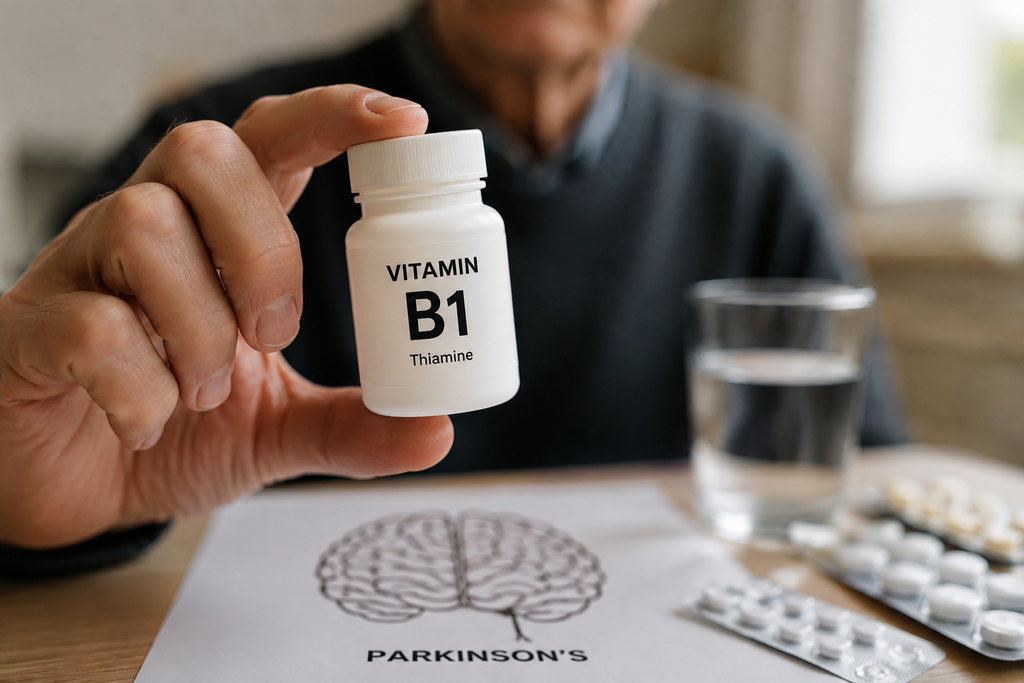
This time, the vitamin is thiamine, also known as vitamin B1.
Some posts describe people with Parkinson’s who reportedly moved better, felt less fatigued, or saw major improvements after receiving high doses of thiamine. The story is often presented as if medicine has overlooked a simple treatment hiding in plain sight.
That is not quite what the evidence shows.
But there is a reason the idea refuses to disappear.
High-dose thiamine has actually been studied in people with Parkinson’s disease, and some of the reported improvements were striking. The problem is that the most encouraging studies were small, open-label, and did not include placebo control groups.
So the real story is more interesting than either extreme.
Vitamin B1 has not been proven to treat Parkinson’s disease. But the theory behind it is not simply an internet myth either.
Why thiamine matters to the nervous system
Thiamine is an essential water-soluble vitamin involved in energy metabolism. Cells rely on thiamine-dependent enzymes to process nutrients and generate energy, and the nervous system is particularly sensitive to severe deficiency.
A serious lack of vitamin B1 can cause significant neurological problems.
That much is well established.
The controversial question is different: could giving very large amounts of thiamine benefit someone whose ordinary blood thiamine level is already normal?
That question eventually led researchers to explore thiamine in Parkinson’s disease.
Where the Parkinson’s connection began
One of the main researchers behind this idea was Italian physician Antonio Costantini, who published a series of observations with colleagues beginning more than a decade ago.
In a 2013 case report, three people with newly diagnosed Parkinson’s disease received high-dose parenteral thiamine.
Their blood thiamine levels were reportedly normal.
After treatment, the researchers described substantial improvements in motor scores, ranging from roughly 31% to 77% on the motor portion of the Unified Parkinson’s Disease Rating Scale, or UPDRS.
Those numbers understandably attracted attention.
But three patients cannot establish that a treatment works.
Case reports are valuable because they can reveal unexpected patterns. They are often where new hypotheses begin. They are not designed to prove cause and effect.
The unusual theory behind high-dose B1
Costantini and colleagues proposed that Parkinson’s disease might involve a problem with thiamine-dependent processes inside cells, even when routine blood measurements do not show vitamin B1 deficiency.
In other words, a patient could theoretically have enough thiamine circulating in the blood while certain cells were still unable to use it efficiently.
The researchers suggested that very high concentrations of thiamine might overcome some form of impaired transport or intracellular metabolism.
It is an intriguing explanation.
It is also still a hypothesis.
The early studies did not prove that people with Parkinson’s have a specific “functional B1 deficiency,” nor did they identify a definitive cellular mechanism explaining the reported response.
The 50-patient study that fueled the excitement
In 2015, Costantini’s group published a larger pilot study involving 50 people with Parkinson’s disease.
The participants were around 70 years old on average and had been living with Parkinson’s for an average of just over seven years.
They received 100 mg of thiamine by intramuscular injection twice a week while continuing their existing Parkinson’s medication.
After three months, the researchers reported a substantial change in clinical scores.
The average total UPDRS score fell from about 38.6 to 18.2. The motor component, UPDRS Part III, dropped from approximately 22 to 9.9.
Those are large changes.
If a treatment reliably produced improvements of that magnitude in a rigorous controlled trial, it would be extremely important.
But that crucial qualification matters.
Why the study design changes everything
The 2015 study was open-label and observational.
The patients knew they were receiving thiamine. The researchers knew they were administering it. There was no placebo group for comparison.
That makes the results much harder to interpret.
Parkinson’s symptoms can fluctuate. Expectations can influence how people perceive symptoms. Evaluators can also be unintentionally influenced when they know that a patient is receiving an experimental treatment.
This is precisely why randomized, double-blind, placebo-controlled trials are so important.
They help answer the question that an open-label study cannot answer confidently:
Would the same improvement have occurred if the patients had not actually received the treatment?
Parkinson’s UK highlighted this limitation in its 2026 discussion of diet and supplements for Parkinson’s, noting that research on vitamin B1 remains very limited and that there is currently not enough evidence to recommend it as a supplement specifically for Parkinson’s.
The Michael J. Fox Foundation has made a similar point: small studies reported improvements, but without placebo groups it is impossible to know how much of the effect was truly caused by thiamine.
A second small study made interpretation even more complicated
A further report published in 2016 followed ten people with Parkinson’s disease who were initially treated with intramuscular thiamine.
Again, improvements were reported.
But there was an important complication.
After the first month, nine of the ten patients either had increases in both thiamine and levodopa or began levodopa together with thiamine. The average levodopa dose rose substantially.
That makes it impossible to attribute later improvements to vitamin B1 alone.
This detail is rarely mentioned in viral posts about high-dose thiamine, yet it is central to understanding the evidence.
Normal blood levels do not prove a hidden cellular deficiency
One of the most compelling parts of the original hypothesis was that patients improved despite having normal blood thiamine levels.
That led researchers to propose that the problem might not be ordinary dietary deficiency but rather impaired cellular handling of the vitamin.
The idea is biologically interesting.
But it remains unproven.
Improvement after high-dose treatment does not automatically establish that a hidden intracellular deficiency existed in the first place.
To demonstrate that, researchers would need more direct mechanistic evidence and independent confirmation.
“High dose” does not mean a standard vitamin tablet
There is another detail that easily gets lost online.
The best-known Parkinson’s studies did not simply give patients an ordinary over-the-counter multivitamin.
In the 2015 study, participants received 100 mg of thiamine by intramuscular injection twice weekly.
That is very different from normal dietary intake and different from simply taking a routine oral supplement.
Dose matters.
Route of administration matters.
Absorption matters.
And an effect reported with injected thiamine cannot automatically be assumed to occur with tablets bought from a pharmacy.
Is thiamine safe?
Vitamin B1 is generally considered well tolerated, especially at ordinary nutritional doses.
That is one reason researchers find it appealing.
But “generally safe” is not the same as “proven treatment,” and it does not mean that very high doses or injections should be used without medical supervision.
People with Parkinson’s often take several medications, and any new supplement or experimental therapy should be discussed with the treating clinician.
The bigger concern is not simply toxicity.
It is also the risk that someone may see vitamin B1 described as a natural breakthrough and decide to reduce or stop a treatment that has actually been shown to help.
Can B1 replace levodopa?
There is no evidence that it can.
In the 50-patient study, thiamine was added to patients’ existing Parkinson’s therapies rather than used as a replacement.
In the later ten-patient report, levodopa was actually increased or introduced in most participants.
So the available research does not support replacing levodopa or other prescribed Parkinson’s medications with vitamin B1.
Can thiamine slow or stop Parkinson’s disease?
That has not been demonstrated either.
The early researchers suggested that thiamine might have restorative or neuroprotective effects.
But improved symptom scores are not the same as proof that neurodegeneration has slowed.
A treatment can improve movement, stiffness, fatigue, or other symptoms without altering the underlying disease process.
To describe a therapy as disease-modifying, researchers need evidence that it changes the course of the disease itself.
The existing thiamine studies do not establish that.
Claims that vitamin B1 “repairs dopamine neurons,” “stops Parkinson’s,” or “reverses the disease” go far beyond the available human evidence.
What has happened since the early studies?
This is perhaps the most revealing part of the story.
The first case reports appeared in 2013. The 50-patient pilot study followed in 2015.
More than a decade later, major Parkinson’s organizations still describe the evidence as limited.
Parkinson’s UK stated in April 2026 that there is not enough research to recommend vitamin B1 supplementation specifically for Parkinson’s disease.
That does not prove that the original findings were wrong.
But it tells us that the dramatic early results have not yet been confirmed at the level required to change standard medical practice.
If a large, well-designed randomized trial eventually reproduces those early improvements, the story could change substantially.
At present, that decisive evidence is missing.
Does that mean the original researchers were mistaken?
Not necessarily.
This is one of the most important distinctions in medical research.
An observation can be genuine while the explanation for it remains uncertain.
The patients in the early studies may truly have improved.
The unanswered question is why.
Was it thiamine?
Was some of the change related to expectations?
Did symptoms fluctuate naturally?
Did existing Parkinson’s medication contribute?
Were there characteristics unique to those particular patients?
Without a rigorous control group, those possibilities cannot be separated with confidence.
So the scientifically accurate conclusion is neither “B1 works” nor “B1 has been disproven.”
It is that there is an interesting signal that has not yet been adequately validated.
Why the research is still worth following
There is a good reason this topic remains fascinating.
Thiamine is not an exotic experimental molecule. It is a well-known vitamin with an important role in nervous-system metabolism.
The early clinical improvements were also large enough to deserve attention.
That makes the hypothesis worth testing properly.
What is needed now is not another dramatic anecdote or another viral before-and-after video.
It is a sufficiently large, randomized, double-blind, placebo-controlled trial capable of determining whether high-dose thiamine produces a real and reproducible clinical benefit.
Until that happens, enthusiasm has to remain separate from proof.
The verdict: real hope or internet hype?
Calling vitamin B1 a proven Parkinson’s treatment would be misleading.
Calling the entire subject fake would also miss the evidence that does exist.
Small human studies have reported substantial improvements after high-dose thiamine. Researchers have proposed plausible biological explanations, and the findings are interesting enough to justify further investigation.
But the strongest early studies lacked placebo controls, involved relatively few patients, and have not yet been followed by the kind of large controlled evidence required for routine treatment recommendations.
So the most accurate conclusion is this:
High-dose thiamine is an intriguing experimental idea in Parkinson’s disease, not an established therapy.
It may eventually prove useful.
It may prove useful only for a subgroup of patients.
Or rigorous trials may show that the early results were far less impressive than they first appeared.
For now, we simply do not know.
Anyone with Parkinson’s who is considering high-dose vitamin B1 should discuss it with their neurologist and should not use it as a substitute for prescribed treatment.
Sources
Antonio Costantini et al., High-dose thiamine as initial treatment for Parkinson’s disease, BMJ Case Reports, 2013.
Antonio Costantini et al., Long-Term Treatment with High-Dose Thiamine in Parkinson Disease: An Open-Label Pilot Study, Journal of Alternative and Complementary Medicine, 2015.
Antonio Costantini and Roberto Fancellu, An open-label pilot study with high-dose thiamine in Parkinson’s disease, Neural Regeneration Research, 2016.
Parkinson’s UK, Diet and supplements for Parkinson’s: what’s the research?, updated April 2026.
Michael J. Fox Foundation, Thiamine (Vitamin B1) and Parkinson’s.