
Some stories sound exaggerated before you even finish hearing them.
Two professional baseball pitchers share the same name. They are nearly the same height. Both have red hair, red beards, and similar glasses. Both underwent Tommy John surgery, and both were operated on by the same famous orthopedic surgeon.
If that were not enough, they look so much alike that people naturally assumed there had to be a family connection.
Eventually, DNA testing was used to settle the question.
There wasn’t one.
The story of Brady Feigl and Brady Feigl is not about twins separated at birth or relatives who accidentally discovered each other through baseball. It is a remarkable case of two unrelated men whose appearance, careers, and medical histories overlapped in ways that seem almost too improbable to be real.
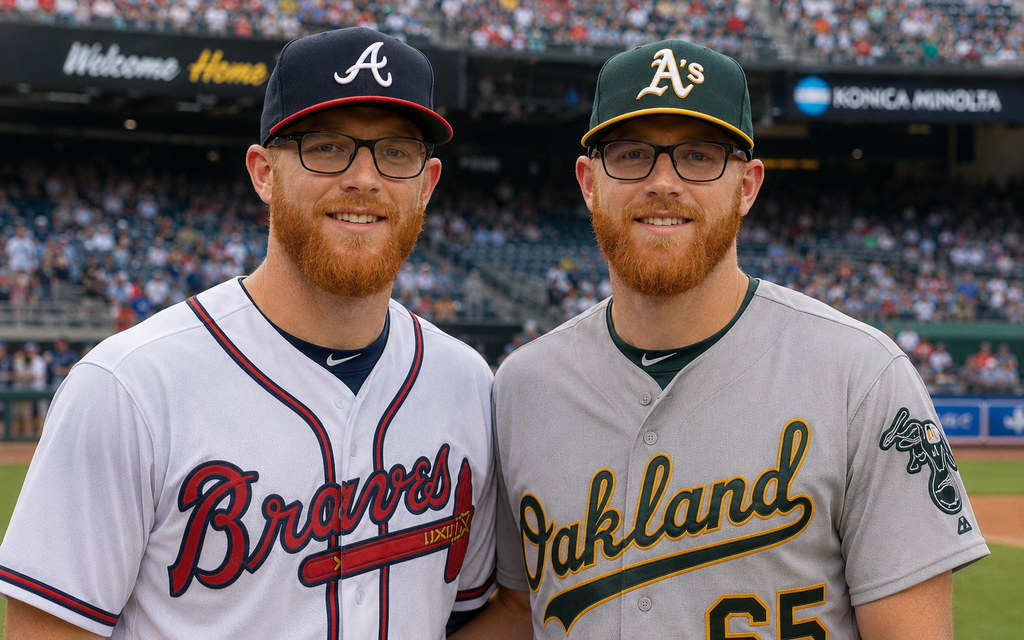
Two pitchers, one name, and a striking resemblance
One of the men is Brady Matthew Feigl, born in Maryland in 1990. He built a long professional baseball career as a left-handed pitcher and eventually reached Major League Baseball.
The other Brady Feigl is younger and was drafted by the Oakland Athletics organization in 2018. He pitches right-handed.
That difference matters on the baseball field, but visually, it does little to solve the mystery.
Both men are tall, have reddish hair and beards, wear glasses, and have facial features similar enough that photographs of them standing together have repeatedly triggered comparisons with brothers or twins.
Even Major League Baseball has acknowledged how frequently the two have been confused.
The shared surname makes the coincidence even more unusual. Feigl is hardly among the most common names in professional sports, yet two men carrying that name ended up playing the same specialized position.
And baseball soon gave them something else in common.
Their medical histories produced another extraordinary overlap
Pitching places tremendous stress on the elbow, particularly on the ulnar collateral ligament, commonly known as the UCL.
When that ligament becomes severely damaged, pitchers may undergo ulnar collateral ligament reconstruction, better known as Tommy John surgery.
Brady Matthew Feigl required the procedure in 2015 after suffering a torn UCL in his left elbow while he was part of the Atlanta Braves organization.
The surgeon was Dr. James Andrews, one of the best-known orthopedic surgeons in American sports medicine.
Remarkably, the other Brady Feigl had already undergone Tommy John surgery earlier in his baseball career.

His surgeon was also Dr. James Andrews.
This detail has been repeated so often online that some viral versions of the story make it sound as though both men arrived at the same clinic at the same time or somehow discovered each other while awaiting surgery.
That is not what the documented evidence shows.
Their procedures occurred at different points in their careers. The verified coincidence is unusual enough on its own: two unrelated pitchers named Brady Feigl, with remarkably similar appearances, both underwent the same career-defining elbow surgery performed by the same surgeon.
The resemblance eventually became impossible to ignore
As stories about the two players began circulating, the obvious question followed.
Could they actually be related?
In 2018, the men met as part of a television feature by Inside Edition. Standing beside one another made the resemblance even more noticeable.
Similar glasses framed similar-looking faces. Both had the same distinctive reddish facial hair and comparable builds.
For viewers, the easiest explanation seemed almost obvious: perhaps there was an unknown family connection.
Maybe they were distant relatives.
Perhaps some unusual family history had gone unnoticed.
The curiosity did not disappear, and eventually the idea was tested in the most direct way possible.
DNA testing.
The DNA result ruled out the explanation everyone expected
The testing showed that the two Brady Feigls were not close biological relatives.
No secret brotherhood emerged. They were not twins separated in childhood, nor did the testing uncover the sort of close family relationship that could neatly explain their resemblance.
The mystery therefore became more interesting rather than less.
There was another curious detail in the ancestry results. Both men reportedly received estimates placing roughly 53 percent of their ancestry in Germanic or German-associated European populations.
At first glance, that seems almost like evidence connecting them.
It is not.
Ancestry estimates describe broad genetic similarities to reference populations. Two unrelated people can easily have comparable ancestry percentages without sharing any recent family connection.
Millions of people can have predominantly Germanic, Scandinavian, British, Mediterranean, or other regional ancestry and still be genealogically unrelated.
The important finding was that the two men did not share the kind of close genetic relationship people had suspected.
Can complete strangers genuinely look this similar?
Cases like this raise a fascinating scientific question.
How can two people who are not closely related end up with remarkably similar faces?
Research suggests that the phenomenon is more than an illusion.
A 2022 study published in the scientific journal Cell Reports examined people who strongly resembled one another despite having no known family relationship. Researchers analyzed photographs using facial-recognition technology and then compared biological data including DNA, epigenetic patterns, and microbiomes.
Some of the strongest facial look-alikes shared genetic variants associated with aspects of facial structure and physical appearance.
In other words, unrelated people can independently inherit similar combinations of genetic variants.
They do not have to be siblings for their faces to develop in surprisingly similar ways.
There is no single “doppelgänger gene”
The discovery does not mean scientists have identified one gene responsible for creating human doubles.
Human appearance is far more complicated.
The shape of the nose, jaw, eyes, forehead, cheekbones, and overall skull can be influenced by many genetic variants working together. Hair pigmentation, height, body composition, and other visible characteristics are also shaped by complex interactions between genetics and environment.
Two unrelated people can therefore inherit overlapping combinations that happen to create a similar overall appearance.
The 2022 research also found that some highly similar-looking individuals shared characteristics beyond their faces, including certain measurements related to height and body size.
That does not mean people who look alike are genetically equivalent, nor does it mean they will necessarily share the same personality, health, or life choices.
It simply shows that resemblance between unrelated people can have a genuine biological component.
With billions of humans, unlikely combinations eventually happen
There is another part of the explanation that is much simpler: statistics.
More than eight billion people live on Earth.
Human faces can vary enormously, but they are still built from a finite set of anatomical structures. Eyes have particular ranges of shape and distance. Noses vary, but within biological limits. Jawlines, skull proportions, hair colors, and facial-hair patterns also exist within bounded ranges.
Given a sufficiently large population, some combinations are bound to appear more than once.
The resemblance can become even stronger when lifestyle and appearance choices overlap.
In the Brady Feigl case, both men wore glasses. Both grew similar reddish facial hair. Both had athletic builds. Both regularly appeared in baseball uniforms and caps.
Our brains are also extremely sensitive to patterns. Once we notice several strong similarities, smaller differences may become less noticeable.
Genetics cannot explain the strangest coincidence of all
Science can offer plausible reasons why two unrelated men might have similar faces.
It cannot fully explain why both became professional baseball pitchers.
Choosing a career is influenced by family, opportunity, geography, training, interests, talent, chance, and countless experiences throughout childhood and adolescence.
No scientific study suggests that people who look alike are destined to choose the same profession.
That part of the Brady Feigl story remains exactly what it appears to be: coincidence.
And the coincidences kept accumulating.
Same name.
Same sport.
Same position.
Similar height.
Similar appearance.
The same major elbow procedure.
The same surgeon.
Yet no close family relationship.
Their careers eventually went in different directions
Despite everything they shared, their baseball paths were never identical.
Brady Matthew Feigl spent years moving through professional baseball before eventually making his Major League debut with the Pittsburgh Pirates in August 2024.
The younger Brady Feigl entered professional baseball after being selected by the Oakland Athletics in the fifth round of the 2018 MLB Draft and developed through the professional system on his own path.
They were never interchangeable people living parallel lives.
They were simply two athletes whose stories crossed in an extraordinarily unusual way.
The real story does not need embellishment
Viral stories often become more dramatic each time they are shared.
A coincidence becomes a mystery. A resemblance becomes “identical twins.” Two similar medical histories become a supposedly simultaneous hospital encounter.
That is why stories like this are worth checking carefully.
In this case, removing the exaggerations does not make the story less fascinating.
Two professional baseball pitchers really are named Brady Feigl.
They really do look remarkably similar.
Both really did undergo Tommy John surgery performed by Dr. James Andrews.
Their resemblance really did attract enough attention that DNA testing was arranged.
And the tests did not reveal the close biological relationship many people expected.
Science can explain part of what makes human look-alikes possible. Genetics can sometimes produce surprisingly similar faces in people who are not close relatives.
But science does not need to explain every detail for the story to remain extraordinary.
Sometimes the most remarkable explanation is also the simplest one:
two strangers can resemble one another, follow strangely similar paths, and still be connected by nothing more mysterious than chance.