
A venomous snake can turn a single mistake into a fatal encounter. Yet one African bird regularly takes that risk on the ground, approaching dangerous prey and striking it with its legs in movements so fast that the human eye can barely follow them.
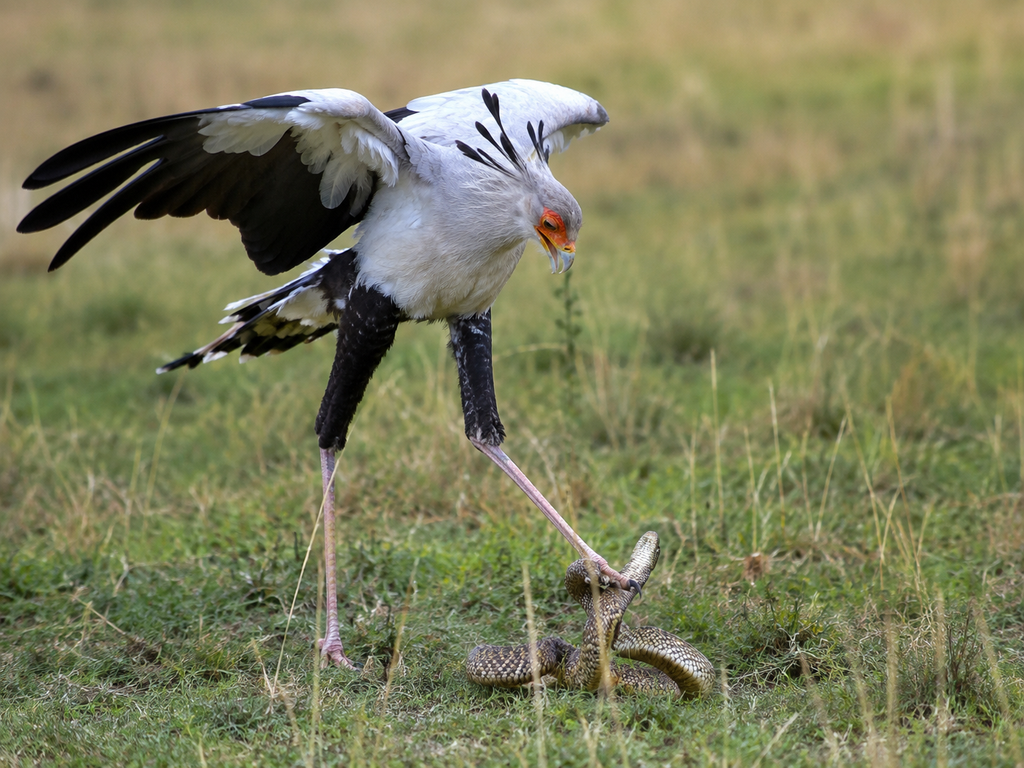
The secretarybird, Sagittarius serpentarius, has become famous online for videos showing it stomping or kicking snakes. The clips often look exaggerated, almost as if the animal had been designed for social media.
In this case, however, the basic claim is real.
Scientists have actually measured the bird’s strike, and the results suggest that its hunting technique depends not only on strength, but also on extraordinary timing, precision and anatomy.
A Bird of Prey That Hunts on Foot
The secretarybird is native to sub-Saharan Africa and is the only living member of the family Sagittariidae. Its appearance is unlike that of almost any other raptor.
It has the head and hooked beak of a bird of prey, an unusually tall body, very long legs and a distinctive crest of dark feathers extending from the back of its head.
Unlike eagles and many other raptors, secretarybirds spend much of their day walking through grasslands and savannas in search of food. They can cover long distances on foot, scanning the ground for anything small enough to catch.
That terrestrial lifestyle is essential to understanding how they hunt.
Their legs are not simply adapted for walking. They are also weapons.
Snakes Are Famous Prey, but Not Their Only Prey
The secretarybird’s reputation has become so closely associated with snakes that it is easy to imagine the species as a specialized snake hunter.
That is misleading.
Secretarybirds have a varied diet that may include insects, rodents, lizards, amphibians, small birds, eggs and other small animals. Snakes are only one part of their menu.
Some of those snakes, however, can be venomous.
This is where the bird’s hunting strategy becomes particularly impressive. Instead of bringing its vulnerable head close to dangerous prey, the secretarybird can attack from above with rapid downward strikes of its feet.
Its long legs allow the head and torso to remain farther away from the snake’s mouth while the foot delivers the attack.
What Happens During an Attack?
When confronting suitable prey on the ground, a secretarybird may strike repeatedly with its feet until the animal is stunned, incapacitated or killed.
Observations suggest that attacks on larger or dangerous prey can be directed toward vulnerable areas, including the head.
That matters enormously when the target is a snake.
A snake may be capable of striking quickly, so the bird cannot simply overpower it through brute force. It has to control distance, recognize the position of the prey and deliver a fast, accurate strike.
The difference between success and injury may come down to fractions of a second.
Scientists Decided to Measure the Kick
For years, the secretarybird’s unusual hunting style was well known from field observations. But researchers wanted to understand exactly what happened mechanically during the strike.
A study published in Current Biology examined the kicking behavior of a male secretarybird named Madeleine at the Hawk Conservancy Trust in the United Kingdom.
Madeleine had been trained to strike an artificial rubber snake. Researchers positioned the target over equipment capable of measuring force and filmed the attacks using high-speed cameras.
This created something researchers rarely get when studying spectacular wildlife behavior: measurable biomechanical data.
The Strike Reached Around 195 Newtons
The results were striking.
The researchers recorded an average peak force of approximately 195 newtons, with some variation between kicks. Relative to the bird’s body weight, that was equivalent to roughly five times its own weight.
That figure is impressive, but the speed of the impact may be even more revealing.
The bird’s foot remained in contact with the target for only around 15 milliseconds on average.
That is just fifteen thousandths of a second.
The event happens so quickly that much of the detail is effectively invisible without slow-motion recording.
Why 15 Milliseconds Matters
The tiny duration of the impact tells us something important about how the bird controls its movement.
Animals constantly use sensory feedback to adjust motion. Muscles, joints and nerves provide information about position and contact, allowing the nervous system to make corrections.
But a 15-millisecond impact is so brief that there is very little time for the bird to detect contact, process that information and substantially change the same strike.
Researchers therefore suggested that the movement relies heavily on predictive, or feed-forward, motor control.
In practical terms, the secretarybird must identify where the target is, prepare the movement and launch the strike with much of the required accuracy already built into the action.
If the target moves unexpectedly, meaningful correction may have to occur on the next strike rather than during the impact already underway.
Against venomous prey, that level of precision is particularly valuable.
Strength Alone Does Not Explain the Attack
A force equivalent to several times body weight sounds extraordinary, but animals can experience large forces during jumping, landing and fast running.
What makes the secretarybird especially interesting is how that force is generated.
The bird is not simply dropping its entire body onto its prey from a height.
Instead, the leg is accelerated rapidly toward the target from a relatively stable body position. Muscles generate the movement and transfer energy through the limb into the impact.
The leg effectively becomes a fast striking mechanism.
The combination of speed, accuracy and distance may be more important than maximum force alone.
Does the Secretarybird Have Immunity to Snake Venom?
There is no good reason to assume that it does.
This is one of the most common ways an impressive animal adaptation becomes exaggerated online. A predator that hunts venomous animals is sometimes described as naturally immune to venom even when that has not been demonstrated.
Secretarybirds are not known to rely on venom immunity as their main defense.
Their advantage appears to be behavioral and anatomical.
Long legs increase distance from the snake’s head. Fast attacks reduce the time available for retaliation. Precise strikes help disable the prey before it can respond effectively.
Avoiding the bite is very different from surviving the venom.
One Famous Number Needs an Important Caveat
The figure of roughly 195 newtons is often repeated as though every secretarybird in the wild produces exactly the same force.
That is not what the study established.
The experiment involved one trained bird striking an artificial snake under controlled conditions.
That makes the research extremely valuable because it provides direct measurements, but it also means the result should not be treated as a universal constant for the entire species.
Wild birds differ in size, age, condition and behavior. Real snakes move differently from artificial targets. Individual attacks will also vary.
The study showed what a secretarybird was capable of producing under the tested conditions. It did not prove that every strike in nature delivers precisely 195 newtons.
That distinction matters, especially when scientific findings are turned into viral facts.
Why Are Its Legs So Long?
The secretarybird’s unusual proportions make much more sense when viewed in the context of its lifestyle.
It lives primarily in open habitats such as grasslands and savannas, where much of its food is found at ground level.
Long legs allow the bird to move efficiently through vegetation and give it a higher vantage point while searching for prey.
Those same limbs also provide a safety advantage when the animal being hunted is capable of biting.
A longer limb means the foot can reach the prey while the rest of the bird remains farther away.
An anatomical feature useful for walking has therefore also become central to its hunting strategy.
Where Did the Name “Secretarybird” Come From?
The bird’s name is almost as unusual as its appearance.
One traditional explanation links it to the long dark feathers extending behind the head. These were said to resemble the quill pens once associated with clerks or secretaries, who were sometimes depicted carrying writing feathers behind their ears.
That explanation is widely repeated, although the exact historical origin of the English name is not entirely certain.
It is therefore more accurate to describe the quill-pen story as a traditional interpretation rather than a proven historical fact.
A Powerful Predator Facing a Much Bigger Threat
An animal capable of confronting venomous snakes might seem almost invulnerable.
It is not.
The secretarybird is currently classified as Endangered, reflecting serious declines across parts of its range.
Its greatest threats do not come from snakes.
Habitat loss and degradation, expansion of agriculture and development, disturbance, poisoning and other human-related pressures have all contributed to concern about the species.
Conservation projects now use tracking data and long-term monitoring to understand where secretarybirds move, which habitats they depend on and how those landscapes are changing.
The irony is difficult to miss.
A bird exquisitely adapted to dealing with some of the most dangerous prey in its environment is far less equipped to cope with the rapid transformation of that environment itself.
What the Viral Videos Get Right — and What They Leave Out
The headline claim is true: secretarybirds can kill snakes by striking them with their feet.
But the real story is more interesting than that sentence suggests.
They are not dedicated snake hunters. They are not known to depend on immunity to venom. And the famous 195-newton figure comes from a controlled experiment involving one trained bird rather than from every wild attack ever observed.
What the research does show is remarkable enough.
The secretarybird is a terrestrial bird of prey capable of generating fast, forceful strikes that can reach several times its own body weight, with contact lasting only a few thousandths of a second.
Its nervous system must prepare those movements with exceptional accuracy, while its long legs help keep the rest of the body away from dangerous prey.
Sometimes the internet exaggerates wildlife until the real animal disappears behind the myth.
The secretarybird barely needs that treatment.
Its real biology is already stranger, more precise and more impressive than the viral version.