
Sometimes, only a few notes are enough to change the way a person responds.
Someone struggling to find words after a stroke may suddenly manage to sing a familiar phrase. A person with Parkinson’s disease may walk more steadily when their steps are guided by a regular beat. Someone living with advanced dementia may appear withdrawn, then become visibly engaged when a song from decades ago begins to play.
Moments like these can look extraordinary.
They are not proof that music can “heal the brain” in some mysterious way. The reality is more complex, but also far more interesting.
Music engages several brain systems at once. Hearing, movement, attention, memory, emotion, anticipation and reward can all become involved in a musical experience. This unusual combination is one reason researchers have explored whether music can be used not only for enjoyment, but also as part of structured therapeutic interventions.
That is where music therapy begins.
Listening to a relaxing playlist is not the same as music therapy
Music can absolutely make us feel better.
A familiar song may calm us after a stressful day, make exercise easier or bring back a powerful memory. Those effects are meaningful, but they should not automatically be described as music therapy.
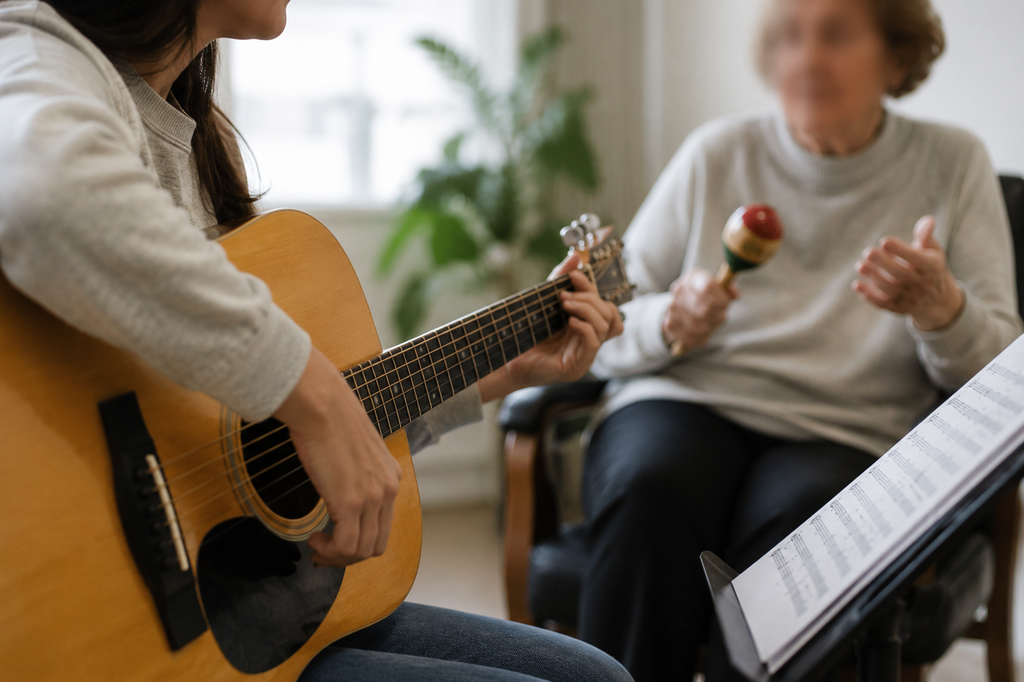
The American Music Therapy Association defines music therapy as the clinical and evidence-based use of music interventions to achieve individualized goals within a therapeutic relationship and under the guidance of a qualified professional.
In practice, this may involve singing, playing instruments, rhythmic exercises, songwriting, improvisation, movement, guided listening or other music-based activities.
The goal is not to become a better singer or musician.
The music is being used as a tool.
For one person, the objective may be to support movement. For another, it may be communication, emotional expression, anxiety reduction or participation in neurological rehabilitation.
Why does music affect so much of the brain?
The brain does not have one isolated “music center.”
When we hear a song, several processes can happen almost at the same time. We analyze pitch and sound, recognize rhythm, anticipate what comes next, connect what we hear with memories and experience an emotional response.
If we tap our foot or begin to move with the beat, auditory and motor networks have to communicate.
If the song reminds us of childhood, memory systems become involved.
If we enjoy what we hear, brain circuits associated with reward and motivation can also participate.
Neuroimaging research has repeatedly shown that musical experiences recruit distributed networks rather than a single specialized area.
This helps explain why music has attracted so much attention in neuroscience.
It can combine timing, movement, emotion, memory and sound within one experience.
And in some forms of therapy, those properties can become clinically useful.
Rhythm can act like an external timing signal
One of the clearest examples comes from movement rehabilitation.
Walking feels automatic when everything is working normally, but it actually requires precise timing between muscles, joints and the nervous system.
In some neurological disorders, the internal regulation of movement becomes less reliable.
An external beat can sometimes provide additional timing information.
This principle is used in a technique known as rhythmic auditory stimulation.
A person may practice walking in time with a steady musical beat or another repetitive sound. The idea is not that the music repairs damaged neurons. Instead, the auditory rhythm provides a predictable temporal structure that the motor system may use to organize movement.
Research in Parkinson’s disease has produced particularly interesting results.
Meta-analyses of rhythmic auditory stimulation have reported improvements in aspects of walking such as gait speed and stride length. At the same time, researchers continue to point out differences in study design and the risk of bias in parts of the evidence base.
Even with those limitations, the principle itself is remarkable.
Rhythm is not merely making the patient feel motivated.
It can become an external reference for movement.
Music after a stroke
Stroke rehabilitation is another area in which music-based interventions have been studied.
Depending on which part of the brain is affected, a stroke can interfere with walking, arm movement, speech, attention and many other functions.
A Cochrane review examining music interventions for acquired brain injury included 29 studies involving 775 participants, with most of the evidence coming from people who had experienced a stroke.
For walking rehabilitation after stroke, rhythmic auditory stimulation was associated with an average increase in walking speed of roughly 11 meters per minute, as well as improvements in stride length.
Some studies also suggested possible benefits for repetitive arm movements and certain aspects of communication.
These findings are encouraging, but they need context.
Many of the studies were relatively small, and the quality of the evidence varied.
Music-based rehabilitation should therefore be seen as a possible addition to established care rather than a replacement for physiotherapy, speech therapy, neurological treatment or other forms of rehabilitation.
How can someone sing words they struggle to speak?
One of the most difficult consequences of stroke can be aphasia.
A person may know exactly what they want to say but struggle to retrieve or produce the words.
In some people, however, speech supported by melody and rhythm can be easier than ordinary spoken language.
This observation contributed to the development of therapeutic approaches that incorporate musical elements into language rehabilitation. One of the best-known examples is Melodic Intonation Therapy.
Rather than simply asking a patient to speak, the technique can use melodic patterns and rhythm to support the production of words or phrases.
A systematic review published in 2025 examined randomized studies of music-based interventions for nonfluent aphasia and found promising effects in areas such as word repetition and naming.
But the researchers also emphasized methodological weaknesses and moderate-to-high risk of bias across the available studies.
So this is not a technique that can magically restore speech in every patient.
What it does show, however, is how adaptable the human brain can be and how rhythm and melody may sometimes support alternative routes during rehabilitation.
Dementia and music: what viral videos do not tell you
Few examples of music therapy are as emotionally powerful as those involving dementia.
A person with Alzheimer’s disease may seem disengaged and barely communicate. Then a song from their youth begins to play.
Their expression changes.
They may smile, sing along or suddenly appear more connected to the people around them.
These reactions can be real.
What is much less certain is the interpretation often attached to them online: that music has somehow reopened lost memories or temporarily reversed dementia.
The scientific evidence is more restrained.
A major Cochrane update published in 2025 assessed therapeutic music-based interventions for people with dementia. The review included 30 studies from 15 countries involving 1,720 participants.
Compared with usual care, music-based interventions probably produce a small reduction in depressive symptoms immediately after treatment. They may also improve some broader behavioral problems.
However, the review did not find convincing evidence that music therapy improves cognition, including memory and thinking, or clearly reduces agitation and aggression. Evidence for anxiety and several other outcomes remains uncertain.
Researchers also did not establish strong evidence for lasting benefits after treatment ends.
That distinction matters.
A familiar song may change someone’s emotional state or make communication easier for a few minutes.
That does not mean Alzheimer’s disease has been reversed.
Why can an old song have such a powerful effect?
Human memory is not stored as a single archive.
An autobiographical memory can be connected to a person, a place, a stage of life, an emotion and a particular sound all at once.
This may help explain why music from adolescence or early adulthood can feel so unusually vivid decades later.
For one person, a song may be linked to their wedding.
For another, it may evoke car journeys with a parent.
For someone else, it might be a hymn they heard throughout childhood.
A random song chosen by someone else does not necessarily carry any of these associations.
This is one reason individualized music matters.
There is no universal playlist capable of “unlocking memory.”
The meaning of the music depends heavily on the person listening to it.
What about depression and anxiety?
Music therapy has also been investigated in mental health care.
A Cochrane review of music therapy for depression included nine studies involving 421 participants. It found that adding music therapy to usual treatment may improve short-term depressive symptoms compared with usual treatment alone.
The review also reported possible benefits for anxiety and general functioning.
Still, the evidence base was relatively small, and researchers could not establish that music therapy was superior to psychological therapy or that one particular music therapy approach was clearly better than another.
That makes an important difference in how the findings should be described.
It would be misleading to say that music “treats depression.”
It is more accurate to say that professionally delivered music therapy may be a useful complementary intervention for some people.
Research on anxiety has continued to develop.
A systematic review and meta-analysis published in eClinicalMedicine in 2025 examined music therapy across a range of clinical settings and found evidence supporting an anxiety-reducing effect.
That does not turn every calming playlist into treatment for an anxiety disorder.
Enjoying music at home may help with relaxation. Clinical music therapy is a structured intervention. Psychotherapy, medical assessment and medication remain important when they are indicated.
Music therapy can be active or receptive
Music therapy is sometimes imagined as a patient lying quietly while soothing music plays in the background.
That is only one possible approach.
In receptive forms of music therapy, listening may be used to encourage relaxation, explore emotions, stimulate memories or support another therapeutic goal.
Active music therapy involves participation.
A person may sing, improvise, play an instrument, move with the rhythm or create music together with the therapist.
Someone undergoing neurological rehabilitation might use rhythm to practice movement.
Another patient might use vocal exercises involving melody to support communication.
In mental health care, improvisation may provide a way to express emotions that are difficult to put into words.
The intervention is chosen according to the person and the therapeutic objective.
It is not based on the idea that one particular song is inherently “good for the brain.”
What about 432 Hz, 528 Hz and so-called healing frequencies?
This is where evidence-based music therapy needs to be clearly separated from internet wellness claims.
Online videos frequently claim that particular frequencies can repair DNA, detoxify the body, heal organs or treat disease.
Those claims are not the same thing as clinical music therapy.
Someone may genuinely find a particular tuning, tone or type of music relaxing.
That subjective experience does not prove that the sound repairs DNA or treats a medical condition.
Feeling calmer is one claim.
Curing disease is another.
The latter requires high-quality scientific evidence.
Evidence-based music therapy does not depend on the existence of a single “healing frequency.”
Is there one kind of therapeutic music that works for everyone?
No.
Music that feels calming to one person may irritate another.
Classical music may be deeply comforting to someone and completely uninteresting to somebody else.
A particular song may trigger one person’s happiest memory and another person’s grief.
This is why individualized therapy matters so much.
Music therapy is not about playing the supposedly correct sound to the brain.
It involves a person with their own history, preferences, emotional associations and therapeutic needs.
The same idea applies outside therapy.
If music helps you relax, exercise or get through a difficult day, it does not need to have extraordinary medical properties to be valuable.
And if someone with dementia becomes calmer or more communicative while listening to songs they loved when they were younger, that moment can matter enormously even if the music is not treating the underlying disease.
Sometimes the value of music is not in curing.
It is in connecting.
Music is not medicine, but its effects are not imaginary
Science does not support the idea that a particular song can cure Alzheimer’s disease, Parkinson’s disease, depression or the neurological damage caused by a stroke.
But science does not tell us that music is merely entertainment either.
In some neurological rehabilitation programs, rhythm can help organize movement.
In aphasia therapy, melody and rhythm can be incorporated into exercises designed to support language.
In dementia care, music may influence mood and certain behaviors even though it does not restore lost memory.
And in mental health care, professionally delivered music therapy may complement established treatments for some patients.
None of this requires miracle frequencies or claims that music can somehow rebuild the brain.
The explanation is grounded in the way the nervous system works.
The human brain is exceptionally sensitive to rhythm. It links sounds with emotion and autobiographical memory. It coordinates movement with auditory information. And it can sometimes use several different neural systems to accomplish a task.
Music therapy attempts to use those characteristics deliberately and therapeutically.
Perhaps the most powerful image is therefore not that of a song magically healing an injured brain.
It is the image of a brain that, even when some of its usual pathways have been damaged, may still be capable of finding another route.
And sometimes that route happens to have rhythm, melody and a human voice.