
For most of his life, Richard Beauvais had no reason to question where he came from.
He had been raised in St. Laurent, Manitoba, in a Métis family and community. He spoke French and Cree. His childhood, his family history and even some of the discrimination he experienced were tied to an identity he understood as his own.
Then, decades later, a genealogy DNA test gave him a result that made no sense.
Instead of confirming the ancestry he expected, it pointed toward Ukrainian and Jewish roots.
At first, Richard searched for an ordinary explanation. Perhaps there was an adoption nobody had told him about. Perhaps something in the family history had been misunderstood.
But the explanation turned out to be far more extraordinary.
About 100 kilometres away, another boy born on exactly the same day had grown up believing he was Ukrainian.
His name was Edward “Eddy” Ambrose.
And nearly seven decades after their births, the two men would discover that each had been sent home from the hospital with the other’s family.
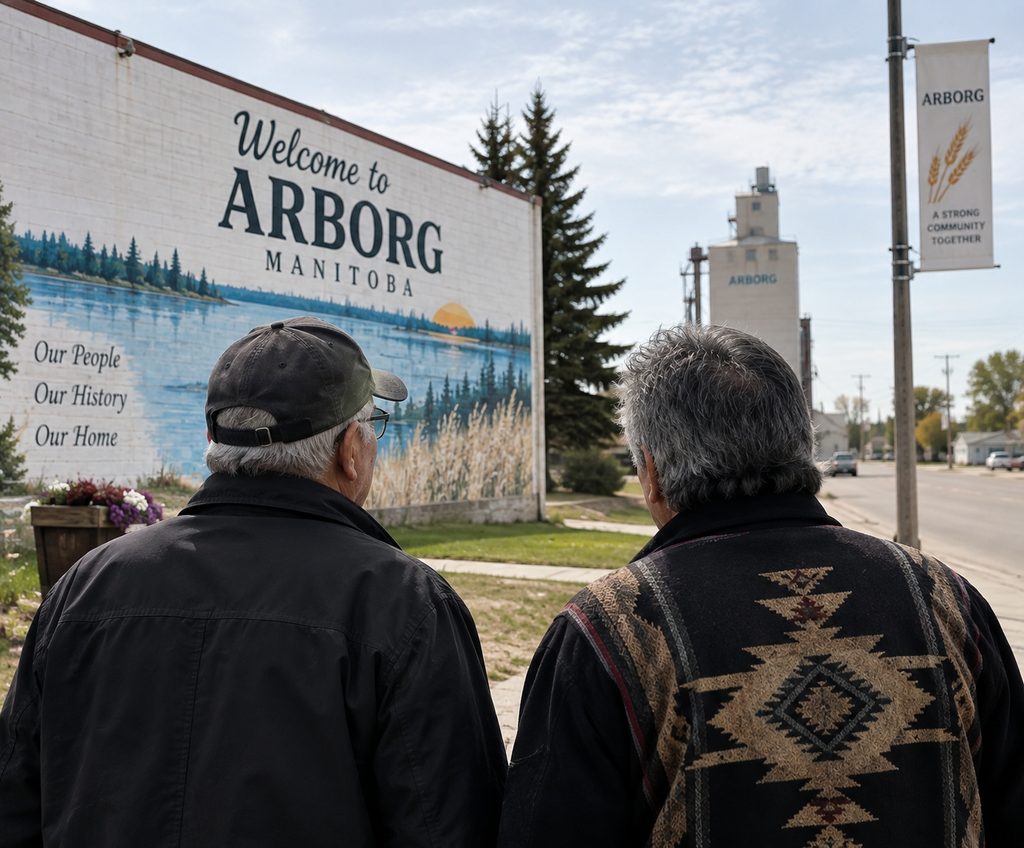
Two Mothers Left the Same Hospital With the Wrong Babies
Richard Beauvais and Eddy Ambrose were both born on June 28, 1955, at a hospital in Arborg, Manitoba.
Richard was biologically the son of James and Kathleen Ambrose. Eddy was biologically the son of Camille and Laurette Beauvais.
But something went terribly wrong before the babies went home.
The Beauvais family left the hospital with Richard.
The Ambrose family left with Eddy.
Neither family knew a mistake had been made.
The boys grew up roughly 100 kilometres apart, and the consequences of that single hospital error extended far beyond genetics.
Richard was raised Métis.
Eddy was raised Ukrainian.
For more than six decades, each man built a life around the family, culture and history into which he had been placed as a newborn.
Richard’s Childhood Had Been Shaped by Being Métis
Richard grew up in St. Laurent, a historic Métis community on the shores of Lake Manitoba.
His father died when he was young, and the family struggled financially. Richard eventually spent time in foster care and attended a residential day school for Indigenous children.
He would later describe experiencing mistreatment and discrimination because he was perceived as Indigenous.
Those experiences mattered when the DNA results arrived many years later. Richard had not simply checked “Métis” on a family tree. That identity had influenced the way he grew up and the way the outside world treated him.
Eventually he became a commercial fisherman and settled in British Columbia.
By then, the question of who he was seemed long settled.
Until someone gave him a genealogy test.
The DNA Result Looked Impossible
Richard expected the test to reflect the family history he had always known.
It didn’t.
The ancestry appearing in his results pointed instead toward Ukrainian and Jewish heritage.
Confused, Richard contacted a cousin and asked whether he might have been adopted without knowing it.
That explanation seemed unlikely. His cousin remembered seeing him at the hospital shortly after his birth.
So the strange DNA result remained unresolved.
Then another test, taken by someone Richard did not yet understand was connected to him, changed everything.
One of Eddy Ambrose’s sisters had also used genealogy DNA testing.
Her results showed that she had a biological brother living in British Columbia.
That man was Richard Beauvais.
Suddenly, the details began lining up.
Richard and Eddy had the same birthday.
They had been born in the same hospital.
And genetically, each man belonged to the family in which the other had grown up.
What had seemed impossible was becoming the only explanation that fit the evidence.
Eddy Had Grown Up in the Family Richard Was Born Into
Eddy Ambrose’s childhood had followed a very different path.
He grew up in Rembrandt, Manitoba, believing himself to be part of a Ukrainian family. Like Richard, however, he experienced significant loss at a young age.
By the time Eddy was 12, both of the parents who had raised him had died. He lived with relatives before eventually entering foster care and being adopted.
Yet his memories of the Ambrose family remained deeply important to him. He remembered the father he admired and the culture in which he had been raised.
Then came the call that forced him to reconsider something he had never imagined questioning.
The woman he had known all his life as his sister had discovered through DNA that they were not biological siblings.
The biological brother identified by the test was Richard.
Further investigation established the extraordinary truth: Richard was the biological child of the Ambrose family, while Eddy was the biological child of the Beauvais family.
The babies had been switched in 1955.
This Was About More Than Finding Different Biological Parents
Many switched-at-birth stories revolve around the same devastating question: Who were my real parents?
For Richard and Eddy, that question was only the beginning.
Their discovery also touched culture, ethnicity, community and belonging.
Richard had lived as a Métis man for more than six decades. He had spoken the languages of the community, grown up among Métis relatives and experienced discrimination as an Indigenous person.
Now DNA was telling him that his biological ancestry came from the family in which Eddy had been raised.
Eddy faced the reverse discovery.
The man who had spent his life believing he came from Ukrainian roots learned that biologically he was Métis.
Yet neither man could simply exchange identities as though correcting two mislabeled files.
DNA could reveal where they had come from.
It could not erase where they had been.
Old Encounters Suddenly Looked Different
Once the families understood what had happened, seemingly insignificant memories acquired a remarkable new meaning.
As a child, Eddy had once invited a girl from a nearby community to join his baseball team.
He had no idea she was his biological sister.
Richard had unknowingly crossed paths with biological relatives as well. As a teenager in British Columbia, he had been in places frequented by one of his biological sisters and had even entered a bar where she worked.
They had been close enough to see one another.
They simply had no reason to recognize each other as family.
Only decades later did those encounters become pieces of a much larger story.
At 68, Eddy Began Discovering a Heritage He Never Knew Was His
Learning the truth did not make Eddy reject the Ukrainian family who had raised him.
Instead, he began exploring another part of himself.
The Manitoba Métis Federation helped him reconnect with his biological community, and in February 2024, at the age of 68, Eddy officially received his Red River Métis citizenship.
He began learning beadwork and attending powwows with his grandson.
It was not a matter of replacing one identity with another.
The Ambrose family remained his family. His childhood remained his childhood.
But now there was another history to learn—one that should have been available to him from the beginning.
Richard also began forming relationships with the biological sisters and relatives he had spent most of his life not knowing.
Their family trees were no longer simple.
But they were finally accurate.
Then Richard Met the Man Who Had Lived the Life He Might Have Had
There was something uniquely unsettling about Richard and Eddy eventually meeting one another.
They were not brothers.
They had not shared a childhood.
Yet each man could look at the other and see a version of the life that might have been his.
The parents who had raised Eddy were Richard’s biological parents.
The Métis family and heritage in which Richard had grown up belonged biologically to Eddy.
A single mistake in a hospital nursery had sent two lives down completely different paths.
Eddy later struggled to describe the strange connection between them. The idea was essentially this: when he looked at Richard, he was looking at the person who had occupied the place in one family that might otherwise have been his.
There was no simple word for that relationship.
The Families Wanted More Than an Explanation
Once the switch had been established, lawyer Bill Gange pursued the matter on behalf of the men.
At first, the Manitoba government disputed direct responsibility, arguing that the Arborg hospital had not been operated or controlled by the province in 1955. Gange challenged that position, pointing to the province’s role in funding municipal hospitals.
But the issue was never merely administrative.
Two mothers had entered a hospital expecting that the babies returned to them would be their own.
They had no reason to suspect otherwise.
By the time the mistake was discovered, most of a lifetime had passed.
Richard and Eddy wanted that failure acknowledged.
They would eventually receive that acknowledgment in one of the most powerful moments of their story.
“Richard Beauvais, I Am Sorry. Edward Ambrose, I Am Sorry.”
On March 21, 2024, Richard Beauvais and Eddy Ambrose sat inside the Manitoba Legislative Building as Premier Wab Kinew formally addressed what had happened to them.
He acknowledged that institutions their families should have been able to trust had failed them from the first day of their lives.
He also recognized the harm done to their biological parents, who had unknowingly been deprived of raising their own sons, and to the children and grandchildren who had grown up separated from parts of their biological family, culture and heritage.
Then Kinew made the apology personal.
He said their names.
“Richard Beauvais, I am sorry.”
“Edward Ambrose, I am sorry.”
Richard later said he believed the apology was sincere.
Almost 69 years had passed since two mothers walked out of a Manitoba hospital carrying the wrong babies.
Nothing said in that chamber could give those years back.
But for the first time, the province was publicly acknowledging the magnitude of what had happened.
DNA Could Reveal the Mistake. It Couldn’t Reverse a Lifetime
Switched-at-birth stories can sound deceptively simple when reduced to genetics.
Baby A belonged to Family A. Baby B belonged to Family B. Someone made a mistake.
Correct the labels, and the mystery appears solved.
Richard Beauvais and Eddy Ambrose show why human identity does not work that way.
Richard’s Métis childhood did not disappear when a DNA test revealed different biological ancestry. The language he learned, the people who raised him, the discrimination he experienced and the community that shaped him remained part of his life.
Eddy’s Ukrainian family did not become less meaningful when he discovered his Métis ancestry either. The parents he remembered, the traditions he knew and the childhood that formed him could not be reassigned by genetics.
What DNA gave them was not a replacement life.
It gave them access to a missing part of the one they already had.
Eddy could discover his Red River Métis heritage while continuing to love the family who raised him. Richard could meet his Ambrose relatives without denying the family and community that had shaped him.
That may be what makes their story so difficult to reduce to the phrase “switched at birth.”
Two babies were exchanged in a Manitoba hospital on June 28, 1955.
But what was exchanged with them was far larger: parents, siblings, languages, traditions, communities and entire branches of family history.
Nearly 69 years later, no government could put those lives back onto the paths they might have followed.
It could only acknowledge what had been taken from them.
And finally say their names.
Richard Beauvais.
Edward Ambrose.
We are sorry.