
A thin sheet of flexible material is pressed against a surface. Under magnification, its apparently smooth face turns into a landscape of microscopic structures. Moments later, a person appears to cling to a wall — or even a ceiling.
It is exactly the sort of demonstration designed to make one comparison irresistible: Spider-Man.
Videos featuring so-called “gecko adhesives” often reduce the explanation to something even more intriguing: scientists have created a special silicone that sticks so well that humans can climb walls with it.
There is genuine science behind that claim, but the reality is both more complicated and more remarkable. Ordinary silicone will not turn a pair of gloves into superhero equipment. What researchers have developed are dry adhesives inspired by gecko feet, engineered at microscopic scales to interact with surfaces in ways conventional sticky materials do not.
And this is no longer merely a laboratory concept capable of holding a lightweight object.
Researchers have already used gecko-inspired technology to support a 70-kilogram human climbing a vertical glass wall.
The breakthrough was not simply a stronger glue.
It was learning how nature creates adhesion without glue at all.
The Gecko’s Feet Are Not Sticky in the Conventional Sense
Watch a gecko race across a wall and it is easy to imagine that its feet must secrete some exceptionally effective natural adhesive.
They do not.
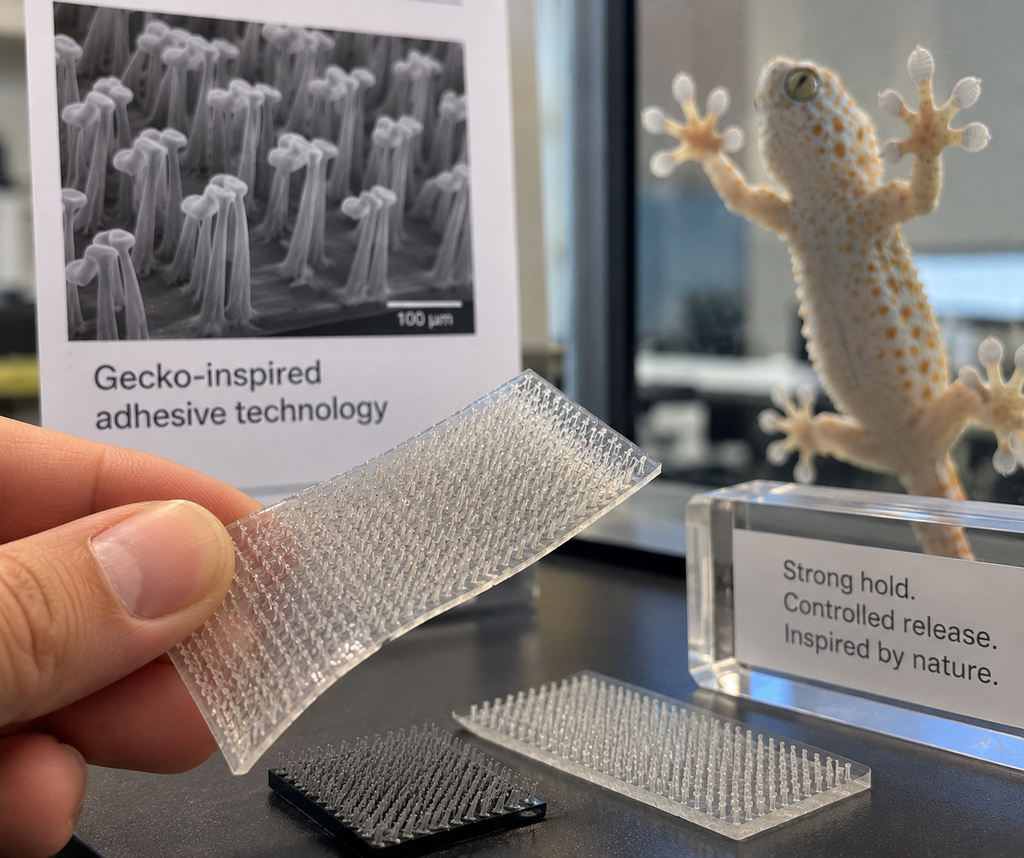
Instead, gecko toes possess an extraordinarily complex microscopic architecture. They are covered with vast numbers of tiny hair-like structures known as setae, which branch into even smaller structures at their tips. Together, they allow the animal’s feet to establish extremely intimate contact with the surface beneath them.
At these tiny distances, intermolecular attractions that would normally seem insignificant begin to matter.
Among them are van der Waals forces.
Individually, these interactions are weak. Across an enormous number of microscopic contact points, however, their combined effect can generate substantial adhesion.
A landmark study published in Proceedings of the National Academy of Sciences provided experimental evidence supporting van der Waals forces as the primary mechanism behind gecko dry adhesion, while arguing against capillary adhesion as the dominant explanation.
That distinction matters.
A gecko is not repeatedly gluing and ungluing itself from a wall. Its feet exploit physical interactions that become powerful because of their microscopic structure and the enormous effective area of contact.
Even more impressive is the animal’s ability to control that attachment almost instantaneously. It can grip a surface while bearing weight, then release a foot quickly enough to run.
That ability to switch between attachment and release became one of the most important clues for engineers trying to reproduce the phenomenon.
Engineers Did Not Simply Copy a Sticky Material — They Copied a Strategy
This field of research is an example of biomimetics, the practice of studying biological systems for solutions to engineering problems.
Instead of asking how to manufacture an increasingly aggressive glue, scientists began asking a different question: could a synthetic surface reproduce some of the geometry and mechanics found on gecko feet?
That approach led to a family of materials generally known as gecko-inspired dry adhesives.
Some experimental designs use silicone-based elastomers and polymers such as PDMS, or polydimethylsiloxane. But calling the technology “sticky silicone” misses the crucial part of the story.
The microscopic architecture matters enormously.
Engineered surfaces can contain arrays of tiny pillars, wedges, fibers or other structures designed to deform and establish close contact with another surface. Their dimensions, shape, orientation and mechanical properties determine how the adhesive behaves.
Two pieces of material that look nearly identical to the naked eye can therefore perform very differently once their microscopic structures are taken into account.
The remarkable property is not simply contained in the chemical formula of the material.
It is engineered into its surface.
Stanford Researchers Put the Idea to a Human-Scale Test
Making a gecko-inspired adhesive capable of holding a small laboratory object is one challenge. Scaling the concept until it can safely support the weight of a person is something entirely different.
Researchers at Stanford University’s Biomimetics and Dextrous Manipulation Laboratory tackled that problem.
Their work, published in the Journal of the Royal Society Interface, described a system designed to distribute loads across multiple adhesive elements rather than allowing a small portion of the material to carry most of the weight.
The result produced one of the most memorable demonstrations in biomimetic engineering.
A 70-kilogram climber ascended a 3.7-meter vertical glass surface, using roughly 140 square centimeters of gecko-inspired adhesive for each hand. The researchers also reported hundreds of individual steps on glass without adhesive failure during testing with the same climber.
It was a striking milestone.
A human being really had climbed a wall using technology derived from the mechanics of gecko adhesion.
But the details of the experiment also reveal why we are not yet buying Spider-Man gloves.
Behind Each Hand Was Much More Than a Patch of “Super Silicone”
The Stanford climbing devices were engineered systems rather than simple adhesive pads.
Each hand-sized unit incorporated 24 adhesive tiles. Those tiles contained microscopic polymer structures approximately 100 micrometers long — roughly comparable to the thickness of a human hair — with a geometry described as resembling tiny saw teeth.
But producing adhesion was only part of the problem.
The researchers also had to solve a fundamental issue in scaling adhesives: load sharing.
Imagine dozens of small adhesive regions supporting one person. If one region carries substantially more weight than the others, it can detach first. Its share of the load is then transferred to the remaining regions, increasing their stress and potentially triggering a cascading failure.
The Stanford team therefore designed a mechanism that distributed the load much more evenly across the adhesive system. That engineering solution was central to making human-scale adhesion possible.
In maximum-load testing reported in the research, the system supported an average load equivalent to roughly 95.6 kilograms under the experimental conditions.
That number illustrates an important distinction.
The achievement was not the invention of one extraordinarily sticky substance. It was the creation of a carefully engineered combination of materials, microscopic geometry and load-management mechanics.
A Good Climbing Adhesive Must Also Be Easy to Remove
There is a paradox at the heart of wall-climbing technology.
An adhesive powerful enough to support your body is of little practical value if you cannot remove your hand from the wall.
Conventional glue illustrates the problem perfectly. Stronger adhesion usually makes separation more difficult. A climber, however, needs to alternate between gripping and releasing with every movement.
Gecko-inspired systems can behave differently because their adhesion can be directional.
When the microscopic structures are loaded in the intended direction, the contact area and adhesive forces increase. Change the load or movement appropriately, and the structures can release much more readily.
This is conceptually similar to the biological system that inspired them. A gecko does not need to violently pull each foot away from the wall before taking another step. The mechanics and orientation of its microscopic structures allow attachment and detachment to be controlled rapidly.
Stanford’s climbing research demonstrated this principle at human scale. The authors reported that the adhesive units could be engaged with very little preload and released with relatively small forces once the climbing load had been removed.
For engineers, therefore, the goal is not necessarily to create the strongest possible adhesive.
The more useful challenge is creating controllable adhesion.
Does This Mean Viral “Spider-Man” Videos Are Real?
This is where two separate questions are often mixed together.
The first is whether technology exists that can use gecko-inspired adhesion to support a human on a vertical surface.
The answer is yes. The Stanford experiment is published evidence that such a system can work under appropriate conditions.
The second question is whether a particular person shown hanging from a wall or ceiling in an online video is being supported exclusively by the piece of material shown earlier in that video.
That cannot be established merely from a few seconds of footage.
A proper assessment would require knowing the construction of the adhesive, its contact area, the surface involved, the direction of the applied forces, how the person’s weight is distributed and whether any additional support systems are being used.
A ceiling also presents a different mechanical problem from a vertical glass wall. Directional adhesives depend heavily on how forces are applied, so demonstrations cannot automatically be treated as interchangeable.
The underlying technology is real.
That does not mean every dramatic social-media demonstration should be accepted without examining how it was performed.
There Is a Reason the Famous Demonstration Used Glass
A smooth sheet of glass offers an enormous advantage to an adhesive that depends on extremely close surface contact.
The real world is much less cooperative.
Painted walls can be textured. Concrete is rough and porous. Brick contains large irregularities. Outdoor surfaces accumulate dust, oils, moisture and other contaminants. At microscopic scales, imperfections that appear insignificant to us can dramatically reduce the amount of intimate contact an engineered adhesive can achieve.
Then there is the human body itself.
A stationary 70-kilogram load is not mechanically equivalent to a 70-kilogram person climbing, swinging or suddenly shifting their center of gravity. Real movement produces dynamic forces that an adhesive system must tolerate repeatedly.
And failure is not a minor inconvenience when the user is several meters above the ground.
These limitations help explain why the most immediate applications of gecko-inspired adhesives may look less like superhero equipment and more like advanced robotics.
The Technology May Become More Useful to Robots Than to Superheroes
Researchers have explored gecko-inspired adhesives for climbing robots, industrial gripping systems and devices capable of manipulating objects without conventional glue.
That has significant practical advantages.
A robotic gripper may need to pick up something delicate without squeezing it aggressively. Another system might need to handle a large smooth object without leaving adhesive residue behind. A climbing robot could potentially inspect structures in places that are difficult or dangerous for humans to reach.
In such applications, engineers can control the forces, contact geometry and operating conditions much more precisely than they can with a person attempting to scale the side of a building.
The technology that attracts attention because it resembles Spider-Man may therefore find some of its most important uses in factories, laboratories, inspection systems and robotics.
That would not make it any less extraordinary.
Spider-Man Is the Hook. The Gecko Is the Real Story.
Popular culture gives us an easy way to describe this research: scientists are trying to build Spider-Man technology.
But that framing reverses the chronology.
Long before comic-book writers imagined a human capable of moving across walls, evolution had produced animals able to perform precisely that feat without suction cups, magnets or permanently sticky secretions.
Scientists did not discover a magical adhesive hidden inside a gecko.
They discovered something subtler: structure can change what a material is capable of doing.
Arrange microscopic features in the right geometry, control how forces pass through them and suddenly an apparently ordinary polymer can interact with a surface in an extraordinary way.
We have already reached the point where a gecko-inspired synthetic system has helped a 70-kilogram person climb almost four meters up vertical glass.
Whether that research will ever lead to lightweight gloves that allow people to move freely across walls and ceilings remains another question.
But perhaps the most remarkable part of the story is that when humans imagined a superhero who could cling to walls, nature had already solved the underlying engineering problem.
We are still learning how to reproduce its design.