
The video lasts only a few seconds, but it is difficult to forget.
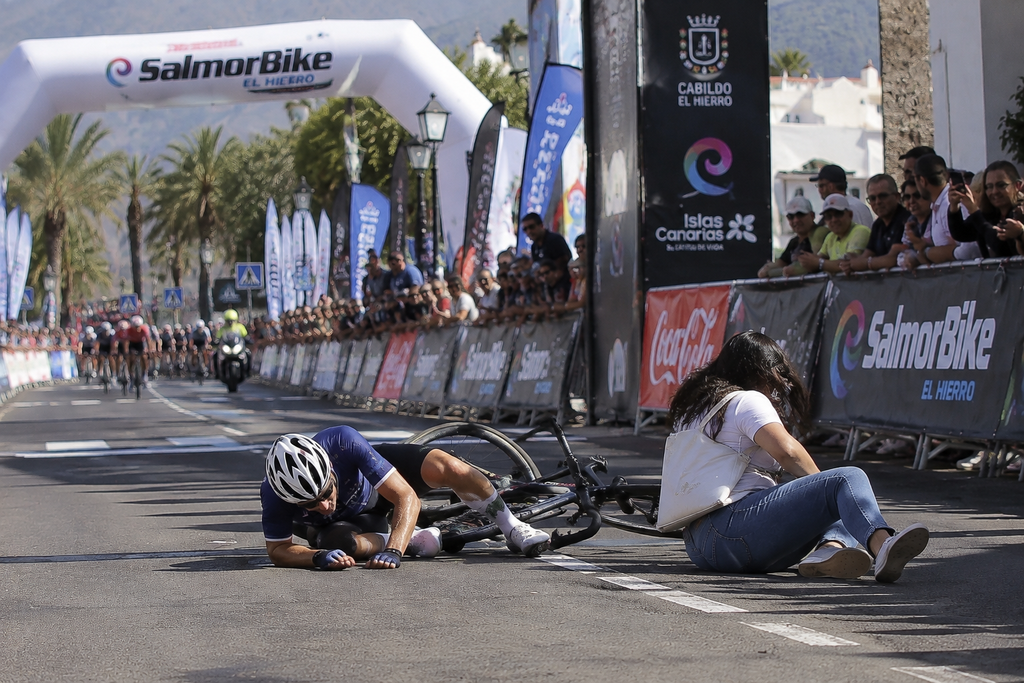
A cyclist is racing toward the finish line, clearly ahead of the riders behind him. Spectators line the roadside, watching what should have been the final moments of the event.
Then a woman steps onto the road.
There is almost no time to react.
The cyclist hits her at speed, and what should have been a triumphant finish turns into a serious accident that would later circulate widely online.
The incident was real. It happened on October 23, 2021, on El Hierro, one of Spain’s Canary Islands, during the third edition of the Cicloturista Condaca Salmor Bike.
But the viral clip tells only the beginning of the story.
In the years that followed, official records revealed a far more complex aftermath involving medical treatment, compensation claims, questions about race safety, and a legal assessment of what had actually caused the crash.
The accident happened near the end of an 88-kilometer route
The Salmor Bike event was organized by the municipality of La Frontera with support from local institutions and sporting organizations. Around 270 riders were registered for the 2021 edition, while the longest route covered approximately 88 kilometers.
The finish area was located in Tigaday.
By the final section of the race, the cyclist involved in the crash had moved into first position. Later administrative records described him as accelerating progressively as he approached the finish.
So the impression created by the video is not misleading: he really was at the front when the collision happened.
Contemporary Spanish media reports also described him as the race leader entering the finishing stretch.
The spectator was aware that the riders were approaching
One obvious question is whether the woman simply failed to realize that cyclists were about to arrive.
Later official reviews provide more context.
The Consultative Council of the Canary Islands examined video evidence, police documentation, witness accounts and medical records. According to that material, the woman had been standing near the finishing area outside the protective barriers and had looked toward the course several times as the riders approached.
The surroundings also made it clear that an organized race was underway. Barriers, flags, race infrastructure and the finish arch were visible, while public announcements indicated that cyclists were nearing the finish.
The official assessment therefore concluded that she was aware that riders were arriving.
Even so, she stepped into the road.
She entered the course without checking the direction of the oncoming cyclists
The video later became important evidence in the administrative proceedings.
According to the official findings, the woman moved onto the roadway abruptly and began crossing without first looking toward the direction from which the cyclists were approaching.
One stage of the case also recorded that she was handling a mobile phone as she entered the course.
Some online posts later reduced the entire incident to the claim that she was “looking at her phone.” That version is too simplistic.
The more important finding was that she stepped into an active race course at the precise moment the leading cyclist was approaching at speed.
The cyclist had almost no room to avoid the collision
A cyclist in a finishing sprint covers distance extremely quickly.
Even several meters can disappear in a fraction of a second, and sudden braking is not always enough to prevent a crash. Swerving sharply can be just as dangerous, especially at racing speed.
The footage shows how little warning the rider had. By the time the woman was directly in his path, there was almost no safe escape route.
The impact threw the cyclist from his bike and knocked the woman to the ground.
The rider suffered a moderate traumatic brain injury and was taken by ambulance to Hospital Nuestra Señora de Los Reyes.
The spectator was also seriously injured. Official records later referred to further medical treatment and transport to Tenerife for care.
Was the cyclist officially declared the winner?
This is one of the most interesting unresolved details.
The official classification for the 88-kilometer route lists Adrián Perdomo González in first place, followed by Edgar Ramos and Jonatan Dorta Martín.
However, the public documents concerning the accident anonymize the cyclist’s identity, and media reports from the time did not name him.
That means it would be inaccurate to state as a confirmed fact that the rider seen in the video was Adrián Perdomo.
What can be established is that the cyclist involved in the collision was leading at the time of the crash, while the official results list Adrián Perdomo as the winner of the 88-kilometer event.
Without a source directly connecting those two facts, they should remain separate.
There is no public confirmation that the woman was fined
After the video spread online, many viewers assumed the spectator must have been fined or otherwise penalized.
There is no reliable public evidence confirming that.
The Guardia Civil investigated the incident, and the accident later became the subject of extensive administrative proceedings, but the available documents do not establish that the woman received a fine, criminal conviction or other specific sanction for crossing the course.
So while her actions were heavily scrutinized, claiming that she was formally fined would go beyond the evidence currently available.
She later sought more than €535,000 in compensation
This is the part of the case that rarely appears in viral reposts.
Less than a month after the accident, the woman’s sister submitted a claim on her behalf to the municipality of La Frontera, initially seeking reimbursement related to medical costs.
The claim later expanded substantially.
The woman argued that the finish area had not been adequately secured and eventually sought €535,121.65 in compensation.
More than €373,000 of that figure related to personal injury, long-term effects and financial losses, while other amounts were associated with medical transport and treatment.
At that point, the case became more complicated than a simple question of whether the spectator had made a mistake.
Investigators also identified weaknesses in race organization
The administrative review did not ignore the responsibilities of the organizers.
Official documents identified shortcomings around the finish area, including staffing issues and questions involving the vehicle that was supposed to accompany and control the cyclists as they entered the final section of the course.
At one point, the possibility of shared responsibility was considered.
That detail matters because it shows that the authorities did not simply look at the video and stop there. They also examined whether race management contributed to the circumstances surrounding the accident.
The final legal assessment, however, reached a different conclusion.
Her decision to cross was ultimately considered the decisive cause
In 2024, the Consultative Council of the Canary Islands concluded that there was insufficient basis to hold the municipality financially responsible for the woman’s injuries.
The reasoning focused heavily on her actions.
The Council found that she knew she was standing at the finish of a cycling event, knew that the riders were about to arrive and had enough information to understand the risk of stepping into the road.
Despite that, she entered the course just as the leader was approaching.
Her conduct was therefore considered the decisive cause of the collision, legally breaking the connection between the organizational shortcomings and the injuries she suffered.
As a result, her compensation claim against the municipality was rejected.
The cyclist also filed a compensation claim
The rider involved in the crash later made his own claim against the municipality.
He sought €20,661.03 in compensation and also raised concerns about safety and event organization.
That claim was not accepted either.
The reasoning was not that the cyclist had caused the accident. On the contrary, the later assessment again pointed to the spectator’s sudden entry onto the road as the immediate and decisive cause of the collision.
In other words, the rejection of his claim against the municipality was not a finding that he was at fault.
A few seconds on video led to years of consequences
The viral clip ends almost immediately after the collision.
The consequences did not.
The cyclist was hospitalized with a head injury after crashing while leading close to the finish.
The woman suffered serious injuries and went through extensive medical treatment.
The organizers faced scrutiny over how the course had been secured.
And the case continued through administrative proceedings for years.
There is also a broader lesson hidden behind the dramatic footage.
A road can look empty for a moment and still be unsafe to cross during a cycling event. Riders in a sprint can cover large distances in seconds, and they cannot stop instantly when someone unexpectedly steps into their path.
Years after the crash, the official review largely confirmed what the footage had suggested from the beginning: the cyclist was approaching the finish in first position when a spectator entered the course directly ahead of him.
What lasted only a few seconds on camera became a case with medical, financial and legal consequences that continued long after the race was over.