
For many moviegoers, “IMAX” simply means a bigger screen, louder sound and a more expensive ticket. That description is not entirely wrong, but it barely scratches the surface.
IMAX is not a single projection format. It is a broader cinema system that can involve specialized cameras, unusually large film formats, dedicated projection technology, expanded aspect ratios, proprietary image processing and carefully calibrated sound systems.
That distinction matters because two theaters can both carry the IMAX name and still offer noticeably different experiences.
One location may use an older digital Xenon setup. Another may use modern laser projection. A small number of theaters around the world can still project actual IMAX 70mm film.
To understand why the differences are so significant, it helps to look at how IMAX was designed in the first place.
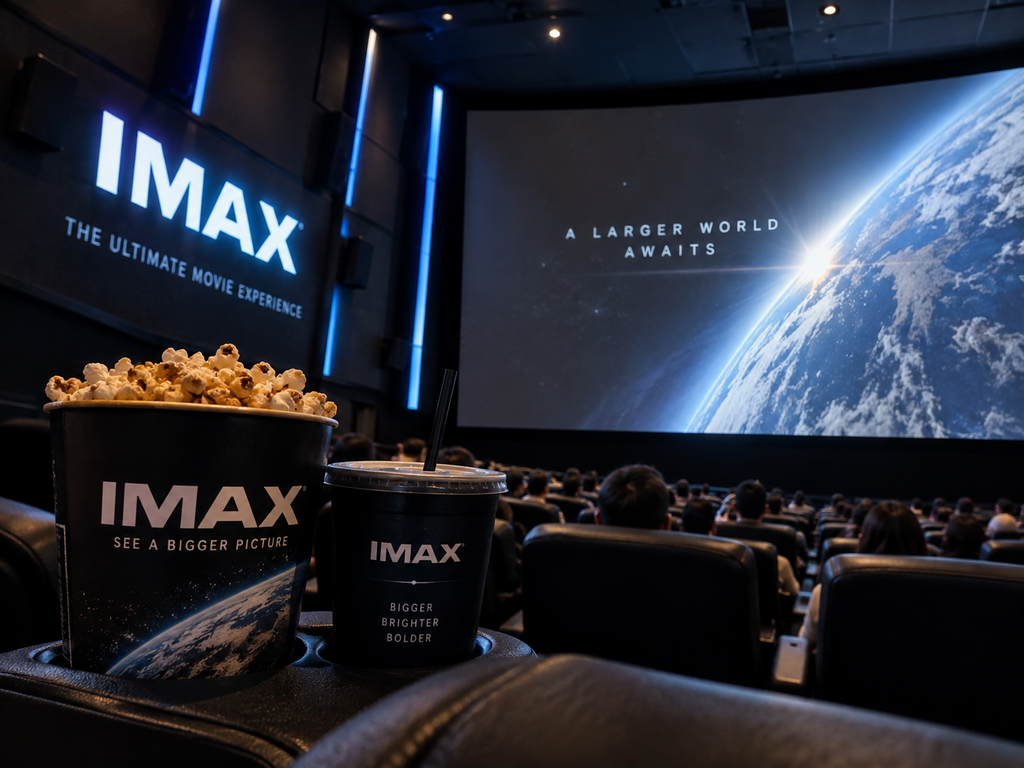
IMAX was built around a simple problem: how do you make an image huge without making it fall apart?
When IMAX was founded in 1967, filmmakers and engineers were experimenting with ways to make cinema more immersive.
A conventional film image can only be enlarged so far before its limitations become easier to see. The solution developed by IMAX was not merely to build a larger screen, but to start with a much larger image.
That led to the format now known as 15/70 IMAX.
What does “15/70” actually mean?
Traditional 35mm film usually moves vertically through a camera and projector. IMAX took a different approach.
For IMAX film capture, 65mm film runs horizontally through the camera. Each frame stretches across 15 perforations. Kodak describes the IMAX format as horizontally transported 65mm film with a 15-perforation frame and an image ratio of approximately 1.43:1. (kodak.com)
Projection prints use 70mm film, which is why the projection format is commonly called 15/70.
The result is an enormous film frame.
Historical IMAX documentation has described the 15/70 image area as roughly ten times larger than a conventional 35mm frame. The Science Museum Group in the United Kingdom gives a somewhat different comparison based on the specific film areas involved, but the conclusion is the same: the IMAX frame is exceptionally large. (investors.imax.com)
That physical size is one of the main reasons the image can hold so much detail when expanded onto a massive screen.
Why does IMAX film run sideways?
The horizontal movement is not a gimmick.
Running the film sideways gives each individual frame far more physical space. Instead of fitting the image into a narrow vertical strip, IMAX can use a broad section of film for every frame.
The Science Museum Group has preserved an IMAX projector from 1982 that demonstrates this design. The 70mm film travels horizontally through the machine, with each frame spanning 15 perforations. (collection.sciencemuseumgroup.org.uk)
That fundamental decision shaped the look and scale of classic IMAX.
Moving that much film required an entirely different projector
A huge frame creates another engineering problem: moving the film fast enough for normal cinema projection.
IMAX developed a system known as the rolling loop.
Instead of treating the film exactly like a conventional projector would, the mechanism forms controlled loops as the film moves through the machine. Each frame is positioned precisely in front of the projection aperture, where vacuum helps hold it stable during exposure.
According to the Science Museum Group, the preserved 1982 IMAX projector moved film at roughly 1.7 meters per second and weighed about 900 kilograms. (collection.sciencemuseumgroup.org.uk)
This is why photographs of IMAX 70mm projection booths often show enormous platters filled with film. These are not ordinary movie reels that can simply be lifted and swapped by hand.
Does IMAX film really have “18K resolution”?
This is one of the most repeated claims about the format.
IMAX itself has used language suggesting that 70mm IMAX film can deliver the equivalent of up to about 18K in captured image information. (investors.imax.com)
But that comparison needs context.
Film does not contain pixels.
So it is not technically accurate to describe an IMAX film frame as having a fixed digital resolution in the same way a digital sensor or video file does.
The visible detail depends on many factors, including the film stock, lens quality, focus, exposure, processing, print generation and projection conditions.
It is therefore better to treat “18K” as an approximate comparison rather than a literal native resolution.
The real advantage comes from the enormous physical area of the film frame.
So what changed with digital IMAX?
For decades, IMAX was closely associated with physical film.
That began to change in 2008, when the company introduced its digital Xenon projection system. IMAX corporate documents note that before this transition, the commercial systems it offered were film-based and required analog prints. (investors.imax.com)
Digital projection dramatically changed the economics of the format.
A 70mm IMAX print is expensive to manufacture, ship, handle and maintain. The projector itself requires significant space and specialized operation.
Digital distribution removes the physical print entirely.
That made it possible for IMAX to expand into far more multiplexes around the world.
The important point is that digital IMAX is still genuine IMAX. It is simply a different generation of the system.
Xenon IMAX and IMAX with Laser are not the same thing
Even the phrase “digital IMAX” covers more than one type of technology.
The major expansion into multiplexes began with digital Xenon systems. Later, IMAX introduced its IMAX with Laser platforms.
According to IMAX, laser systems offer improved brightness, stronger contrast, deeper blacks and a wider color range compared with older digital projection technologies. The company has also stated that it no longer sells new Xenon systems, although existing installations continue to operate. (investors.imax.com)
That means two theaters can both advertise IMAX while using noticeably different projection systems.
For viewers, that difference can affect contrast, brightness and overall image quality.
The aspect ratio may matter more than the resolution
One of the most obvious differences between a standard cinema presentation and IMAX is not necessarily sharpness.
It is the shape of the image.
Many modern movies are shown in a very wide format such as 2.39:1.
Classic IMAX, by contrast, can use an aspect ratio of 1.43:1, creating a much taller image.
When a movie has been composed and prepared for that format, the viewer is not simply seeing the same image enlarged.
There can be substantially more picture visible above and below the conventional widescreen frame.
This is why some IMAX sequences appear to “open up” vertically.
1.43:1 and 1.90:1 are very different experiences
Not every IMAX theater can display the full classic IMAX frame.
The traditional 15/70 film format uses a ratio of approximately 1.43:1, as Kodak notes in its technical material. (kodak.com)
Many modern digital IMAX screens, however, use a ratio closer to 1.90:1.
That still allows a taller image than conventional widescreen cinema, but it does not reveal as much vertical information as the full 1.43:1 presentation.
A good example is Oppenheimer. IMAX explained that in theaters equipped for 15-perf/70mm presentation, scenes photographed with IMAX cameras could expand to the full 1.43:1 frame. (imax.com)
As a result, two people can both say they saw the same movie “in IMAX” while actually having seen different amounts of the original image.
“Filmed for IMAX” does not always mean IMAX film
Another source of confusion is the phrase “Filmed for IMAX.”
It does not automatically mean that the movie was shot on 65mm IMAX film.
Modern productions can use digital cameras that are certified for IMAX workflows and can be planned specifically around expanded IMAX framing.
A movie may therefore be designed for IMAX presentation, contain expanded imagery and carry the “Filmed for IMAX” label without using physical IMAX film at all.
That is different from a movie described as being shot with IMAX film cameras.
The distinction is important because the production process is different even if the final theater experience can still be highly immersive.
What is IMAX DMR?
IMAX can also present movies that were not originally shot with IMAX cameras.
For that, the company uses a process known as DMR, or Digital Re-Mastering.
The technology began appearing in major Hollywood releases in the early 2000s. Apollo 13: The IMAX Experience became an important early example, followed by films such as The Matrix Reloaded and The Matrix Revolutions. (imax.com)
The process prepares image and sound specifically for IMAX presentation.
So IMAX is not just a camera format or a projector format. It can also describe a post-production and presentation workflow.
The sound system is a major part of the experience
Discussions about IMAX usually focus on the screen.
But audio has always been an important part of the format.
Modern IMAX installations can use carefully calibrated multichannel sound systems designed around the geometry of the room.
This is why IMAX is not simply a case of putting a powerful projector in front of a large screen.
The room itself matters.
Screen size, viewing angles, speaker placement, audio calibration and projection technology all contribute to the final result.
Why did IMAX film survive the digital transition?
Once the cinema industry moved overwhelmingly toward digital projection, it would have been reasonable to expect 15/70 IMAX film to disappear.
It did not.
A small group of filmmakers continued to work with the format, with Christopher Nolan playing a particularly visible role.
Movies including The Dark Knight, Interstellar, Dunkirk and Oppenheimer helped keep public interest in IMAX film alive.
Their success also gave theaters a reason to preserve or reactivate 70mm IMAX projection systems.
“The Odyssey” marked another major milestone
In 2026, Christopher Nolan’s The Odyssey became the first theatrical feature photographed entirely with IMAX film cameras, according to IMAX. (investors.imax.com)
For the production, IMAX also developed newer camera technology and engineering improvements intended to make large-format film capture more practical.
The company later reported that roughly 2.1 million feet of IMAX film had been used during production. (investors.imax.com)
That makes the continued relevance of the format especially interesting.
Cinema distribution is now overwhelmingly digital, yet one of the industry’s most prestigious presentation formats still relies on physical film moving mechanically through a projector.
Is 70mm IMAX automatically better than IMAX Laser?
Not necessarily.
It is tempting to turn the comparison into a simple analog-versus-digital debate, but the reality is more complicated.
IMAX 70mm offers the enormous photographic frame, the texture of film and the possibility of a direct analog presentation for movies designed around that format.
IMAX Laser offers extremely stable digital projection, strong brightness, high contrast and consistent performance from screening to screening.
There is also no physical print wear.
Some IMAX Laser theaters are capable of displaying the full 1.43:1 image as well. IMAX maintains separate information about theaters equipped for 70mm film and laser systems capable of expanded ratios. (imax.com)
The best format therefore depends partly on how the movie itself was made.
A digitally photographed movie mastered specifically for laser projection may look exceptional in that environment.
The better question is not simply “film or digital?”
It is:
How was the movie photographed, and what presentation format was it designed for?
How to find out what kind of IMAX you are actually buying
If you want to know what your ticket really includes, there are several useful details to check before booking.
First, look at the projection system.
If the theater specifically advertises IMAX with Laser, it is using a modern digital laser setup. If a screening is listed as IMAX 70mm Film, the movie is being projected from an actual physical film print.
Next, check the theater’s maximum aspect ratio.
A screen capable of 1.43:1 can display the full classic IMAX frame when the movie contains it. A 1.90:1 screen may still show more image than a conventional widescreen presentation, but it cannot reproduce the full 1.43:1 composition.
It is also worth checking how the film was produced.
“Filmed for IMAX” may refer to a digital IMAX-certified production workflow, while wording such as “shot with IMAX film cameras” indicates actual large-format film capture.
Finally, check whether the expanded IMAX ratio is used throughout the movie or only in selected sequences.
These details explain why the IMAX logo alone does not always tell the whole story.
Two IMAX tickets can represent very different experiences
Imagine three theaters.
All three sell tickets labeled IMAX.
The first uses an older Xenon digital system and a 1.90:1 screen.
The second uses modern laser projection and can display 1.43:1 imagery.
The third is one of the rare venues equipped with a 15/70 film projector and is showing a physical 70mm IMAX print.
All three are IMAX theaters.
But the experience is clearly not identical.
That may be the single most useful thing for moviegoers to understand.
IMAX is not one universal specification that looks exactly the same everywhere.
IMAX has never been only about a big screen
The most persistent misconception about IMAX is that it simply means an oversized movie screen.
Its history tells a much more interesting story.
The format began as an engineering solution to a difficult question: how can a cinema image become enormous without losing the detail, stability and visual impact needed to sustain the illusion?
The original answer involved an unusually large photographic frame, 70mm film moving sideways through a projector, 15 perforations for every image and projection machinery built specifically for the task.
More than half a century later, the technology now includes digital laser systems, certified cameras, specialized remastering and sophisticated audio.
The tools have changed dramatically.
The core idea has not.
An IMAX image is not supposed to feel like a normal movie projected onto a slightly larger wall.
At its best, the format is designed to fill enough of the viewer’s field of vision that the edges of the screen begin to matter less.
That may be the most accurate way to understand IMAX: not simply as a projection format, but as an attempt to make the boundaries of the screen disappear.