
Every March 17, the world turns green.
Parades fill city streets, shamrocks appear on everything from hats to storefronts, and an ancient story is repeated once again: Saint Patrick drove the snakes out of Ireland.
The legend is memorable. The documented story behind the man is arguably more remarkable.
Roughly sixteen centuries ago, a teenager living in Britain was captured and taken across the sea to Ireland. For six years, he lived in captivity and worked tending animals. Eventually, he escaped, survived a difficult journey and made his way back to his family.
For most people, that would have been the end of Ireland forever.
For Patrick, it wasn’t.
Years later, he chose to return to the country where he had once been enslaved.
And unusually for a figure from this distant period, we don’t have to rely entirely on stories written centuries after his death. Patrick left an account of his own experiences in a Latin work known as the Confessio.
One of the oldest surviving copies of that text can still be seen today.
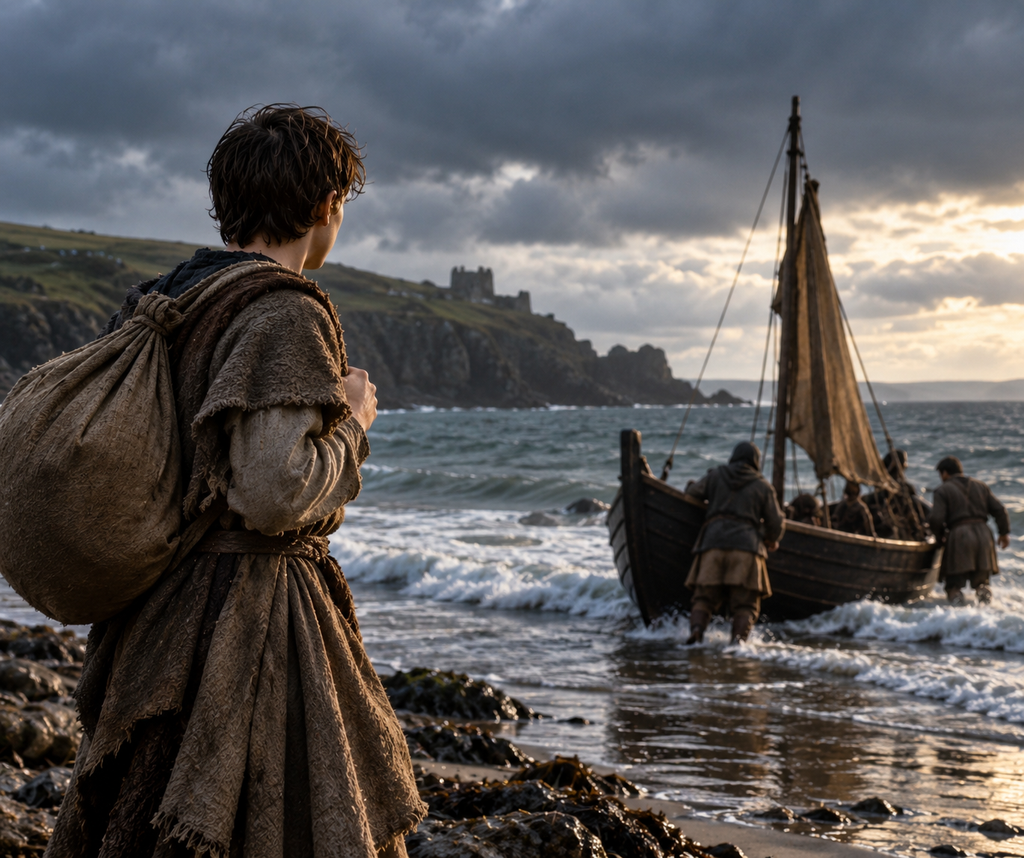
Before the saint, there was a frightened teenager
Patrick’s own introduction tells us something about the world into which he was born.
His father, Calpornius, was a deacon, while his grandfather Potitus had been a priest. Patrick identifies the family’s home as a place called Bannavem Taburniae. Historians have never been able to establish its precise location, although Patrick clearly places his origins in Britain.
Then his life changed abruptly.
Patrick says he was about 16 when he was taken captive and carried off to Ireland along with thousands of other people.
Later retellings often describe Irish raiders storming his family home and kidnapping him. Raiding and slave-taking certainly fit the historical world in which Patrick lived, but there is an important distinction between historical context and Patrick’s actual testimony: he does not provide us with a detailed account of the raid itself.
What he does tell us is devastating enough.
He was still a teenager when he lost his freedom and was transported to Ireland.
Captivity transformed him
In Ireland, Patrick spent years looking after animals, frequently alone and exposed to the elements.
His Confessio describes this period not simply as one of hardship but as the beginning of a profound religious transformation.
Patrick had grown up in a Christian family, yet he presents his younger self as someone whose faith had not meant very much to him. Captivity changed that.
Prayer gradually became central to his life.
He recalls praying as many as a hundred times during the day and nearly as often at night. He describes getting up before dawn and praying outdoors in forests and on mountains, through rain, frost and snow.
The significance of those details is easy to overlook.
They were not invented by a medieval biographer trying to make Patrick appear more saintly. They come from the way Patrick himself chose to remember and describe those years.
The place where he had lost almost everything became, in his telling, the place where his faith became his own.
Then came the message: his ship was waiting
After approximately six years, Patrick says something extraordinary happened.
While sleeping, he heard a voice telling him that he would soon return to his homeland. Later came another message telling him that his ship was ready.
Freedom, however, was nowhere nearby.
Patrick estimated that the ship was about 200 miles away.
He fled from the man he had been serving and set out toward the coast, traveling through unfamiliar territory. In his account, he emphasizes that he had never been to the destination before and knew no one there.
Eventually, he found a ship.
But the man in charge initially refused to take him.
Patrick walked away and began praying. Before he had even finished, members of the crew called him back.
He boarded.
Escape did not immediately mean safety. Patrick’s account goes on to describe a difficult journey and further hardship before he eventually found his way back to the people he had left years earlier.
His family wanted him to stay
Imagine the reunion from his family’s perspective.
A son who had disappeared as a teenager had somehow survived years of captivity and returned home.
Patrick says his relatives welcomed him and pleaded with him not to leave them again.
At this point, his story could have ended almost perfectly.
He had survived.
He had escaped.
He was home.
Then Patrick describes a dream.
A letter called “The Voice of the Irish”
In the dream, a man Patrick identifies as Victoricus appeared carrying letters from Ireland.
Patrick took one and began reading.
He associates it with the words The Voice of the Irish.
As he read, Patrick says he seemed to hear people in Ireland calling to him, asking him to come and walk among them once more. He describes being so emotionally overwhelmed that he could read no further.
A historian cannot independently verify a dream or determine precisely what Patrick experienced internally.
But we can distinguish the historical claim from the spiritual one: Patrick himself reports the experience, and he understood it as a call to return to Ireland.
The country he had once desperately tried to escape was pulling him back.
Eventually, he went.
The former captive returned as a missionary
After religious preparation, Patrick returned to Ireland as a Christian missionary and bishop.
His Confessio describes his work among the Irish, including baptisms and conversions, as well as the dangers he associated with his mission.
Yet another surviving work gives us an especially revealing glimpse of Patrick.
Known as the Epistola, or the Letter to the Soldiers of Coroticus, it was written after followers of a British leader named Coroticus attacked Irish Christians who had recently been baptized.
Some were killed. Others were captured and enslaved.
Patrick’s response was fierce. He condemned the attackers and called for the captives to be released.
The parallel with his own life is difficult to miss.
The teenager who had once been carried away as a captive was now speaking on behalf of other people who had been captured and sold into slavery.
The dates are not as certain as popular history suggests
Modern summaries of Patrick’s life often provide remarkably precise dates.
The year 432 is frequently given for his mission in Ireland, while 461 is traditionally associated with his death.
The historical evidence does not allow that degree of certainty.
Patrick is generally placed in the fifth century, but scholars continue to debate the chronology of his life. The precise years associated with many events in popular accounts should therefore be treated as traditional dates rather than firmly established facts.
That includes March 17.
It became Patrick’s traditional feast day and is regarded as the traditional date of his death. We do not possess contemporary evidence establishing March 17 as his exact date of death.
That distinction matters, particularly when a story that has been retold for more than a millennium is presented as straightforward biography.
A manuscript more than 1,200 years old preserves his story
There is another remarkable physical connection to Patrick’s story.
The Book of Armagh survives.
Today it is preserved at Trinity College Dublin as MS 52. The manuscript was produced in the early ninth century, around 807–808, with much of the work attributed to a scribe named Ferdomnach of Armagh.
Among its contents is the oldest known surviving copy of Patrick’s Confessio.
That sounds almost like a direct physical link to Patrick himself, but an important correction is necessary.
The Book of Armagh is not Patrick’s original manuscript.
It was created centuries after his lifetime.
No page preserved there can simply be described as Patrick’s own handwriting. What survives is something different but still extraordinary: a medieval copy transmitting a text attributed to him across more than a thousand years.
There is another complication.
The version of the Confessio preserved in the Book of Armagh is not complete. Portions of the text were omitted, and scholars can compare it with later manuscript witnesses to reconstruct and study the textual tradition.
Patrick’s other authentic surviving work, the Epistola, was not included in the Book of Armagh.
So when a photograph of the manuscript circulates online with the suggestion that we are looking at “Patrick’s words,” that statement needs qualification.
We are looking at an extraordinarily old copy of those words — not the pages Patrick personally wrote.
What about the snakes?
This is where the historical Patrick and the legendary Patrick begin to separate dramatically.
Nothing in Patrick’s own surviving writings says that he drove snakes from Ireland.
There is also a major natural-history problem with taking the story literally: Ireland has no native snake populations, and the explanation is geological and ecological rather than miraculous. Following the last Ice Age, Ireland’s geography and isolation prevented snakes from naturally recolonizing the island.
The famous snake story appears in traditions written long after Patrick’s lifetime.
It has sometimes been interpreted symbolically, with the snakes representing evil or pre-Christian beliefs. But that is a later interpretation, not an explanation Patrick gives us himself.
The Patrick who emerges from his own writings never mentions the episode.
And the famous shamrock?
The shamrock is now almost inseparable from Saint Patrick.
According to one familiar story, he used its three leaves to explain the Christian doctrine of the Trinity: Father, Son and Holy Spirit, distinct yet united in one God.
It is a powerful teaching image.
There is just no good historical evidence that Patrick actually used it.
The episode does not appear in his surviving writings, and the documented visual association between Patrick and the shamrock emerges much later.
That doesn’t make the shamrock meaningless. Centuries of tradition can give a symbol genuine cultural importance.
It simply means that we should distinguish between the historical Patrick available to us through early evidence and the Patrick created through more than a millennium of storytelling, religious tradition and art.
The man behind March 17 may be more interesting than the legend
Sixteen centuries of tradition have transformed Patrick into something larger than one human life.
There are snakes and shamrocks, green rivers and enormous parades. His name has become inseparable from Ireland even though he was born elsewhere, and March 17 is recognized far beyond the country where he spent the defining years of his life.
Strip all of that away, however, and the surviving story does not become less compelling.
A boy of about 16 says he was captured and taken across the sea.
He spent six years in captivity.
He escaped and made an extraordinary journey toward freedom.
He eventually returned to his family, who begged him not to leave again.
And then, after everything Ireland had represented in his youth, he chose to go back.
We cannot independently verify every autobiographical detail Patrick records, and his Confessio should not be mistaken for a modern, neutral biography. It is a deeply personal religious testimony written for purposes of its own.
That limitation is precisely why separating Patrick’s testimony from later tradition matters.
Once we do, something unusual remains.
For a man who lived roughly a millennium and a half ago, Patrick is not known to us only through people who wrote about him generations later. Through manuscripts preserving his works, we can still encounter the story he chose to tell about himself.
Long before the parades, the green clothes and the shamrocks, there was a captive teenager whose greatest hope was to get home.
He did.
And then, years later, he went back.