
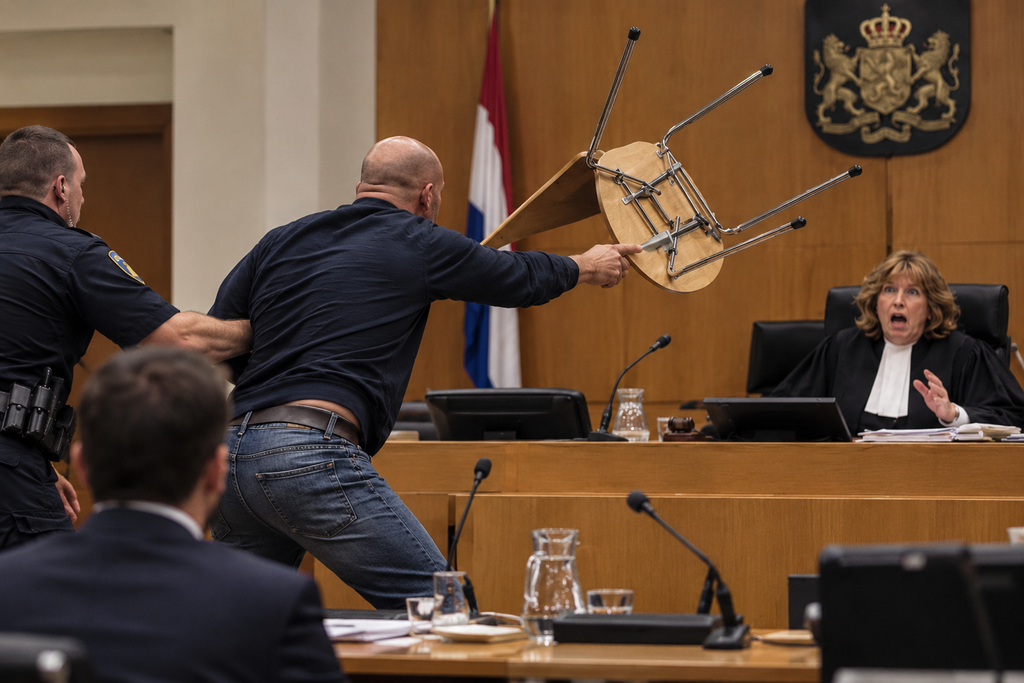
A courtroom video has circulated online with a caption designed to provoke an immediate reaction: a grieving father throws a chair toward a judge after the driver responsible for a crash that killed his two-year-old daughter receives just 120 hours of community service.
The scene is real. The child died. Her grandparents died with her. The father did throw the chair. And the first court really did impose 120 hours of community service.
But there is a major problem with the story as it is usually shared online.
That was not the final outcome of the case.
The full story unfolded over several years, involved two courts reaching different conclusions about crucial evidence, and eventually resulted in a prison sentence.
Understanding why requires going back to a road in the Dutch province of Limburg in 2013.
A family lost three people in a single crash
On May 19, 2013, a 33-year-old Polish driver lost control of his car on Heldensedijk, near the Dutch town of Meijel.
The vehicle became unstable, left the roadway and entered a bicycle path.
A 67-year-old man and his 64-year-old wife were there with their two-year-old granddaughter, Ize. The little girl was riding in a child seat attached to a bicycle.
All three were killed.
For Ize’s parents, the crash meant losing their daughter and two of her grandparents on the same day.
Yet a criminal court could not decide the driver’s guilt simply by looking at the devastating result. Judges had to determine what had happened in the seconds before the collision and, crucially, whether prosecutors could prove the level of culpability required for the more serious traffic offense. Dutch judiciary’s explanation of the original Meijel ruling
Investigators found no alcohol, drugs or phone use
The investigation did not find evidence that the driver had been under the influence of alcohol or drugs. Nor was there evidence that he had been using his phone when the crash occurred.
The driver had suggested that a technical problem with the vehicle might explain why he lost control, but an examination of the car did not establish a defect that could account for the accident.
That left investigators with another critical question: speed.
Prosecutors argued that the car had been traveling at more than 120 km/h on a road where the limit was 80 km/h.
If that could be proved, it would provide important evidence that the crash resulted not merely from a driving error, but from conduct serious enough to support the more severe criminal charge.
Prosecutors initially sought a 15-month prison sentence.
Then the technical evidence complicated the case.
The speed estimate had an enormous range
According to the Limburg District Court’s own explanation of its decision, experts could not establish one precise speed for the car.
The estimated speed as the vehicle moved toward the bicycle path ranged from approximately 76 to 124 km/h.
The speed limit was 80 km/h.
Tests involving a comparable vehicle also indicated that the curve itself could be negotiated at around 130 km/h without the car necessarily becoming uncontrollable.
That created a serious evidentiary problem.
A range beginning below the legal limit and extending far above it could not, in the first court’s assessment, establish with sufficient certainty that excessive speed had caused the driver to lose control.
And that distinction would determine the sentence.
Three deaths did not automatically prove the more serious offense
This is the part that disappears almost completely when the case is compressed into a viral caption.
Dutch prosecutors pursued a more serious charge under Article 6 of the Netherlands’ Road Traffic Act, which concerns traffic accidents involving a legally significant degree of culpability.
There was also a lesser alternative under Article 5 concerning conduct that creates danger on the road.
The existence of three fatalities did not, by itself, establish the elements required for the more serious offense.
The prosecution still had to prove the driver’s conduct and the necessary degree of culpability.
That distinction can feel deeply unsatisfying when the consequences are catastrophic. But it reflects an important principle of criminal law: a terrible outcome does not, on its own, prove how blameworthy the conduct that produced it was.
The first court concluded that the evidence did not establish the more serious charge to the required standard.
Then came the 120-hour sentence
On November 21, 2014, the Limburg District Court acquitted the driver of the more serious traffic offense but convicted him of the lesser offense of creating danger on the road.
He received 120 hours of community service, along with a one-year suspended driving ban subject to a two-year probationary period.
The court also noted that he did not have a criminal record in the Netherlands, Poland or Germany.
For a court, those details were part of sentencing law.
For the parents sitting in the courtroom, there was another reality: their two-year-old daughter was dead.
The girl’s father picked up a chair
After the sentence was announced, Ize’s father, Erik Derijks, grabbed a chair and threw it in the direction of the judge.
It fell before reaching her, and Derijks was removed from the courtroom.
The moment was captured on camera.
It became the image through which millions of people would eventually encounter a complicated criminal case.
Derijks later said he was not proud of what he had done and had not intended to hit anyone. He described essentially losing control after hearing the sentence.
The video had everything social media favors: grief, anger, an apparently astonishing punishment and a dramatic reaction captured in seconds.
But the legal proceedings were not over.
Prosecutors appealed — and the evidence was reconsidered
The prosecution challenged the ruling, bringing the case before the Court of Appeal in ’s-Hertogenbosch.
Further investigation followed. Experts were questioned, and witness accounts concerning the car’s speed before the crash were considered alongside the other evidence.
This time, the judges reached a different conclusion.
The appeals court found that the vehicle had been traveling above the 80 km/h speed limit. Witnesses had also described the car as moving at a very high speed.
Taken together, the evidence persuaded the appeals court that the driver’s conduct was sufficiently careless to satisfy the requirements of the more serious offense.
The legal picture had changed dramatically.
The 120 hours became 15 months in prison
On September 23, 2015, the Court of Appeal imposed a new sentence:
15 months in prison and a four-year driving ban.
The punishment was actually more severe than what prosecutors had requested at the appeal stage: 12 months in prison and a three-year driving ban.
The court referred to the seriousness of the driver’s conduct and the irreversible suffering caused to the victims’ family. Court of Appeal summary of the 2015 judgment
The driver subsequently attempted to challenge the decision before the Supreme Court of the Netherlands. That effort did not overturn the conviction, and the prison sentence ultimately became final.
But there was another chapter.
Authorities later found him in England
Once the sentence became final, Dutch authorities still had to ensure that it was served.
FASTNL, the Dutch team responsible for tracing convicted fugitives, worked with British authorities to locate him.
On August 14, 2016, British police found the man at a residence in the Thames Valley area west of London. According to the Dutch Public Prosecution Service, he was working in Britain as a seasonal worker.
He was arrested and transferred to the Netherlands on August 23.
After credit for 11 days he had already spent in custody shortly after the crash, authorities said he still had 439 days to serve. Dutch Public Prosecution Service account of his extradition
That is a very different ending from the one suggested by a viral image accompanied only by the words “120 hours of community service.”
Why the viral caption is so effective
The most interesting thing about this story is that the viral version does not need to fabricate the central scene.
A father really did lose his daughter.
He really did throw a chair toward a judge.
A driver involved in a crash that killed three people really was sentenced to 120 hours of community service.
Those facts are powerful precisely because they are true.
What changes their meaning is what gets left out.
Calling the driver simply the child’s “killer,” for example, can give readers the impression that someone convicted of deliberately killing a child received 120 hours of community service. This was a fatal traffic case centered on the degree of criminal culpability that prosecutors could prove.
More importantly, the 120-hour sentence was the decision of the first court.
It was not the final sentence.
The appeals court later imposed 15 months in prison and a four-year driving ban.
How could two courts reach such different conclusions?
Nothing about the human cost of the crash changed between the two trials.
Three people were still dead.
The same man had been driving.
The collision had happened on the same road.
What changed was the courts’ assessment of the evidence concerning his behavior before the crash.
The first court found that the technical speed estimate was too broad to establish the more serious offense with sufficient certainty.
The appeals court, after further investigation and consideration of expert and witness evidence, concluded that speeding and the required degree of culpability had been established.
That difference transformed the legal outcome from community service to imprisonment.
It also illustrates something easily lost in discussions of criminal cases: courts do not determine culpability by asking only how terrible the consequences were. They must determine what conduct can actually be proved.
The law can explain a sentence. It cannot undo a family’s loss
There is an uncomfortable tension at the center of cases like this one.
Criminal justice systems distinguish between intention, serious negligence and lesser forms of dangerous conduct because those distinctions matter. Two accidents with equally tragic consequences do not necessarily involve the same degree of criminal responsibility.
For a grieving family, however, legal categories cannot make a child come home.
That helps explain why the courtroom footage remains so emotionally powerful years later. We are watching two different ways of understanding the same event collide in a few seconds: the legal system’s demand for proof and a parent’s experience of irreversible loss.
The Dutch judiciary itself published explanatory material following controversy over the original ruling, discussing why fatal traffic accidents are not automatically punished in the same way as intentional killings. Dutch judiciary explanation of sentencing in fatal traffic cases
A true photograph can still tell an incomplete story
The viral image captures a real moment from November 2014.
What it cannot show is everything that happened around it.
It does not show the disputed speed calculations. It does not explain the distinction between the two traffic offenses. It does not show the prosecution’s appeal. It does not show the 15-month prison sentence imposed the following year. And it certainly does not show British police locating the convicted driver in 2016 so that the sentence could be enforced.
That is what makes this case a useful lesson in how misinformation works online.
False stories are not always built from fake photographs or invented events.
Sometimes every individual fact in front of us can be genuine while the conclusion we draw from them is badly distorted.
All that is required is to stop telling the story at exactly the right moment.
The viral version ends with 120 hours of community service.
The real case did not.