
Some photographs look so improbable that our first instinct is to search for the trick.
A huge Moon dominates the sky. A distant mountain peak cuts into its glowing disk. Far below, an illuminated basilica seems to sit on exactly the same line. The proportions look almost too perfect to have occurred naturally.
Yet the celebrated photograph by Italian photographer Valerio Minato was not created by taking a separate picture of the Moon, enlarging it and placing it behind the landscape.
NASA describes the image as a “single shot”, capturing the Basilica di Superga, the Alpine peak of Monviso and the Moon in one extraordinary alignment.
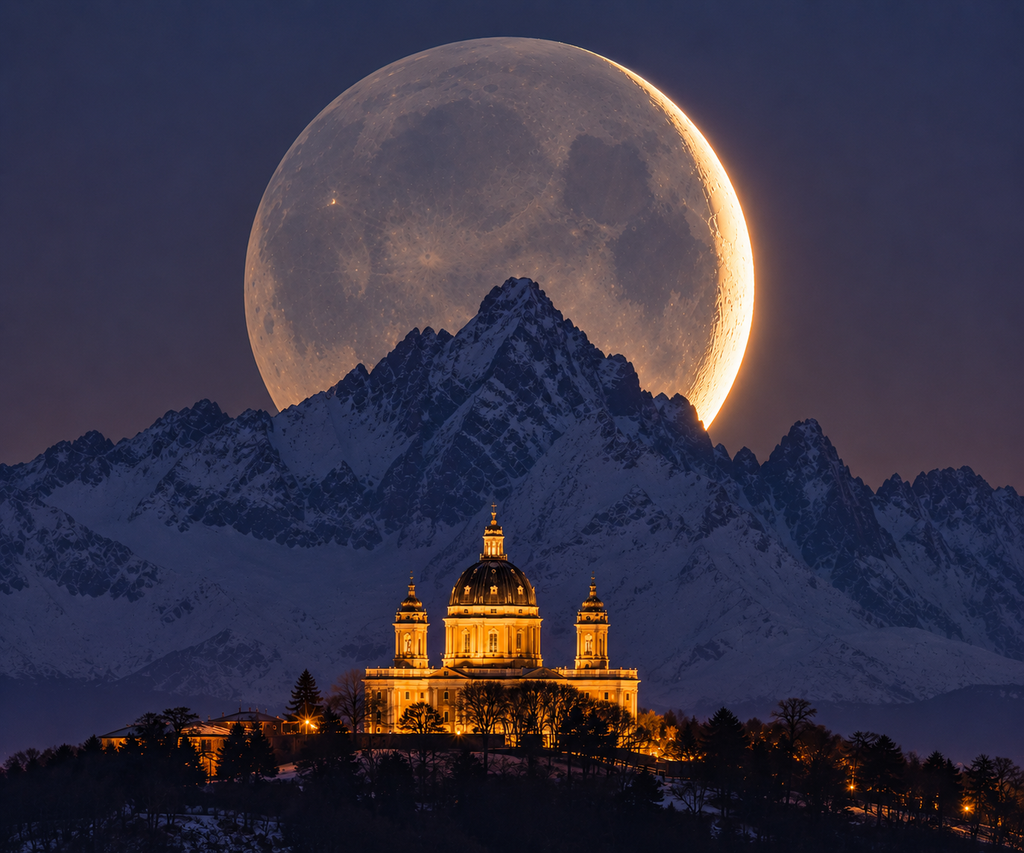
Illustrative image generated with the assistance of artificial intelligence. This article discusses the original photograph by Italian photographer Valerio Minato. The original image, selected by NASA as Astronomy Picture of the Day on December 25, 2023, can be viewed on NASA’s website.
View the original “Cathedral, Mountain, Moon” photograph on NASA APOD
The photograph really began years before the shutter clicked
Minato did not simply happen upon this scene while carrying a camera.
The idea had been developing since 2017. To create the composition he envisioned, three objects separated by enormous distances had to appear along almost the same line from one carefully chosen location: the Basilica di Superga, Monviso and the Moon.
Having the Moon rise somewhere behind the mountain was not enough.
The photographer also needed Superga and Monviso to appear sufficiently close together from his position. Minato had previously managed an alignment involving a full Moon, but from a higher viewpoint the basilica and mountain appeared too far apart for the composition he wanted.
Changing his position changed their apparent relationship.
That meant finding a lower and far more precise observation point, then waiting for the Moon to arrive in exactly the right part of the sky.
Years of calculations, scouting and missed opportunities followed. NASA notes that weather interfered with five attempts over a period of six years.
Then, on December 15, 2023, at 6:52 p.m., the geometry and the weather finally cooperated.
Ten days later, NASA featured the photograph as its Astronomy Picture of the Day.
Was the Moon really that enormous?
This is where the photograph becomes a fascinating lesson in perspective.
The Moon does not suddenly become several times larger when it approaches the horizon. Its angular diameter in our sky is roughly half a degree, varying somewhat because the Moon’s distance from Earth changes during its orbit.
The average Earth-Moon distance is about 384,400 kilometers (238,900 miles).
If a photographer moves a few kilometers forward or backward on Earth, that movement is essentially insignificant compared with the distance to the Moon. Its apparent size barely changes.
A terrestrial object behaves very differently.
Move farther away from a building and it quickly occupies a smaller angle in your field of view. The same principle applies to mountains, although their much greater size and distance change the scale involved.
That difference is central to understanding Minato’s photograph.
A simple thought experiment explains the effect
Imagine someone standing three meters in front of you with the Moon behind them.
The person occupies a large portion of your field of view. Compared with them, the Moon looks relatively small.
Now imagine that person moving hundreds of meters away.
They become tiny.
The Moon, nearly 384,400 kilometers away, remains almost exactly the same apparent size.
Suddenly, the Moon looks enormous relative to the person.
The same geometric principle can produce dramatic relationships between the Moon and terrestrial landmarks.
The trick is not to make the Moon bigger.
It is to find a position from which the objects on Earth occupy the right apparent size.
What if the photographer had moved closer?
It sounds counterintuitive, but getting closer to the foreground landmark would not have made the Moon look even more spectacular relative to it.
It would have weakened the effect.
Move substantially closer to the basilica and the building becomes larger in the frame relative to the Moon. Changing the observer’s position relative to the mountain also changes its apparent dimensions and, crucially, the alignment between the different layers of the landscape.
The Moon barely notices a movement of a few kilometers.
The terrestrial scene does.
This is why the photographer’s location matters so much. The extraordinary proportions are not created simply by pointing a powerful lens at the Moon. They begin with geometry.
So what did the 500 mm lens actually do?
The photograph was taken with a 500 mm telephoto lens, using settings reported as ISO 1600, f/4.5 and an exposure of approximately 0.6 seconds.
This is where another common misunderstanding appears.
A telephoto lens does not selectively enlarge the Moon while leaving the mountain and basilica untouched.
It provides a narrow field of view.
Instead of capturing a vast landscape with a small Moon somewhere inside it, the photographer can fill the image with a tiny portion of the distant scene. The Moon, mountain and basilica are all magnified within that narrow view.
The perspective itself, however, is primarily determined by where the camera is positioned.
Consider another experiment.
Suppose a photograph were taken from exactly the same position with a much wider lens and an extraordinarily high-resolution camera. The resulting image would show far more of the surrounding landscape.
Now crop that enormous photograph down to precisely the area containing the basilica, Monviso and the Moon.
Their geometric relationship would remain the same.
A long telephoto lens allows the photographer to capture that narrow field directly and with far more useful detail.
Why wouldn’t it look like this to someone standing there?
Because human vision experiences the scene in a much broader context.
Standing outdoors, you would perceive an expansive sky and landscape. Trees, hills, buildings and other visual references would surround the Moon.
The telephoto photograph removes almost all of that context.
The frame contains essentially three dominant elements: architecture, mountain and Moon.
Once the surrounding landscape disappears, the lunar disk becomes visually overwhelming.
The result can look almost artificial even though the alignment itself is real.
This isn’t simply the famous “Moon illusion”
There is another phenomenon that can complicate the discussion.
Most people have experienced the Moon illusion: a Moon close to the horizon often seems larger than the same Moon high in the sky.
NASA explains that photographs taken with the same focal length show that the Moon’s horizontal angular size remains essentially unchanged.
The atmosphere can produce a different effect very close to the horizon. Atmospheric refraction can slightly compress the lunar disk vertically, sometimes making it look flattened.
Neither phenomenon accounts for the enormous-looking Moon in Minato’s composition.
The dramatic scale comes primarily from viewpoint, relative angular sizes and tight telephoto framing.
There’s another beautiful detail: it wasn’t a full Moon
At first glance, the lunar disk can look almost complete.
It wasn’t.
Only part of the Moon was directly illuminated by the Sun. Much of the darker portion remained faintly visible because of a phenomenon known as Earthshine, sometimes called the “da Vinci glow.”
The process is remarkable.
Sunlight strikes Earth. Some of that light is reflected toward the Moon, faintly illuminating the part of the lunar surface that is experiencing night. A small fraction of that reflected light then travels back toward Earth and reaches our eyes — or, in this case, the camera.
So the ghostly surface visible beyond the bright crescent is being illuminated partly by sunlight reflected from our own planet.
The relatively long exposure helped reveal that faint lunar surface while the directly illuminated crescent remained dramatically brighter.
Why couldn’t he simply try again the following evening?
Because the Moon does not return to precisely the same position relative to the landscape every night.
Its position against the sky changes. Its phase changes. The time at which it reaches a particular altitude and direction changes as well.
Meanwhile, the photographer’s own position and elevation determine how the terrestrial landmarks overlap.
Then there is the weather.
You can calculate the geometry perfectly, travel to exactly the right location and prepare all your equipment — only for a cloud to drift across the critical part of the sky.
That is why the often-repeated story of “six years of attempts” needs some context.
It doesn’t mean Minato spent six years photographing the same scene every evening. It means the astronomical opportunity, desired geometry and suitable weather had to coincide.
Those opportunities were limited.
How precise did the location have to be?
Very.
Move sideways and the basilica can shift away from the mountain. Change elevation and the peak may appear higher or lower relative to the architecture.
Meanwhile, the Moon continues moving across the sky.
In photography like this, pressing the shutter may be the simplest part of the process.
Much of the real work happens beforehand: determining where the camera needs to be when the sky reaches the required configuration.
Is it a photograph or a composite?
NASA explicitly describes Minato’s image as a single shot.
There are also interviews and behind-the-scenes accounts documenting the planning required to achieve the alignment.
That does not mean a photograph reproduces human vision exactly. Lens choice, exposure, framing and camera settings inevitably shape how a scene is presented.
But there is an important difference between photographing a real alignment with a telephoto lens and photographing the Moon separately, enlarging it and digitally placing it behind a landscape.
In Minato’s photograph, the remarkable relationship between the three subjects already existed from the chosen viewpoint.
The challenge was finding that viewpoint.
Sometimes an “impossible” photograph is really a lesson in geometry
Perhaps that is what makes this image so compelling.
At first, it seems to demonstrate how easily photography can deceive us. Look more closely, however, and it reveals something more interesting: how extraordinary the real world can appear when viewed from one very specific place.
The Moon didn’t need to be enlarged.
The mountain didn’t need to be moved.
The basilica didn’t need to be added afterward.
What had to be found was the exact place on Earth from which all three could briefly fall into line.
And sometimes that is all it takes to turn an ordinary landscape into a photograph that looks impossible.