
For most people, 4 a.m. is still the middle of the night. For Mordehay “Miki” Grunberger, it was part of a familiar routine.
The 71-year-old pastry chef had reportedly spent years starting his workday long before sunrise. His family later said he would wake around 3 a.m. to prepare for work, following a schedule that had become part of everyday life.
On January 16, 2026, that routine ended in tragedy.
Grunberger died after becoming caught in an industrial dough-mixing machine at South Florida Kosher Market in North Miami Beach, Florida. Police treated the incident as an accident, while federal workplace-safety authorities opened an investigation into the circumstances surrounding his death.
The case quickly spread across social media, where dramatic videos began offering detailed descriptions of exactly how the accident supposedly happened. But many of those details were never confirmed by investigators.
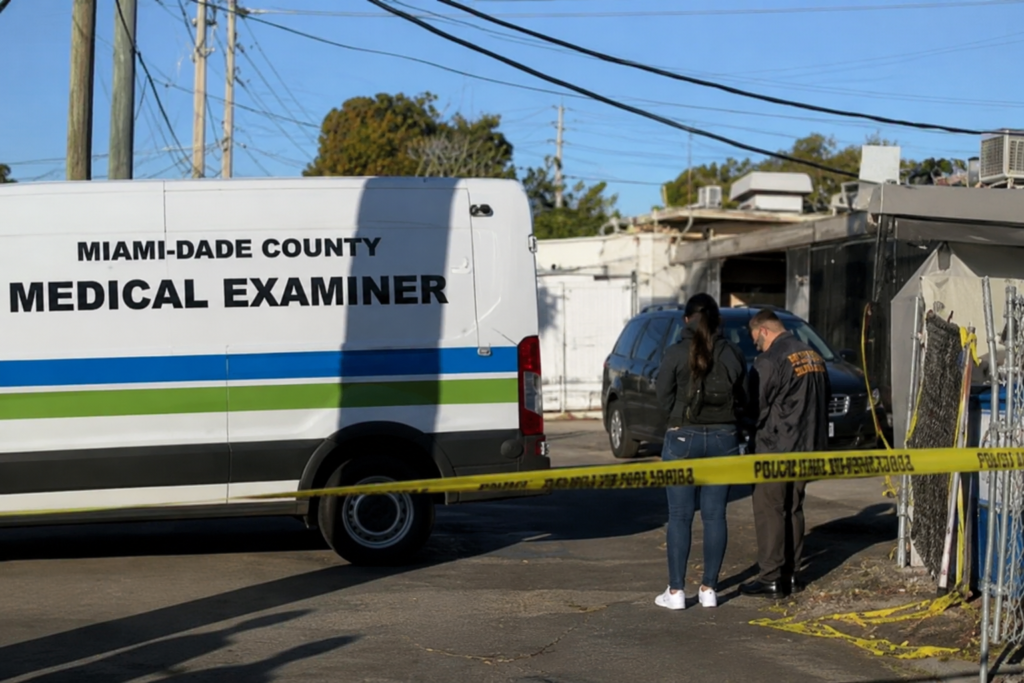
An Early-Morning Workplace Accident
Authorities responded to the South Florida Kosher Market in North Miami Beach at around 4 a.m. after receiving reports of a serious workplace incident involving industrial equipment.
Police later identified the victim as Mordehay Grunberger, a longtime employee of the store.
Investigators confirmed that he had become caught in an industrial machine used for mixing dough. No evidence initially suggested foul play, and the death was treated as accidental.
What authorities did not immediately explain was equally important.
Public reports did not establish exactly what Grunberger was doing when the incident occurred, how he came into contact with the moving equipment, or whether anyone directly witnessed the moment he became trapped.
Those unanswered questions matter because online accounts soon began presenting a much more detailed version of events than investigators themselves had released.
Social Media Filled in the Missing Details
Some widely shared posts claimed Grunberger had been preparing dough for the morning’s baked goods when the mixer suddenly pulled him inside.
Others suggested that coworkers were nearby but the accident happened too quickly for anyone to activate an emergency stop.
These claims create a vivid and disturbing picture, but they should not be treated as established facts unless investigators confirm them.
Early news reports made clear that officials had not yet publicly reconstructed the precise sequence of events.
That distinction is especially important in fatal workplace accidents. What may initially look straightforward can involve mechanical failure, missing safeguards, maintenance procedures, unexpected equipment movement, human error, or several factors acting together.
Until an investigation establishes what happened, presenting speculation as fact can distort the story and unfairly assign responsibility.
More Than a Name in a Tragic Headline
Grunberger had celebrated his 71st birthday only days before the accident.
His family described him not simply as an employee, but as a deeply loved husband, father and grandfather whose life had taken him through very different chapters.
According to relatives, he had once served in the Israeli Navy and had worked as a captain before later building a career in baking and pastry work in the United States.
He was the father of five children and grandfather of ten.
Family members remembered him as someone defined by generosity, devotion and an extraordinary work ethic. His son described him publicly in terms of love and selflessness, while his wife spoke of losing both her husband and her closest companion.
Those details give a very different perspective on the story.
A viral clip may reduce the event to a shocking industrial accident. For the people who knew him, however, January 16 marked the sudden loss of the person around whom much of their family life revolved.
Why Industrial Dough Mixers Can Be Dangerous
Commercial dough mixers are far more powerful than the appliances found in a typical home kitchen.
They are designed to move large quantities of dense, heavy dough and therefore rely on strong motors and rotating mechanical components capable of generating considerable force.
That same power can become extremely dangerous if a worker comes into contact with moving parts.
Industrial safety standards are designed to reduce these risks through physical guards, interlocking systems, emergency-stop mechanisms and strict procedures for shutting down and isolating machinery before certain maintenance or cleaning tasks are performed.
One of the most important concepts in industrial safety is controlling hazardous energy.
When a machine is being cleaned, serviced, adjusted or repaired, simply pressing the normal “off” button may not always be enough. Workplace-safety procedures can require equipment to be fully isolated from its energy source so that it cannot unexpectedly restart or move.
However, it would be wrong to assume that any particular safety measure failed in Grunberger’s case without evidence from the official investigation.
The existence of safety standards does not tell us whether a violation occurred.
OSHA Opened an Investigation
The U.S. Occupational Safety and Health Administration became involved after the accident.
OSHA investigations following fatal workplace incidents can examine equipment condition, employee training, machine guarding, maintenance practices, operating procedures and whether workplace-safety requirements were being followed.
Such investigations can take time because determining why an industrial accident occurred often requires much more than identifying the machine involved.
Investigators may need to establish what the worker was doing, whether the equipment was operating normally, what safeguards were installed, what instructions employees had received and whether any mechanical or procedural failure contributed to the incident.
Until those findings are available, assigning a precise cause would be premature.
The Human Cost Continued After the Accident
The tragedy did not end when investigators left the workplace.
Grunberger’s family reportedly faced immediate financial pressure after his death. Relatives said he had been a major source of financial support, and a fundraising effort was launched to help cover funeral and family expenses.
He was buried shortly after his death.
For a family already dealing with the shock of losing someone unexpectedly, practical concerns such as funeral costs and lost income added another layer of difficulty.
It is a reminder that fatal workplace accidents rarely affect only one person.
They can suddenly reshape the emotional and financial lives of an entire family.
A Real Tragedy That Does Not Need Embellishment
The story of Mordehay Grunberger is already powerful without reconstructing his final moments through speculation.
A 71-year-old pastry chef went to work before dawn, as he had done countless times before, and died in an accident involving an industrial dough mixer.
He left behind a wife, five children, ten grandchildren and a family searching not only for comfort, but also for answers.
What happened inside the bakery that morning remains a matter for investigators to establish.
And that may be the most responsible way to tell this story: separating what is known from what social media merely claims to know.
Because behind every viral workplace tragedy is something much more important than the shock value of the accident itself.
There is a person, a family and a life that cannot be reduced to a few seconds of disturbing footage.