
I recently read a post by a woman who described going in for a shoulder MRI and coming out… wherever she could find light. Literally. With the panic button still in her hand.
I laughed. A lot.
Because it was funny.
And because it wasn’t funny at all.
Because if you’ve ever had an MRI with anxiety running through your veins, you know there are two kinds of people: those who slide calmly into the tube and those who go in thinking this might be their last life experience.
I am, obviously, in the second category.
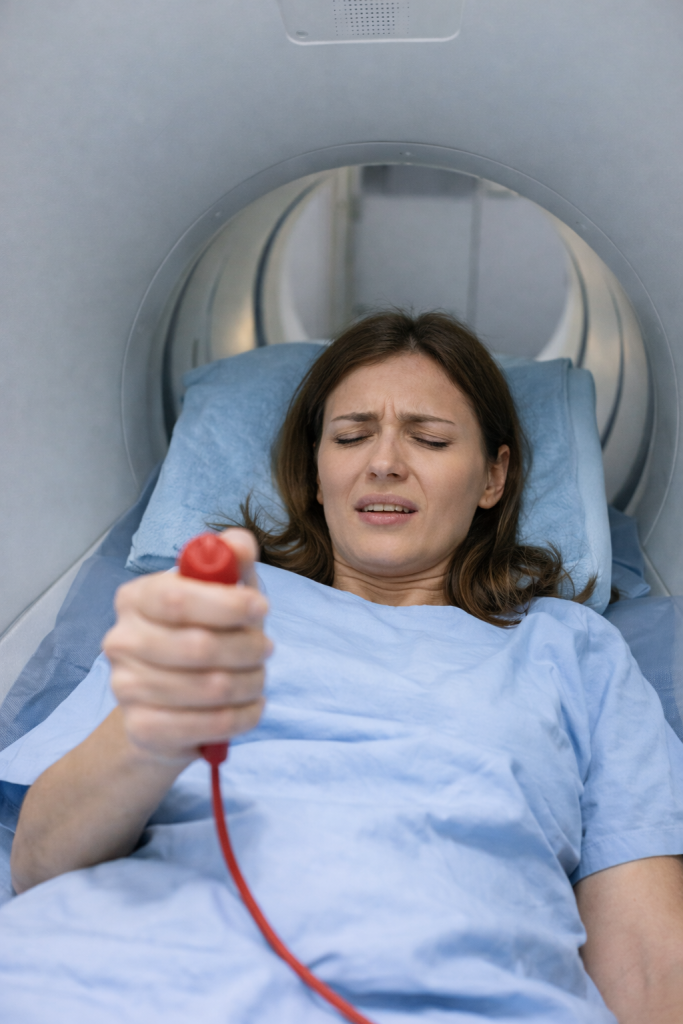
My first MRI was supposed to be with contrast dye. I was already terrified of the idea of lying inside a narrow, noisy tube with no control. For an anxious person, an MRI is the perfect mental setup: a confined space, immobilization, the unknown, and the inability to get out whenever you want.
But, because life has a sense of humor, a well-meaning friend tried to reassure me by saying:
“If you’re allergic to the contrast dye, you’ll die within a minute.”
Excellent.
So not only was I about to enter a narrow tube, I also had an imaginary countdown running.
The morning of the appointment I arrived at the clinic, signed the consent form acknowledging everything that could possibly happen, and had an IV placed. I went into the room, lay down on the table, and was handed the panic button.
“We’ll do a quick test first,” they said.
The table started moving.
Slowly. Very slowly.
Head first.
The moment my head entered the tube, my heart rate spiked. When I was halfway inside, I said:
“Get me out of here. I can’t do this.”
They pulled me out. It felt like it took forever.
I asked if I could take a Xanax.
They told me I should have taken it beforehand.
So I stepped out, took it, and came back. The second attempt wasn’t any easier. The third was a final negotiation with myself. I managed to stay long enough to go fully inside the tube. I looked up and saw that small light at the end. I kept oscillating between asking to be taken out, pressing the panic button, or just screaming — all while quietly praying.
Then came the contrast dye.
In my head, the script was running: “We now have one minute to find out if we die.”
I felt the injection and, strangely, it seemed like I could feel the dye traveling exactly to the area being scanned. I don’t know if contrast dye is intelligent or if anxiety has its own GPS, but the sensation felt very real.
About 30 minutes later I came out of the tube. Alive.
Then came surgery, more scenarios, the ultimate fear: losing control and not waking up from anesthesia. For an anxious person, control is the illusion of safety. And when you lose it, imagination takes over.
You’d think one experience like that would be enough for a lifetime.
Not for my spine.
At some point my back started hurting. Not the manageable kind — the kind that makes you rethink all your life choices. After digging through my memory, I remembered the moment at a baptism when I picked up both kids at the same time for dancing and photos. Because, obviously, you don’t go to a baptism every day.
Actually, last year I went to three. By the third one, I had learned my lesson.
After episodes of pain, a week of sleeping on the floor, and creative self-diagnoses, I ended up back at the doctor. Verdict: lower back pain. Bonus prize — hip bursitis. And, to figure out exactly what was going on, I needed another MRI.
This time I was determined not to repeat the experience. I searched for an open MRI. The photos online looked airy, spacious, almost poetic. For a claustrophobic person, it seemed perfect.
I arrived. I lay down on the table. I looked at the machine, which looked nothing like the website photos. The table started moving. In went the legs, then the pelvis, then the abdomen.
“Are we stopping anytime soon?” I wondered.
We did not stop.
The plate above me started getting closer to my face. It reached my neck. Soon it was right above my face. Panic set in instantly.
“Get me out of here.”
I asked again if I could take a Xanax.
“Sure, but it won’t help,” the technician said.
I took it. I went back in. My heart was pounding so hard I was convinced the machine would detect an entirely different diagnosis. I kept running scenarios: “They’ll find out what I have… because I’m not sure I’m getting out of here alive.”
In a moment of panic-fueled clarity, I even considered escape strategies — slowly pulling myself out, inch by inch, until I cleared the machine.
The staff’s empathy felt close to zero. Naively, I had expected that people coming for an open MRI are often scared, like me. So the staff would be used to that. They weren’t.
I stayed.
I don’t know how.
But I stayed.
After the MRI… my back stopped hurting.
I don’t know if it was coincidence, placebo, or if my body simply decided that anything was more bearable than another experience inside that machine.
There is something almost universal about the MRI experience. For some, it’s a routine medical test. For others, it’s a direct confrontation with the fear of losing control, with confined spaces, with the scenarios the mind creates when it has nowhere to run.
And yet, most of us go back in when we have to.
With anxiety.
With the panic button in hand.
With internal negotiations.
With prayers.
With humor.
Because sometimes courage doesn’t mean the absence of fear.
It means going into the tube even when your mind is telling you to run.
And coming out — maybe shaking, maybe sweating, maybe exhausted — but proud that you did it.