
The human body is, on average, more than half water. The brain, blood, muscles, and internal organs all depend on a delicate balance of fluids to function properly. And yet, one of the most common physiological states of modern life is mild, chronic dehydration. Not dramatic. Not obvious. Just enough to quietly affect performance, mood, and long-term health.
Dehydration doesn’t begin when you feel extremely thirsty. Thirst appears when the body has already lost about 1–2% of its weight in water. At that point, measurable effects are already taking place.
After just a few hours without fluid intake, blood plasma volume begins to decrease. The blood becomes more concentrated and slightly more viscous. The heart has to work a little harder to maintain efficient circulation. Heart rate may rise subtly, and blood pressure can fluctuate. Not enough to cause dramatic symptoms, but enough to place strain on the cardiovascular system over time.
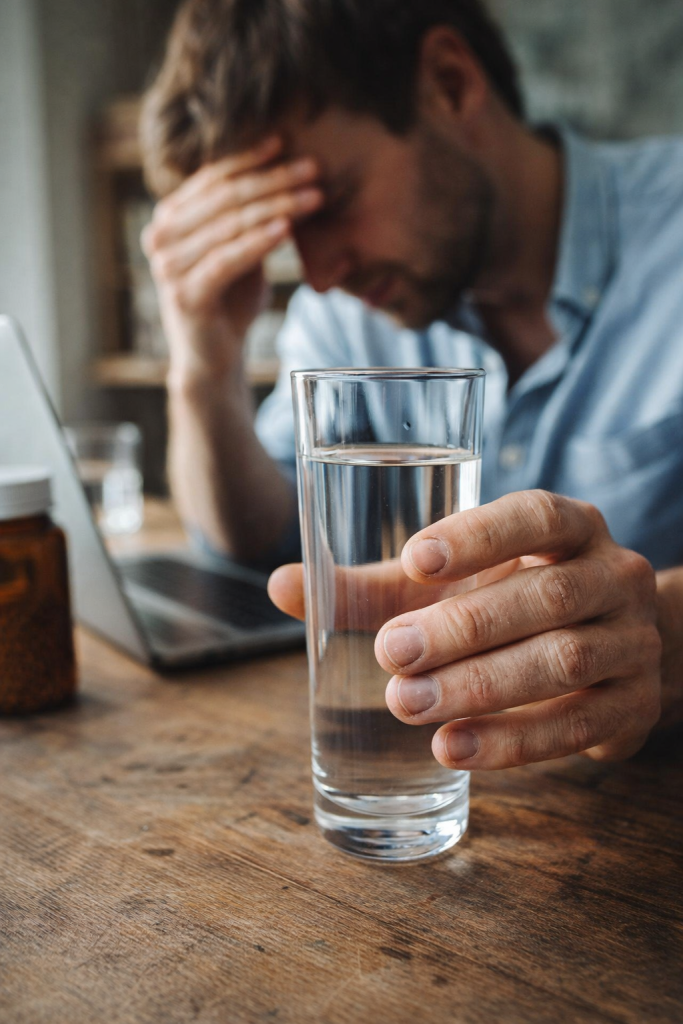
The brain is one of the first organs affected. Studies show that even mild dehydration of 1–2% can reduce concentration, short-term memory, and reaction time. What many people describe as “brain fog” often has a simple physiological component: insufficient hydration. Afternoon headaches are frequently linked to this subtle fluid deficit. At the same time, cortisol — the stress hormone — can rise, because the body interprets lack of water as a form of physiological stress.
The kidneys quickly switch into conservation mode. Their role becomes preserving water. Urine becomes more concentrated, darker in color, and reduced in volume. It remains one of the simplest indicators of hydration status: very pale yellow usually reflects good hydration, while darker amber suggests a deficit. If you rarely go to the bathroom and the amount is small, the body is trying to conserve every available drop. Over time, repeated concentration of urine increases the risk of kidney stones and urinary tract infections.
The digestive system is also directly affected. Water is essential for normal intestinal movement. Without enough fluids, digestion slows. Constipation, bloating, and abdominal discomfort can appear. Thirst is often mistaken for hunger, which means people sometimes eat when the body is actually asking for water.
The effects can be visible externally as well. Skin may appear drier and more dull, temporarily losing some elasticity. Fine lines can look more pronounced during periods of dehydration. Hair may seem more fragile, and the scalp drier. Nails can become more brittle. These are not dramatic changes, but they are subtle signals of an internal imbalance.
Impact varies with age. Children and teenagers dehydrate more quickly than adults, and their cognitive performance is sensitive to hydration levels. Fatigue, irritability, and difficulty concentrating can sometimes stem from something as simple as not drinking enough water.
Among adults — especially between 20 and 50 — mild chronic dehydration is extremely common. Busy schedules, high coffee intake, irregular meals, and long workdays contribute to insufficient fluid intake. Caffeine has a mild diuretic effect, and without adequate water to compensate, the deficit grows. The result may be persistent fatigue, recurring headaches, increased sugar cravings, and decreased physical performance.
After age 50–60, the thirst mechanism begins to weaken. Many people no longer feel the urge to drink water until dehydration is already present. This can contribute to dizziness, confusion, increased risk of falls, and recurrent urinary infections.
There are also differences between women and men. Women may feel the effects of dehydration more strongly during certain hormonal phases, and migraines can be triggered or worsened by insufficient fluid intake. Men, who often have greater muscle mass and sweat more, may lose larger amounts of water without realizing the need to replace it.
If you drink almost no water for an entire day, the body shifts into a stronger conservation mode. Heart rate rises, blood pressure may drop, dizziness can occur when standing, mental performance declines, and urine becomes highly concentrated. Fatigue becomes more pronounced. Repeated frequently, this state puts strain on the kidneys, slows metabolism, and increases the risk of urinary and digestive problems.
A common question arises: can not drinking enough water have any benefits? From a physiological standpoint, there are no proven benefits to dehydration. The body gains nothing from a fluid deficit. It does not boost metabolism, does not “detox,” and does not improve organ function. On the contrary, any reduction in hydration forces the body into conservation mode.
Sometimes people believe that drinking less water helps with rapid weight loss or reduces bloating. In reality, these effects are temporary and represent loss of water and glycogen, not true metabolic benefit. In certain athletic or aesthetic competitions, fluid reduction is done in a controlled and very short-term way, but it is a visual strategy, not a health strategy, and it places significant physiological stress on the body.
The human body is built to survive short periods without water. It activates hormonal conservation mechanisms, reduces losses, and slows nonessential processes. But these mechanisms represent adaptation to deficit, not an advantage. It is survival mode, not optimal function.
The body can adapt to a lack of water.
But adaptation is not a benefit.
It simply means the organism is trying to function as well as possible in a state of deficit.
This naturally leads to another question: how much water should we actually drink?
There is no universal number that fits everyone. The classic “eight glasses a day” rule is more of a general guideline than a strict requirement. Real needs depend on body weight, sex, climate, activity level, diet, and intake of caffeine or alcohol. For most healthy adults, a realistic range is about 0.5–0.6 ounces of water per pound of body weight per day, coming from both beverages and food. A 155-pound adult, for example, typically needs around 70–85 ounces daily, more if sweating is significant or temperatures are high.
When you drink water matters less than consistency. Still, in the morning, after waking, the body is mildly dehydrated from hours without fluid. A large glass of water early in the day helps reactivate circulation and metabolism. It is not a miracle ritual, but it is physiologically logical.
Drinking large amounts right before bed isn’t necessary and may disrupt sleep due to nighttime bathroom trips. Effective hydration means distributing water throughout the day rather than trying to “catch up” all at once. The body cannot optimally use large volumes consumed suddenly; excess will simply be eliminated.
A simple indicator of adequate hydration remains how you feel overall: stable energy, fewer headaches, normal skin and mucous membranes, light-colored urine, and regular elimination. Intense thirst, unexplained fatigue, dark urine, or infrequent urination are signs the body is already compensating for a deficit.
Hydration isn’t a trendy wellness habit or a dramatic health intervention. It is one of the simplest conditions required for the body to function normally. Sometimes, the difference between constant fatigue and steady energy is surprisingly basic.