
And why it’s not something “dirty”
Few things are as misunderstood — and as unfairly judged — as earwax.
We see it and our first reaction is:
“I need to clean this.”
“This looks gross.”
“This isn’t hygienic.”
But the biological truth is exactly the opposite:
earwax is not a sign of poor hygiene.
It’s a sign that your body is working exactly as it should.
Your body produces earwax on purpose
Earwax, medically called cerumen, doesn’t appear by accident.
It’s not useless residue.
It’s not something your body “forgot” to remove.
It is produced intentionally by specialized glands in the outer ear canal.
Inside your ear canal are tiny glands that release:
- protective oils
- antibacterial substances
- constantly renewing skin cells
All of these combine to form cerumen.
It’s essentially a biological shield.
Why your body makes earwax
Every day, your ears are exposed to:
- dust
- bacteria
- airborne particles
- water
- pollution
- microorganisms
Earwax works like a smart, sticky filter.
It traps particles before they reach the eardrum.
It lubricates the delicate skin of the ear canal.
It creates a slightly acidic environment where bacteria and fungi struggle to grow.
Simply put:
earwax is your ear’s natural defense system.
Your ears clean themselves
One thing many people don’t know:
the ear canal has its own self-cleaning mechanism.
The skin inside the ear slowly migrates outward, like a tiny invisible conveyor belt.
Earwax naturally moves toward the opening of the ear and eventually falls out on its own.
That means most ears do not need internal cleaning at all.
When we insert cotton swabs, we usually don’t remove wax —
we push it deeper.
When does earwax production begin?
Surprisingly early.
Even before birth, during the last months of pregnancy, a baby’s skin glands begin to function.
After birth, some newborns already have visible earwax.
This is normal.
It does not mean the baby needs deep cleaning.
It simply means the skin is functioning as it should.
Babies and earwax
In babies:
- wax is softer
- amounts are small
- ears usually clean themselves efficiently
Pediatricians recommend cleaning only the outer ear if needed.
Nothing should be inserted into the ear canal.
Children and teens
During childhood and adolescence, production varies widely.
Some children have almost none.
Others produce more.
Both are normal.
Ear canal shape and genetics play a major role.
Adults: everyone is different
Among adults, earwax production varies greatly.
Some people:
- produce very little
- rarely notice it
- never develop blockages
Others:
- produce more
- need occasional professional removal
- develop wax buildup more easily
Both situations are considered normal.
Older adults
With age:
- earwax becomes drier
- natural removal slows
- buildup can occur more easily
This is why wax impaction is more common after age 60.
Different types of earwax
There are two main types:
- wet and sticky
- dry and flaky
Your type is determined by genetics and does not reflect hygiene.
People of East Asian descent more often have dry wax.
People of European and African descent more often have wet wax.
Both are normal.
Common myths
Myth: Earwax means you’re not clean.
False. It’s a natural protective secretion.
Myth: You should remove it daily.
False. The ear usually cleans itself.
Myth: Cotton swabs are meant for inside the ear.
False. Most doctors advise against inserting anything into the ear canal.
Myth: Earwax causes infections.
In reality, it helps prevent them.
How to clean your ears correctly
The outside of the ear can be cleaned normally:
- in the shower
- with a towel
- with a soft cloth
The inner ear canal usually does not need routine cleaning.
What not to put in your ears
Avoid inserting:
- cotton swabs
- bobby pins
- tissues
- towel corners
- ear candles
Cotton swabs often push wax deeper, compact it, and irritate the canal.
In rare cases, they can even damage the eardrum.
When earwax becomes a problem
Earwax only requires medical attention if it causes symptoms such as:
- a blocked sensation
- reduced hearing
- ringing
- dizziness
- discomfort or pain
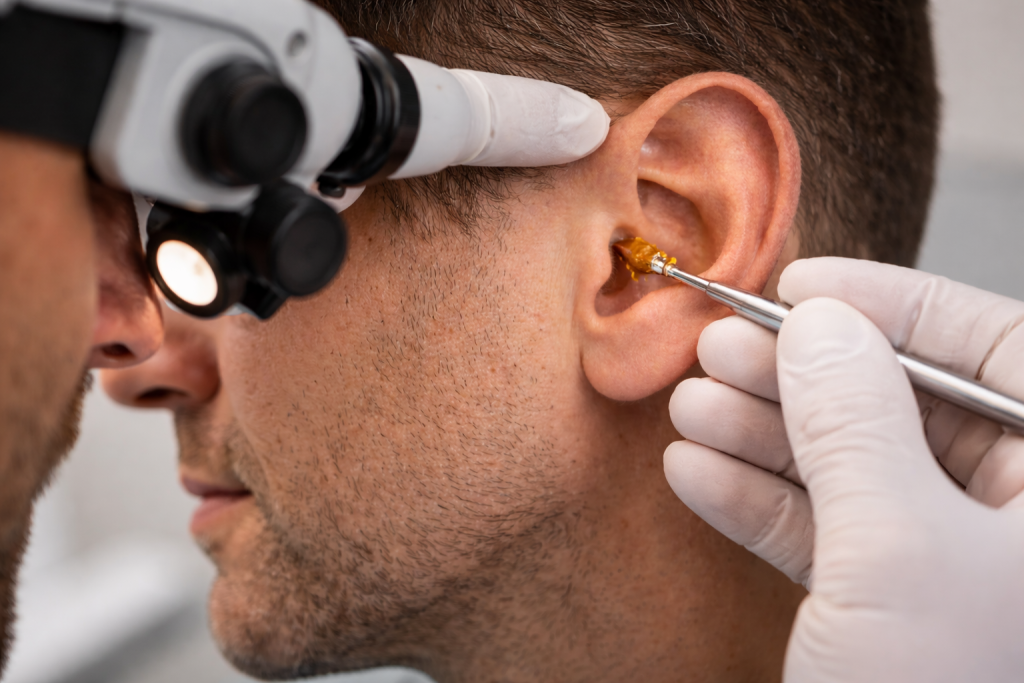
In these cases, a healthcare provider can remove it safely using:
- gentle suction
- irrigation
- specialized instruments
Does diet affect earwax?
There’s no strong scientific evidence that specific foods increase earwax production.
However:
- dehydration can make wax drier
- skin conditions can affect consistency
There’s no proven “earwax-producing” diet.
A fascinating detail
Earwax is so genetically specific that it has been used in research to:
- study population genetics
- identify metabolic conditions
- analyze environmental exposure
It’s one of the most individualized body secretions we have.
The simple takeaway
Earwax is not something your body needs to get rid of.
It’s something your body makes to protect you.
Most of the time, the best thing you can do for your ears is surprisingly simple:
leave them alone and let them do their job.