
There comes a moment in adult life when you realize you’ve moved past the phase of “I’m too embarrassed to ask for help,” but you’re not quite at “I don’t care at all.”
That moment is when you walk into the office restroom, lift the toilet seat… and discover what looks like a very small, very personal crime scene.
I’m not talking about a single drop.
I’m talking about the whole landscape: splashes on the rim, marks on the seat, sometimes even a… “signature” left exactly where the next person will innocently place their trust.
And that’s when the mental movie begins.
Scenario 1: You pretend you didn’t see anything
You lower the lid, avoid touching anything, and try to get out as fast as possible.
But of course, the exact second you open the door to leave… someone walks in.
And suddenly you feel it: that silent assumption hanging in the air.
You’re hit with that ridiculous, childish, but very real fear —
that you’ll be associated with someone else’s mess.
Scenario 2: You clean it
This is where the movie splits in two, like a moral test.
On one side: basic decency.
“I can’t just leave it like this.”
On the other: indignation.
“Why am I cleaning up after another adult?”
Especially when you realize it’s not a one-time incident.
It’s a pattern.
There’s clearly an “artist” who shows up regularly, leaves their mark, and disappears as if the office restroom exists outside the laws of society.
And what’s most frustrating is that it rarely looks accidental.
Because the mess appears in places you have to work to reach: the front of the seat, the back, under the rim.
You may not know how it happened, but you know one thing:
a normal person looks before they leave.
That’s the part that hits hardest — not that it happens, but that someone stands up, sees it, and still decides:
“Someone else will deal with it.”
Scenario 3: You tell someone
And this is where the social problem begins.
Because nobody wants to be “the bathroom person.”
You don’t want to walk into a meeting carrying that invisible label:
“Oh, that’s the one who talks about restroom issues.”
And yet… there’s a threshold.
A moment when you realize it’s not just unpleasant — it’s unsanitary.
Sometimes even unsafe (especially if there’s liquid on the floor and someone could slip).
So you end up doing what rational people do in irrational situations:
you look for a solution that won’t expose you.
What actually happens in real offices
Here’s the part nobody says out loud: this happens everywhere.
Not just in gas stations or malls.
Not just in men’s restrooms.
Not just among “uncultured” people.
Sometimes it’s:
- simple carelessness (someone rushes out),
- a medical issue (urgent stomach problems, incontinence),
- germ anxiety (someone avoids touching anything and misses everything),
- cultural habits (washing with water, improvised solutions),
- or yes… plain indifference.
The difference between an accident and indifference is one small action: cleaning up.
Accidents happen.
Leaving them behind is a choice.
The dilemma that traps you
This is the worst part:
If you walk out, you feel guilty without being guilty.
If you clean it, you feel resentful for doing someone else’s job.
If you speak up, you worry you’ll sound dramatic.
And yet the truth is simple:
Using a shared restroom is a basic social contract.
It’s not about perfection.
It’s about not leaving discomfort and risk behind for the next person.
What you can realistically do without becoming the “bathroom police”
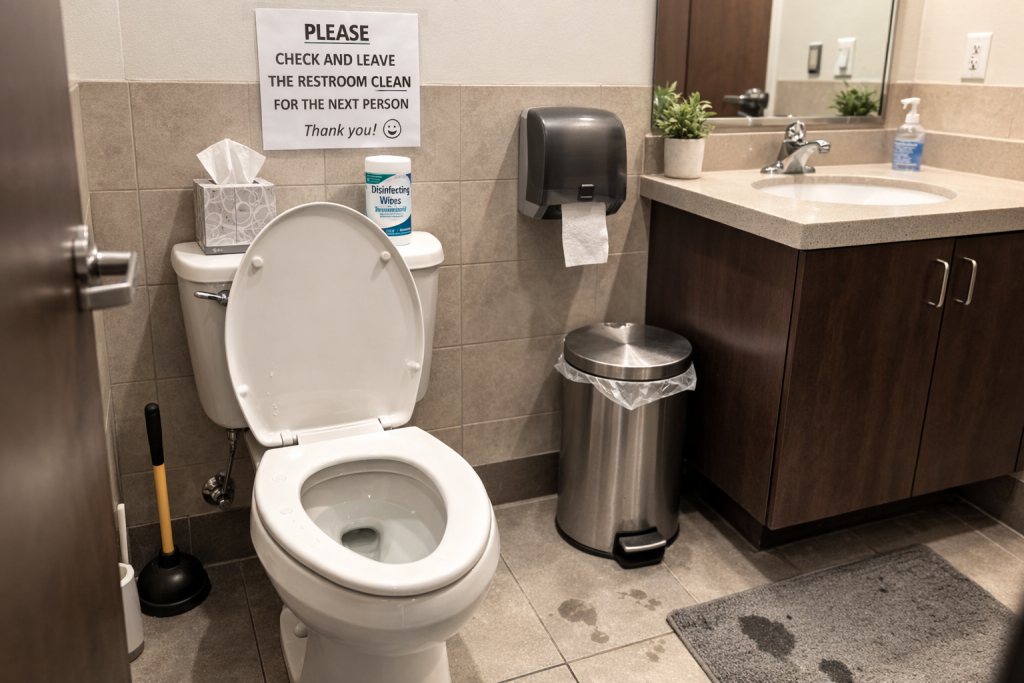
- Ask discreetly for disinfecting wipes and gloves to be visible and accessible. When they’re there, the message is clear: clean if needed.
- Suggest a short, neutral sign:
“Please check and leave the restroom clean for the next person. Thank you.”
No shaming. No accusations. - If it keeps happening, raise it as a hygiene and safety issue with management or HR — not a personal complaint.
The key wording: “We’re having a recurring cleanliness issue in the restroom,” not “Someone keeps…” - Survival trick (when you’re in a hurry): clean just enough to avoid becoming the “suspect,” protect your own sanity, and remind yourself:
I didn’t make this mess. I just don’t want to socially pay for it.
Is that cynical?
Not really.
It’s self-preservation in a mildly absurd system.