
There’s an unspoken rule of modern life:
when you sleep somewhere that isn’t your home, you operate on trust.
Trust that the sheets have been washed.
Trust that the bathroom has been cleaned.
Trust that the towels are fresh.
Trust that the glass in the room is actually clean and not just rinsed.
And yes — trust that the coffee maker in your hotel room has been used… for coffee.
You can’t walk into a hotel room with a forensic kit and a UV lamp. You can’t dismantle the coffee machine to inspect it. You can’t sanitize every surface before you exist in the space. The entire concept of hospitality runs on a quiet agreement: I pay, you provide a clean, safe environment.
That agreement works only on trust.
Until someone on the internet completely ruins your ability to ever drink hotel-room coffee peacefully again.
Viral culture has lowered the bar to the floor
Recently, a health and lifestyle influencer went viral after posting a video explaining how she washes her underwear in hotel coffee makers when she runs out of clean pairs while traveling.
Yes. That.
The “hack” was explained in detail: hot water cycle, rinse cycle, repeat. A coffee machine repurposed as a tiny washing machine for underwear.
After backlash exploded, she posted follow-ups claiming it was a joke, that she never actually does it, and that she finds the entire controversy entertaining. Laughing. Amused. Thriving on the attention.
But once people have that image in their heads, it doesn’t go away.
It no longer matters if she did it.
It no longer matters if it was satire.
The idea now exists. And with it, the damage to trust.
Rumors began circulating that the hotel chain where the video was filmed had to replace in-room coffee machines and might be pursuing legal action due to reputational and financial damage. None of that has been officially confirmed, but the mere possibility added fuel to the outrage.
At this point, whether there’s a lawsuit or not is almost irrelevant.
The psychological effect is already done.
She’s not the only one with these ideas
If this were just one influencer chasing views, maybe we could dismiss it as internet absurdity.
Except it isn’t.
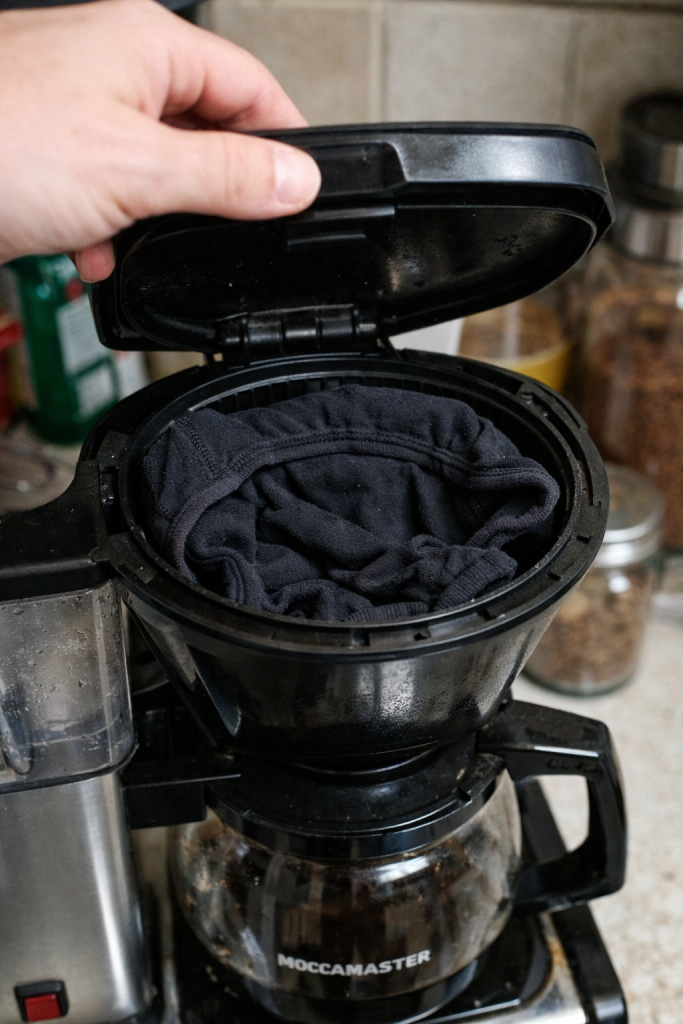
On Reddit, in a thread about nightmare roommates, someone shared a story about waking up and discovering their roommate had used his underwear — allegedly clean — as a coffee filter in their coffee maker.
Not in a hotel.
Not for content.
At home.
A high-end coffee machine. No filters available. Improvisation followed.
Photo evidence included.
The comments exploded. Some people joked (“straight to jail,” “this coffee tastes nutty”), but most reactions were dead serious: that machine would need replacing. There was no coming back from that.
Because the issue wasn’t just the gross factor.
It was what underwear represents: detergent residue, fabric softener chemicals, intimate contact, basic hygiene boundaries. Even if technically “clean,” it crosses a line most people never imagined needing to define.
And the most unsettling part?
For someone, this felt like a reasonable solution.
The influencer isn’t a lone anomaly.
There are people who genuinely think this way.
The psychological fallout: hotel coffee is now ruined
Online reactions became a kind of informal sociology study.
Some people admitted they already avoided hotel coffee makers because they assumed they weren’t cleaned thoroughly.
Others shared experiences opening water reservoirs that smelled moldy.
Former hotel workers chimed in explaining that how deeply rooms get cleaned depends heavily on staffing levels and occupancy — and in many places, staffing is stretched thin.
Translation: anything not visibly urgent gets less attention.
A lot of commenters said the same thing:
“I never used those machines anyway. Now I definitely won’t.”
Because the reality of shared spaces is simple — we don’t know who was there before us.
We don’t know what they touched.
We don’t know what they improvised.
We rely on probability.
On social norms.
On basic common sense.
When someone publicly normalizes using food-related equipment for intimate personal hygiene, even as a joke, it chips away at that fragile layer of trust.
This isn’t about hygiene. It’s about responsibility.
This conversation isn’t really about bacteria.
It’s not about boiling temperatures.
It’s not about whether something is technically sanitized.
It’s about boundaries.
Objects intended for food and drink have a social category.
There’s an understood separation between personal intimate hygiene and shared consumption spaces.
When someone turns crossing that boundary into content — into a joke, a hack, a viral moment — the impact goes beyond their own behavior.
With hundreds of thousands of followers, you’re no longer just a person making a bad joke.
You’re influencing norms, whether you intend to or not.
Even if 99% of people would never do something like this, there will always be a small percentage who try. Or who begin to see it as acceptable.
In shared public environments, that small percentage is enough.
Modern life runs on trust in strangers
We eat in restaurants without knowing who handled the plates.
We sleep in beds other people slept in.
We use shared appliances, glasses, kettles, and coffee makers.
We cannot control everything.
We cannot sanitize everything.
We cannot live inside sterile bubbles.
That’s why we rely on basic social contracts.
On restraint.
On common sense.
And perhaps on a bit more awareness before hitting “Post.”
When virality becomes the goal
There’s a repeating pattern online:
An outrageous idea → disgusted reactions → massive sharing → “it was just a joke.”
Outrage drives engagement.
Disgust drives reach.
Shock becomes monetizable.
And maybe the most unsettling part is this:
regardless of whether she actually did it, regardless of whether any lawsuit exists, the influencer achieved exactly what viral culture rewards — attention.
But the cost isn’t only hers.
The cost is a small crack in collective trust.
In the end, it comes back to all of us
The next time you walk into a hotel room and look at the coffee maker, you’ll hesitate for half a second.
Not because you know something happened.
But because now you know it could.
And that may be the real loss in the age of virality:
Not hygiene.
Not comfort.
But trust.