
And why it’s not just a reaction to heat
Sweating doesn’t only happen when it’s hot.
It doesn’t only happen when you work out.
And it doesn’t only happen when you “overheat.”
Your body can start sweating for dozens of reasons — some obvious, others completely invisible.
Sweating is one of the most sophisticated regulatory systems your body has.
Without it, your internal temperature would rise quickly to dangerous levels.
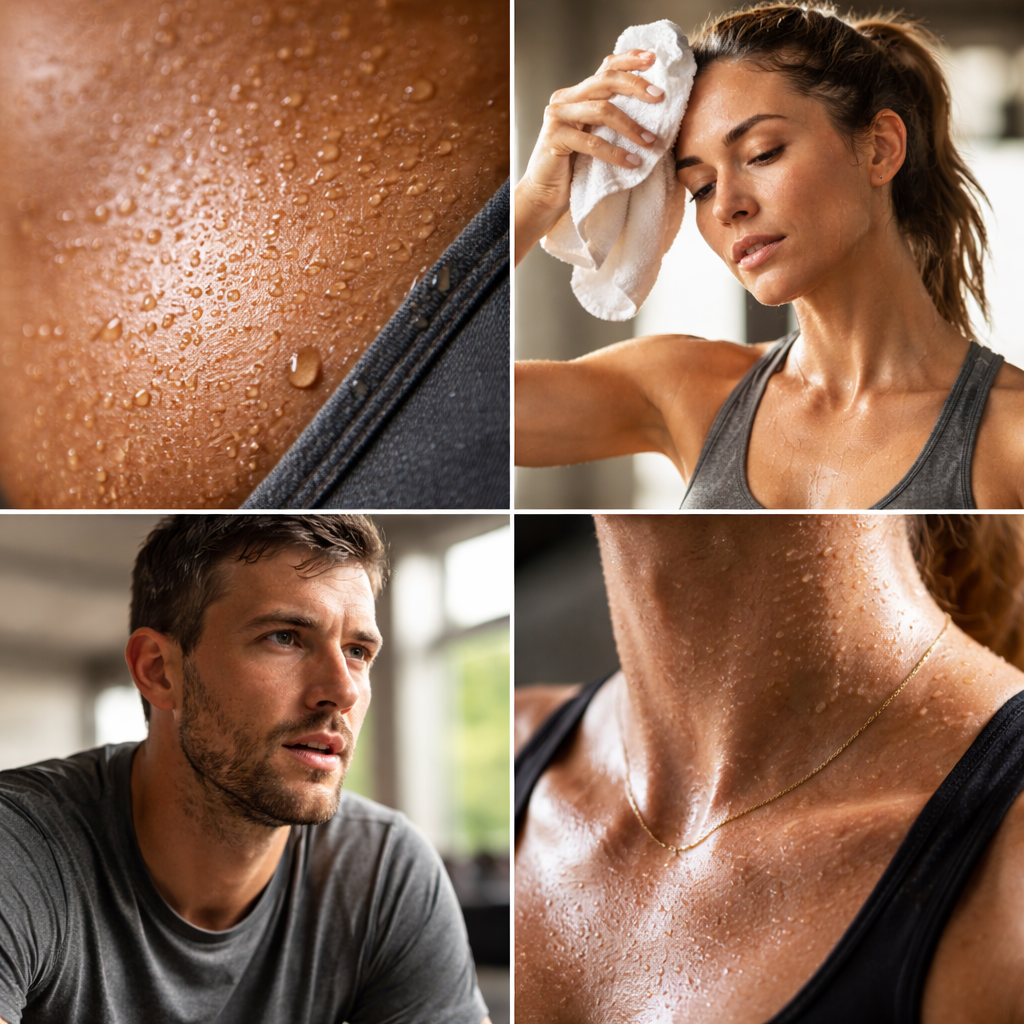
What sweat actually is
Sweat is a fluid produced by sweat glands.
It is made up mostly of:
- water (about 99%)
- salts (especially sodium)
- small amounts of potassium, lactate, and urea
Its primary role: regulating body temperature.
When your internal temperature rises, your brain sends a signal to your sweat glands.
They release fluid onto the surface of your skin.
As that fluid evaporates, it cools your body.
It’s essentially your body’s built-in air conditioning system.
What happens in your body when you start sweating
The process begins in the brain — not the skin.
The hypothalamus (your temperature control center) constantly monitors your core temperature.
When it detects an increase, it:
- sends signals through the nervous system
- activates sweat glands
- increases blood flow to the skin
Sweat droplets appear.
Evaporation lowers your body temperature.
All of this happens automatically, without conscious control.
Types of sweat glands
Your body has two main types:
1. Eccrine glands
- 2–4 million throughout the body
- located on the forehead, back, chest, palms, and soles
- produce watery, odorless sweat
Their main job: cooling.
2. Apocrine glands
- found in the armpits
- groin area
- around the nipples
They produce a thicker secretion.
Initially odorless — but when skin bacteria break it down, body odor develops.
Why sweat smells
Sweat itself does not smell.
Odor happens when bacteria on your skin break down apocrine secretions.
This creates compounds with a distinct smell.
That’s why:
- armpits tend to smell more
- palms barely smell
- each person has a unique body odor
Smell is influenced by:
- skin bacteria
- hormones
- genetics
- diet
- stress levels
Do babies sweat?
Yes — but differently.
Newborns:
- have functioning sweat glands
- but their temperature regulation is still immature
They often sweat:
- on the head
- during sleep
- while feeding
They don’t regulate heat as efficiently as adults, which is why they can overheat more easily.
Children and teenagers
In childhood:
- sweating is usually lighter
- body odor is minimal
During puberty:
- apocrine glands become active
- body odor develops
- sweating increases
Hormones play a major role.
Women vs. men
There are biological differences.
Men:
- tend to have more active sweat glands
- sweat in larger volumes
- respond faster to heat and physical exertion
Women:
- often begin sweating at slightly higher temperatures
- may produce lower overall volume
- but may experience more noticeable emotional sweating (palms, underarms)
Does body weight matter?
Yes.
People with higher body weight:
- generate more metabolic heat
- require more cooling
- often sweat more during heat or exertion
However:
thin people can also sweat heavily due to genetics.
Sweat level alone is not a reliable indicator of fitness or health.
Can you sweat without doing anything?
Yes — very often.
Sweating can occur due to:
- emotions
- anxiety
- stress
- hormonal changes
- menopause
- fever
- low blood sugar
- certain medications
- hyperhidrosis (excessive sweating disorder)
You can sweat even while sitting still in a cool room.
Are there people who don’t sweat?
Yes, but it’s rare.
The condition is called anhidrosis.
It means a person sweats very little or not at all.
This can be dangerous because:
- the body cannot cool itself effectively
- there is risk of overheating
Does sweating help you lose weight?
Not in any meaningful way.
When you sweat:
you lose water and electrolytes — not fat.
Once you rehydrate, the weight returns.
Real fat loss comes from a calorie deficit, not from sweating.
Does food affect sweating?
Sometimes, yes.
These can increase sweat production:
- spicy foods
- alcohol
- caffeine
These can influence odor:
- garlic
- onions
- curry
- alcohol
- certain medications
But each body reacts differently.
Does sweating a lot mean you’re healthier?
Not necessarily.
Some perfectly healthy people sweat a lot.
Others sweat very little.
Both can be normal.
It becomes medically relevant if:
- sweating starts suddenly and excessively
- night sweats are frequent and heavy
- it’s accompanied by weight loss, fever, or heart palpitations
The simple takeaway
Sweating is not a flaw.
It’s not a sign that something is “wrong” with you.
It’s one of the body’s most important survival mechanisms.
Without it, your internal temperature would rise quickly, and your body wouldn’t be able to protect itself.
Most of the time, sweating doesn’t mean something is wrong.
It means your body knows exactly what it’s doing.