
There is a creature so small you can’t see it without a microscope, yet so resilient it can survive conditions that would destroy almost any known form of life.
It’s called a tardigrade—often nicknamed the “water bear.”
And no, that’s not an exaggeration.
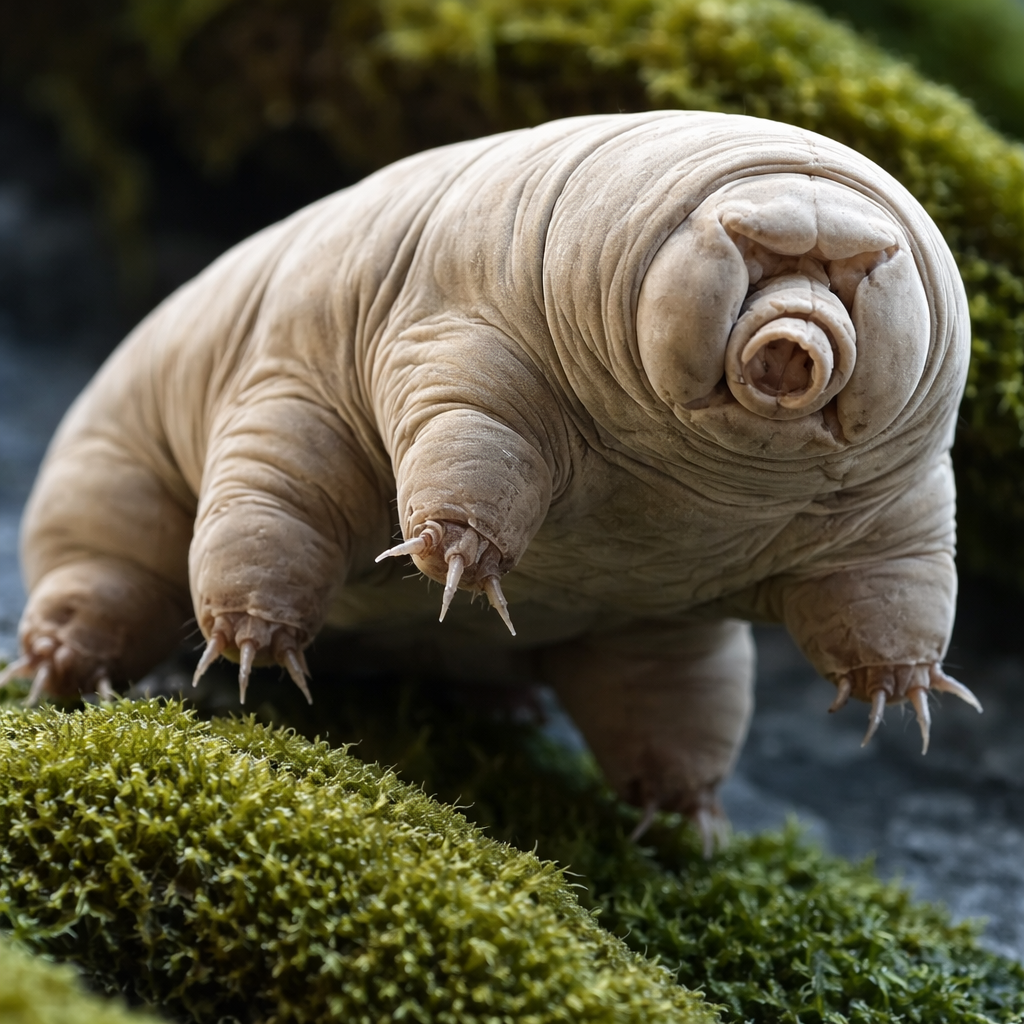
It Doesn’t Look Like Something That Should Be This Tough
At first glance, a tardigrade looks almost harmless. It has a tiny, segmented body, eight short legs, and a slow, clumsy way of moving.
Most measure between 0.3 and 0.5 millimeters.
But behind that simple appearance is one of the most resilient organisms ever discovered.
It Has Survived the Vacuum of Space
In a 2007 space mission, tardigrades were exposed directly to the vacuum of space.
No air.
No protection.
Intense radiation.
Some of them survived. Even more surprising, a number of them were later rehydrated and continued to live—and reproduce.
Not because they actively “fight” extreme conditions.
But because they know how to shut down.
Their Secret: Pressing Pause on Life
When conditions become extreme—lack of water, intense heat or cold, radiation—tardigrades enter a state called cryptobiosis.
Their bodies almost completely dehydrate, and their metabolism slows to nearly zero.
In this state, they stop growing, stop consuming energy, and stop reacting.
It’s essentially a biological pause.
They don’t fight the environment.
They wait it out.
The Biology Behind Their Survival
Their resilience isn’t random. Tardigrades produce unique molecules that protect their cells under extreme stress.
One of the most studied is a protein known as Dsup, which helps shield their DNA from radiation damage.
During dehydration, their cells also stabilize in a way that prevents internal breakdown.
This isn’t just toughness.
It’s highly efficient biology.
They Can Withstand Extreme Conditions
In their cryptobiotic state, tardigrades can survive extremely low temperatures—close to -200°C—as well as high temperatures for short periods.
They can endure radiation levels hundreds of times higher than what would be lethal to humans and can survive both extreme pressure and the vacuum of space.
They are, quite literally, built for the limits of life.
How They Come Back to Life
When conditions improve—especially when water becomes available—the tardigrade rehydrates and resumes activity.
Its metabolism restarts, its body returns to its active form, and it continues as if nothing happened.
As if time had been paused.
How Long Do They Actually Live?
In their active state, tardigrades typically live only a few months.
But what makes them remarkable is their ability to extend that lifespan through cryptobiosis. In this suspended state, they can remain inactive for years—or even longer—without aging in the usual sense.
They are not immortal.
But they come very close to bending time.
They’re Everywhere—Even If We Don’t Notice
Tardigrades are not rare.
They’ve been found in moss, soil, freshwater, oceans, and even extreme environments like glaciers and hot springs.
Chances are, they exist around you right now—you just don’t see them.
How They Reproduce—and Whether They Care for Their Young
Most tardigrades reproduce sexually, although some species can reproduce asexually.
Females lay eggs, sometimes inside their own shed cuticle.
There is no parental care.
They don’t raise or protect their young.
Instead, their survival strategy relies on something else entirely: each individual is equipped to survive on its own from the very beginning.
Could They Survive a Global Catastrophe?
Because of their extreme resilience, tardigrades are often considered among the organisms most likely to survive major planetary events.
Not because they are powerful.
But because they know when to stop—and when to wait.
What They Teach Us About Life
The tardigrade completely reshapes the idea of fragility.
It’s a microscopic organism that doesn’t win through strength, speed, or dominance.
It survives through adaptation.
Through knowing when to conserve energy, when to retreat, and when to begin again.
It may be one of the few living things that doesn’t try to survive every moment.
It knows when to pause.
And sometimes, that’s what makes the difference between disappearing… and enduring.
It doesn’t look impressive.
But it is one of the most resilient life forms we’ve ever discovered.