
It doesn’t start the same way for everyone.
For some, it begins with noticing more hair on the pillow or in the brush and assuming it’s just temporary. For others, it’s more sudden — a small, clearly defined patch where the hair is simply gone, without warning or a gradual change.
And that’s usually the moment when the question appears:
what is actually happening inside my body?
Because unlike common pattern hair loss, alopecia isn’t just about time or hormones.
It involves your immune system.
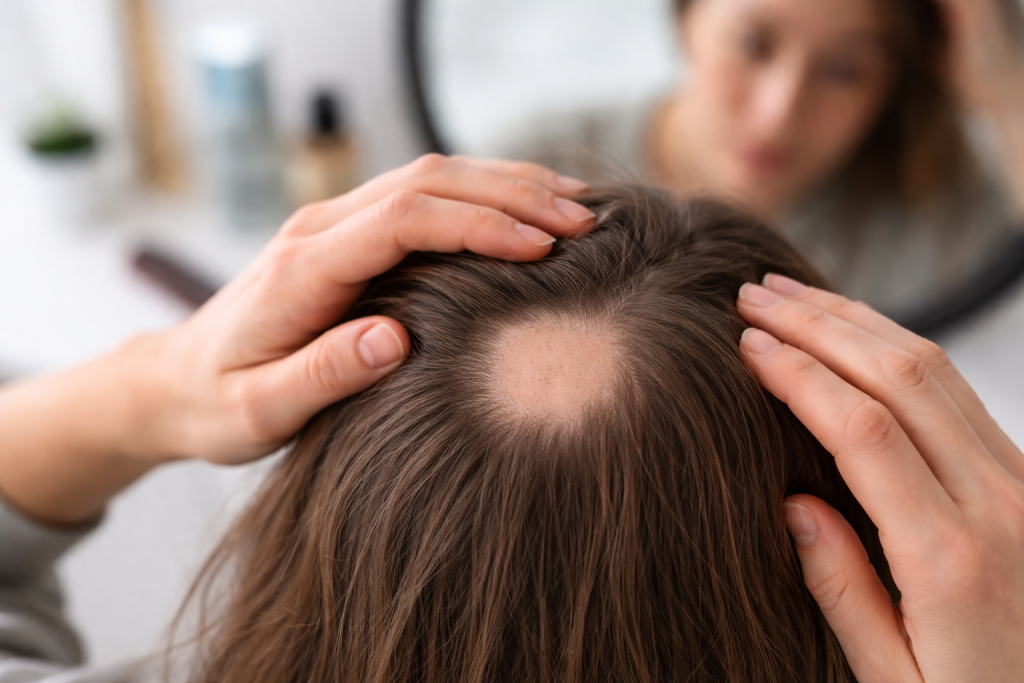
When the body reacts against its own hair follicles
In the most common forms, especially alopecia areata, the immune system mistakenly targets the hair follicles.
This is not an aggressive or painful reaction.
It’s subtle and happens at a microscopic level.
Immune cells gather around the follicle and interfere with its normal function, disrupting the hair growth cycle. The follicle isn’t necessarily destroyed, but its activity is interrupted.
The result can be surprising: hair falls out relatively quickly in well-defined patches, often round or oval in shape.
In some cases, it can seem like it happened overnight.
An important detail is that, in many situations, the follicles remain alive. This means hair can grow back, sometimes even without treatment.
However, the course is not always predictable.
How common it is and who it affects
Alopecia is more common than it may seem.
Research suggests that around 1–2% of people will experience alopecia areata at some point in their lives, and various forms of noticeable hair loss affect an even larger portion of the population.
Unlike androgenetic hair loss, which is more common in men, alopecia areata affects men and women at relatively similar rates.
The difference is often in how it is experienced and perceived.
In terms of age, onset frequently occurs before the age of 30, and a significant number of cases begin during childhood or adolescence. This early onset is one of the reasons why the emotional impact can be especially strong.
Why it happens
Alopecia is considered an autoimmune condition, but it doesn’t have a single clear cause.
Several factors may contribute, including genetic predisposition, intense stress, hormonal changes, or certain infections. In some cases, it is associated with other autoimmune conditions, such as thyroid disorders or vitiligo.
Still, there are many situations where it appears without an obvious trigger.
And that uncertainty can be difficult to process.
Because there isn’t always a clear moment or reason you can point to.
The difference between normal shedding and alopecia
Losing hair daily is normal. Most people shed between 50 and 100 strands per day as part of the natural growth cycle.
With alopecia, the change is not just about quantity.
It’s about pattern.
Hair may disappear from specific areas, eyebrows or eyelashes can become thinner, and regrowth may not follow the usual rhythm.
This makes the change more noticeable and often more concerning.
Different types, different experiences
Alopecia can appear in several forms, each with its own pattern.
Alopecia areata typically causes small, well-defined patches.
Alopecia totalis involves complete hair loss on the scalp, while alopecia universalis affects the entire body.
There are also temporary forms, such as telogen effluvium, where hair sheds diffusely, often after significant stress, illness, or major life events.
This is why not all hair loss means the same thing, even if it looks similar at first.
What happens beneath the surface
At a microscopic level, the hair growth cycle is disrupted.
The growth phase, which normally lasts for years, is shortened or interrupted, and the follicle enters a resting phase earlier than it should.
Low-grade inflammation plays a role in this process, even if it isn’t visible on the surface.
In some cases, changes can also appear in the nails, suggesting that the process is not limited to the scalp alone.
Can it be reversed?
In many cases, yes.
Hair can regrow on its own, especially in milder forms or isolated episodes. In other situations, treatments may help stimulate the follicles or regulate the immune response.
However, the evolution is unpredictable.
Hair may return and later fall again.
This variability makes each person’s experience different.
Differences between men and women
Biologically, the underlying mechanism is similar.
But the experience is not always the same.
Hair loss in men is often more socially normalized, especially because of common pattern baldness.
For women, it can be more difficult to cope with, as hair is often more closely tied to identity and self-image.
As a result, even when the condition is similar, the emotional impact may differ.
It’s not just about hair
Alopecia is not only a physical change.
It can affect how you see yourself and how you believe others see you.
Hair is not just a cosmetic detail.
For many people, it is part of their identity.
What remains beyond the explanation
Perhaps the most important thing to understand is that alopecia is not caused by a personal mistake.
It is not something you did or didn’t do.
It is a complex biological process in which the immune system behaves differently than expected.
And even when it appears suddenly and without a clear reason, it does not mean that something is fundamentally wrong with you.
It simply reflects one of the many ways the human body can function.