
It doesn’t begin with a clear moment. There’s no specific day when you can say, “this is when it started.”
More often, it shows up subtly—maybe in a photo where the light hits differently, or in an ordinary morning when you’re fixing your hair and, for a brief second, something feels off. It doesn’t sit the same. It doesn’t look as full. Something has changed, even if you can’t quite explain how.
And that’s when a question quietly appears, one most people don’t say out loud:
What is actually happening inside my body?
The answer isn’t simple. It’s a quiet combination of hormones, genetics, and time.
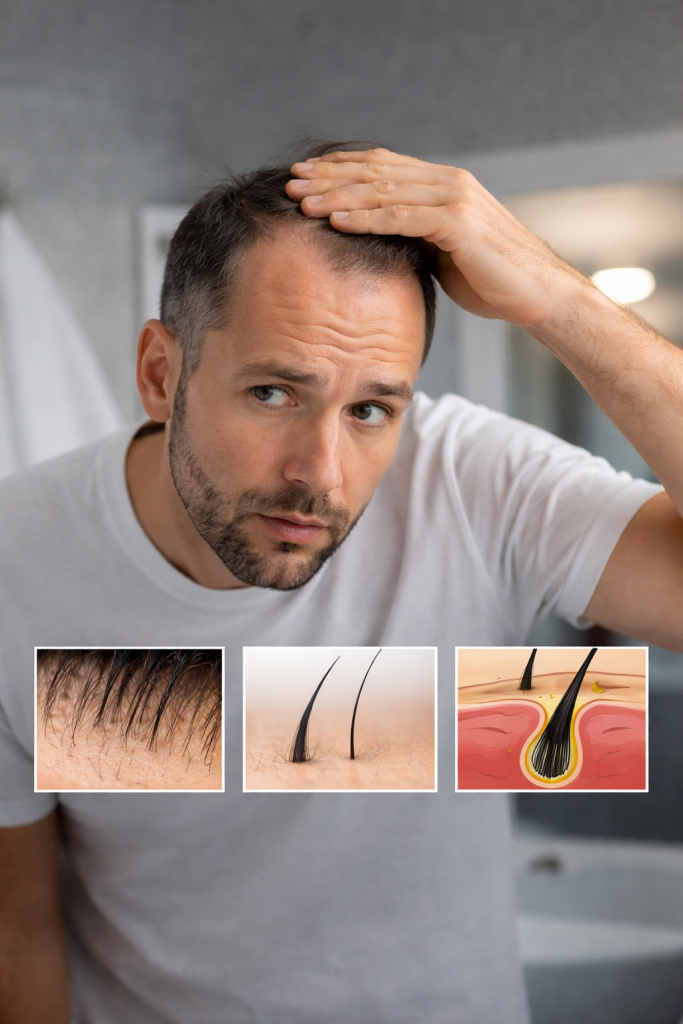
It’s Not That Your Hair Is Falling Out—It’s Changing How It Grows
One of the most important things to understand is that, in most cases, hair doesn’t suddenly “disappear.” The follicles—the tiny structures in your skin that produce hair—are still there.
What changes is how they behave.
Under the influence of androgens, especially a hormone called dihydrotestosterone (DHT), these follicles begin a slow process known as miniaturization. It sounds technical, but the effect is easy to notice over time: each new strand grows slightly weaker than the one before.
Thinner. Shorter. More fragile.
At first, the change is so subtle that it’s easy to ignore.
DHT: Not the Enemy, But a Rule-Changer
DHT is a derivative of testosterone and plays an essential role in development, particularly in men. Without it, many male characteristics wouldn’t develop properly.
So the problem isn’t the hormone itself.
The real issue is how sensitive your hair follicles are to it.
At the scalp level, DHT binds to receptors in the follicles and gradually alters the hair growth cycle. The growth phase, which normally lasts for years, begins to shorten.
As a result, the hair doesn’t have enough time to grow thick and strong before it sheds.
At the same time, the resting phase occurs more frequently, meaning the follicle spends more time inactive.
The outcome isn’t sudden hair loss, but a slow transformation—almost invisible day by day, yet obvious over time.
Why Some People Lose Hair and Others Don’t
Two people can have similar hormone levels and experience completely different outcomes.
The difference comes down to genetics.
Some follicles are simply more sensitive to DHT, and this sensitivity is inherited. It determines where hair thinning begins and how quickly it progresses.
That’s why certain patterns appear.
In men, the hairline often recedes, and thinning develops at the crown—what’s commonly known as male pattern hair loss.
In women, the pattern is usually different. The frontal hairline often remains intact, while overall density gradually decreases, especially along the central part. It’s less about bald spots and more about noticeable thinning over time.
Differences Between Men and Women
Men are generally more affected because they have higher levels of androgens and, in many cases, greater follicle sensitivity.
Hair loss can begin relatively early, sometimes even in the early 20s.
In women, the situation is more complex. Hormonal balance plays a key role, and estrogen has a protective effect. As estrogen levels decline—especially after menopause—the influence of androgens becomes more noticeable.
This is why many women experience changes later in life.
Aging Doesn’t Cause Hair Loss—But It Speeds It Up
As we age, cellular regeneration slows down. Hair follicles become less efficient, and growth cycles shorten.
Even without a strong genetic predisposition, hair can become finer over time.
When combined with DHT sensitivity, the effect becomes more visible.
A Detail Many People Don’t Know
In the early stages, hair follicles don’t die.
They continue to produce hair, just at a reduced level. This means there is often a long period during which the process can be slowed or managed.
That’s also why early intervention tends to be more effective.
It’s Not About Hair Care—It’s About Biology
One of the most common myths is that hair loss is caused by shampoo, styling products, or how you care for your hair.
In reality, these factors may affect how your hair looks, but not the underlying process.
Androgenetic hair loss is primarily driven by genetics, hormone activity, and time.
It’s not something you caused.
Why It Can Be Hard to Accept
Because it’s not just about hair.
It’s about identity—how you see yourself and how you believe others see you. Hair is one of the most visible features we have, and often one of the first to change.
That’s why the reaction isn’t only physical.
It’s emotional, too.
What Remains, Beyond the Explanation
Perhaps the most important thing to understand is that this process doesn’t happen randomly.
It’s not a sign that something is “wrong” with you.
It’s the result of a complex biological mechanism, shared by millions of people, quietly unfolding over time.
You’re not simply losing hair.
Your body is changing the way it produces it.
And sometimes, it begins without asking.