
“An animal that builds… better than a human?”
It sounds like an exaggeration—until you look at what beavers actually do in the wild. Not in controlled environments, not with blueprints or machines, but using instinct, persistence, and a surprisingly effective understanding of how water behaves.
Because a beaver doesn’t just build a dam.
It reshapes entire ecosystems.
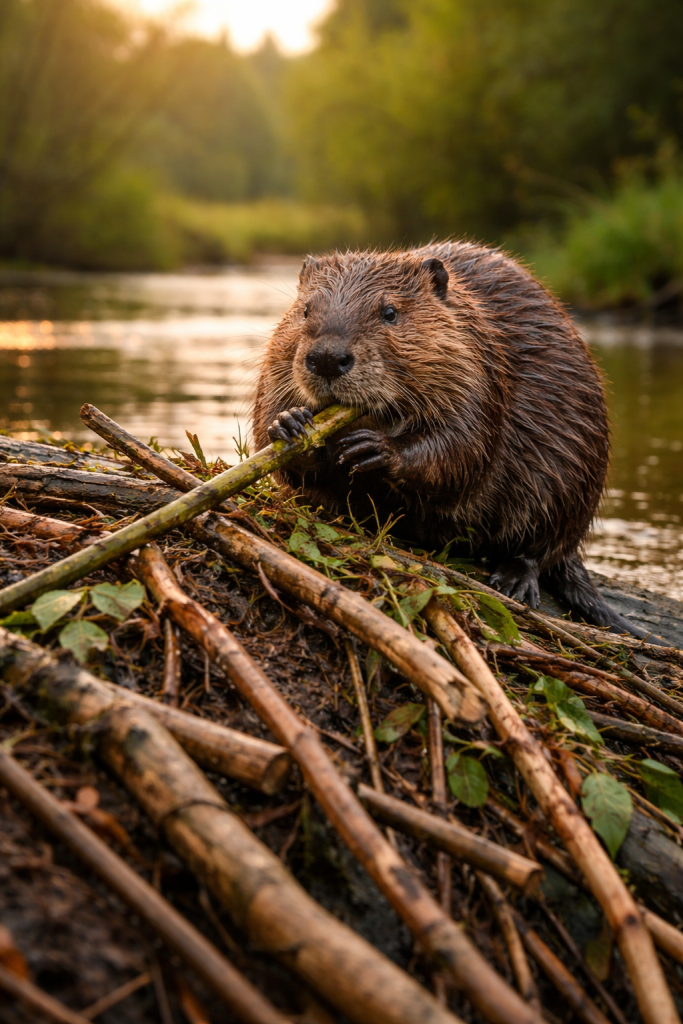
A builder that changes landscapes, not just rivers
Beavers—both the North American (Castor canadensis) and the Eurasian (Castor fiber)—are among the very few animals capable of transforming landscapes at scale.
Using branches, mud, stones, and vegetation, they construct dams that slow down flowing water. What may look chaotic is, in reality, a functional structure that alters how water moves through an area.
And the scale can be remarkable. The largest beaver dam ever recorded, in Alberta, Canada, stretches over 850 meters (2,790 feet) and is visible from satellite images.
But the real impact begins after the dam is built.
From a stream to a living ecosystem
When a beaver blocks a stream, fast-moving water turns into a pond or wetland. This change triggers a cascade of effects.
Sediment settles. Vegetation shifts. Water spreads and becomes more stable.
Over time, these areas turn into rich habitats that support fish, amphibians, birds, and even large mammals. This is why beavers are classified as a keystone species—their presence has a disproportionately large impact on the ecosystem.
Remove the beaver, and the entire system changes.
Water management—without engineering degrees
One of the most studied effects of beaver activity is how it influences water availability.
By slowing down water, their dams allow more of it to seep into the ground, helping recharge underground reserves. In multiple field studies across North America, landscapes with active beaver populations retained significantly more water and stayed hydrated longer during dry periods.
In simple terms, where beavers exist, drought behaves differently.
At the same time, these dams reduce the speed of water during heavy rainfall, spreading it across the landscape and lowering the intensity of floods downstream.
It’s a natural form of water management—continuous, adaptive, and surprisingly effective.
Real-world impact: when beavers help
This isn’t just theory.
In parts of Idaho and Oregon, during severe drought years, researchers observed that areas with beaver activity remained green while surrounding land dried out. The ponds created by beavers acted as natural reservoirs, keeping vegetation alive when water became scarce.
During wildfire seasons in California, satellite images revealed something even more striking: patches of land shaped by beaver activity were significantly less affected—or even untouched—while nearby areas burned.
Without any intention, beavers had created natural fire-resistant zones simply by holding water in the landscape.
But not always in our favor
Despite their benefits, beavers don’t always align with human needs.
There are documented cases in both Europe and North America where beaver dams have flooded farmland, blocked drainage systems, or affected local infrastructure. In smaller water systems, their dams can temporarily reduce downstream flow, impacting agriculture or nearby communities.
Because of this, wildlife management often involves balancing their ecological value with practical concerns—using solutions like controlled water flow devices rather than removing the animals entirely.
Instinct, not design—and still effective
Perhaps the most fascinating part is that beavers don’t “plan” in the human sense.
They don’t calculate or draft designs. Instead, they respond to environmental cues—especially the sound and pressure of moving water. If they detect a leak, they reinforce it. If water flows too fast, they build more.
The result is a structure that adapts, self-corrects, and continues to function.
Not because it’s perfect.
But because it works.
So… better than a human?
Not in intelligence as we usually define it.
But in one specific way—working with natural systems instead of against them—the beaver is remarkably efficient.
It doesn’t try to control nature.
It becomes part of it, reshaping it in ways that support entire ecosystems.
And maybe that’s the real takeaway.
Not whether a beaver builds better than a human.
But whether we’ve forgotten how to build in a way that actually works with the world around us.