
Have you ever wondered how you would react if you knew, without any doubt, that there was no way out?
Not in a hypothetical situation or a movie scene, but in a real moment—when everything you thought you could control suddenly slips away and becomes unavoidable.
I came across a story that, at first glance, feels almost impossible.
An airplane is going down. The atmosphere inside turns heavy, movements become erratic, and people around are panicking—some are crying, others are praying, all trying to make sense of what’s happening.
And yet, in the middle of all that chaos, one passenger sits quietly.
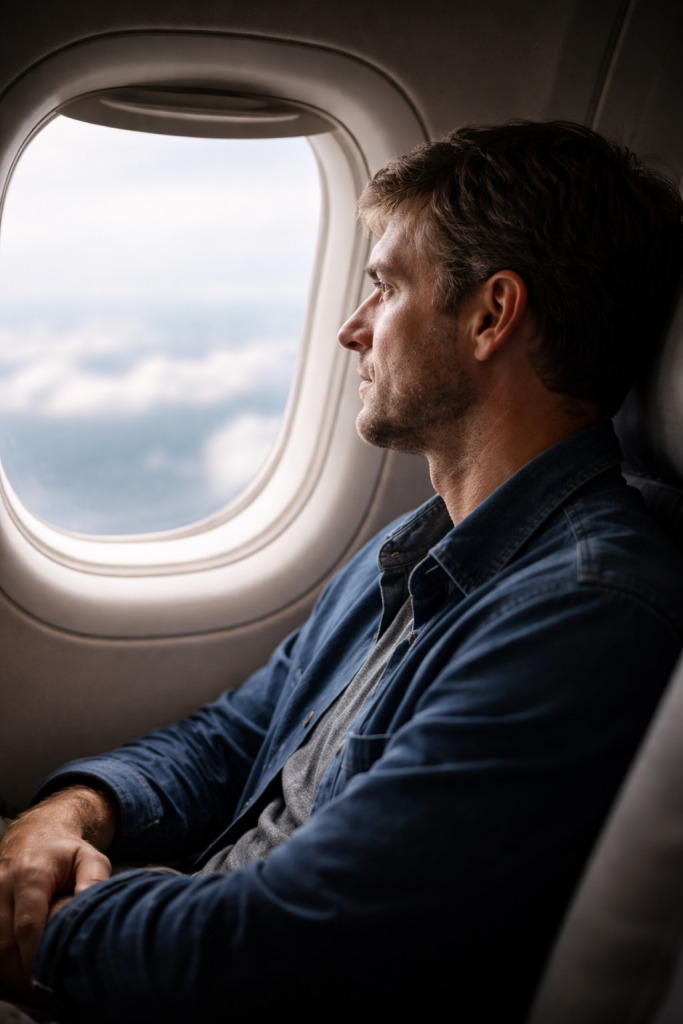
He isn’t shouting. He isn’t reacting like the others. He doesn’t even seem afraid.
The person next to him, confused, asks how he can remain so calm.
His answer is simple, almost unsettling in its simplicity: if the crash is inevitable, he hopes at least they’ll land in a forest—so their bodies might return something to the earth.
It doesn’t sound like a normal response.
And yet, it raises a difficult question:
Is it actually possible not to be afraid of death?
The Brain Doesn’t Always Respond the Way We Expect
In extreme danger, the brain doesn’t operate the way it does in everyday life. It doesn’t carefully analyze options or weigh decisions.
Instead, it switches into survival mode.
At the center of this process is the amygdala, a small but crucial structure responsible for detecting threats. When it senses danger, it triggers a chain reaction throughout the body.
Stress hormones like adrenaline and cortisol are released, increasing heart rate, raising blood pressure, and preparing the body to act.
This is the response most of us are familiar with—the classic fight, flight, or freeze reaction.
But the reality is more complex than that.
When Calm Appears Where You Least Expect It
Alongside these well-known reactions, there are moments when the brain activates a different kind of response—one that feels counterintuitive.
When it recognizes that there is no escape, no solution, it may begin to lower the intensity of emotional distress.
This is not weakness. It’s a form of protection.
Some people enter a deep freeze state, while others experience a type of psychological distancing known as dissociation. In this state, reality feels slower, more distant, almost as if it’s no longer fully happening to them.
From the outside, it can look like unusual calm.
But internally, it’s the brain adapting to a situation it can no longer change.
Paradoxically, calm in these moments is not the absence of reaction—it is simply a different kind of response.
Acceptance Is Not the Same as Fearlessness
We often think there are only two possibilities: either you’re afraid, or you’re not.
In reality, human responses are far more nuanced.
It’s possible to feel fear and, at the same time, stop resisting it. To understand what’s coming and reach a point where the mind no longer searches for an escape.
In that sense, calm isn’t the absence of emotion.
It’s what happens when the brain stops fighting what it cannot control.
Some People Have Chosen This Calm
There are also moments when this kind of calm is not just biological, but conscious.
Not just in stories.
In real life, there have been people who, when faced with death, chose not to run—even when they had the chance.
One example is Janusz Korczak.
A Polish doctor and educator who ran an orphanage during World War II, he was given an opportunity to escape when the children under his care were being deported to the Treblinka extermination camp.
He refused.
He chose to stay with them.
Not because he didn’t understand the danger or because he felt no fear, but because, in that moment, abandoning them would have been harder than facing what was coming.
This kind of calm does not come from a lack of emotion.
It comes from a decision.
What Actually Frightens Us
Maybe it’s not death itself that is hardest to accept.
Maybe it’s the loss of control.
The idea that nothing can be changed, that there are no more options, that all the systems we rely on to feel safe suddenly stop working.
And yet, in those moments, the mind sometimes finds an unexpected way to cope.
Not through resistance.
But through acceptance.
What Remains, Beyond the Explanation
The story of the airplane may or may not be real.
But the reaction is not impossible.
Because human beings are not built to respond in just one way. Some will panic. Others will fight until the very end.
And some, for a brief moment, will become unexpectedly calm.
Not because they feel nothing.
But because, somewhere deep inside, their mind has chosen a different way to face what cannot be changed.
Because sometimes, in the face of the inevitable, what defines us is not our instinctive reaction—
but the way we choose to remain.