
Most of the time, you don’t think about the color of your eyes. It’s not something you check, and it rarely draws your attention. And yet, there are moments when that sense of normal quietly shifts, often in a way that seems almost insignificant at first, when you look in the mirror or someone close to you points out that something feels different.
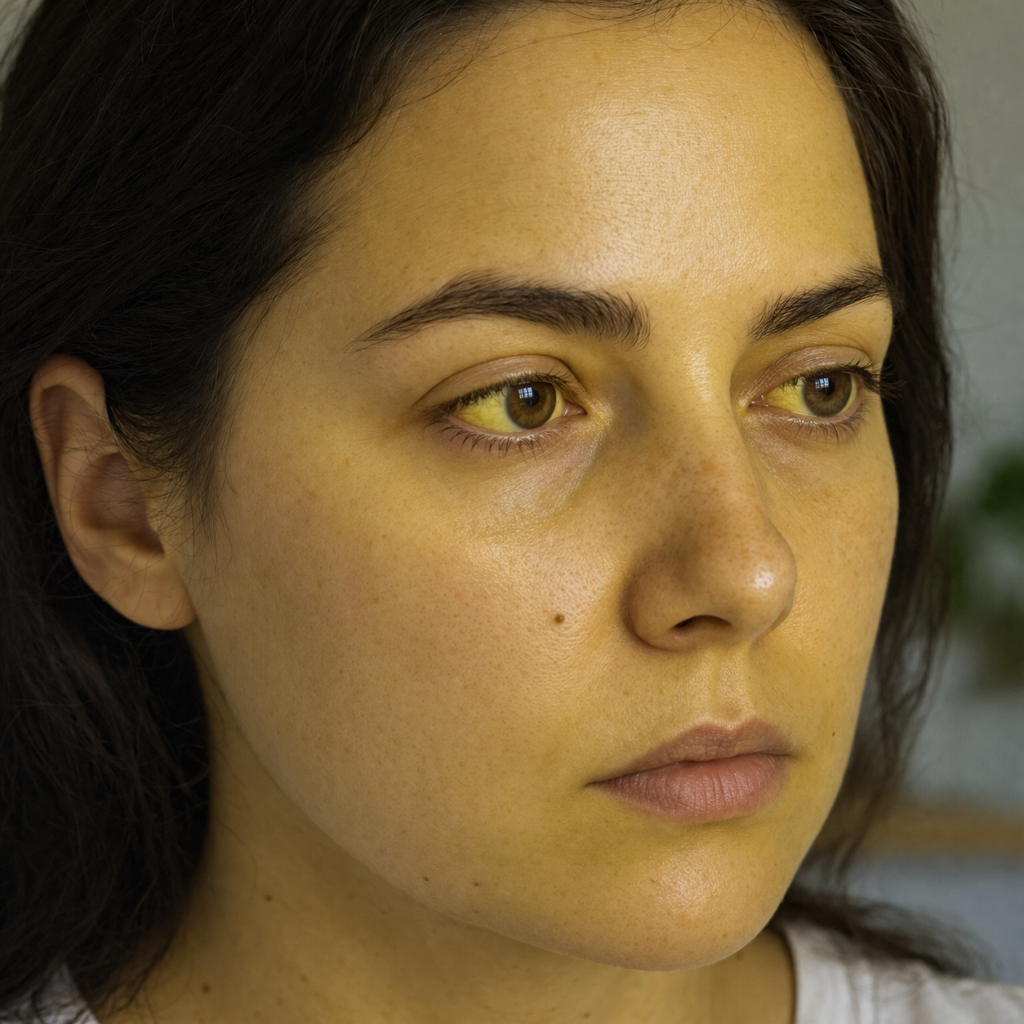
It’s not the lighting. It’s not just fatigue. The white of your eyes doesn’t look quite white anymore. There’s a subtle yellow tint.
That small detail is often one of the first visible signs of something happening inside the body: jaundice.
It is not a disease on its own, but a signal that your body is trying to manage an imbalance.
Where the yellow color actually comes from
Every day, your body replaces millions of aging red blood cells. As part of this natural process, a substance called bilirubin is produced. Under normal conditions, the liver takes this bilirubin, processes it, and prepares it to be eliminated through bile and, eventually, through the digestive system.
As long as this system works properly, bilirubin does not accumulate and remains invisible.
The problem begins when this balance is disrupted and bilirubin starts to build up in the bloodstream.
Why the eyes show it first
As bilirubin levels rise, it begins to deposit in tissues. The skin may gradually change color, but one of the earliest and most noticeable signs appears in the eyes.
The sclera, the normally white part of the eye, highlights even subtle changes, which is why jaundice is often first noticed there before it becomes obvious on the skin.
It is one of the few situations where the body gives a clear visual clue about an internal process.
Why it’s common in newborns—and why that’s different
For many parents, jaundice in newborns can be worrying, especially because it appears quickly and is easy to notice. In many cases, however, it is part of a normal adjustment after birth.
Newborns break down a different type of hemoglobin used during pregnancy, which leads to higher bilirubin production. At the same time, their liver is still maturing and may not process bilirubin as efficiently as an adult liver.
This combination explains why jaundice is common in the first days of life. In most cases, it resolves on its own or with minimal support, although higher levels may require monitoring or treatment.
Where the process can be disrupted later in life
Beyond the newborn stage, the mechanism remains the same, but the causes can vary and may require medical attention.
In some situations, the body produces more bilirubin than it can process, such as when red blood cells break down faster than normal.
In other cases, the liver may not process bilirubin efficiently due to inflammation or other conditions affecting its function.
There are also situations where bilirubin is processed but cannot be properly eliminated because bile flow is blocked.
Although these situations may look similar from the outside, the underlying causes can be very different.
Does age or context matter?
The core process is the same, but context makes a difference.
In newborns, jaundice is common and often temporary, but it still needs monitoring. In older children and adults, however, its appearance should not be ignored and usually requires medical evaluation.
There are also specific situations, such as pregnancy or certain inherited conditions, that can influence how bilirubin is processed, but these are particular cases rather than the general rule.
Other signs your body may show
Along with yellowing of the skin and eyes, other changes may appear. Urine can become darker, stool lighter in color, and some people may experience fatigue or abdominal discomfort.
These are not random symptoms, but part of the same internal process.
How serious is it and when should you see a doctor?
Jaundice is not something to ignore, but it does not always mean an immediate emergency. The context matters.
In newborns, it is common and often temporary, but it should be monitored to ensure bilirubin levels remain within a safe range.
In adults and older children, however, the appearance of jaundice is usually a sign that the body needs medical evaluation, even if there are no other obvious symptoms.
You should see a doctor if you notice yellowing of the eyes or skin, especially if it appears suddenly or becomes more noticeable over time.
More urgent evaluation is recommended if jaundice is accompanied by symptoms such as:
– very dark urine
– pale or clay-colored stools
– abdominal pain, especially in the upper right side
– fever
– nausea or vomiting
– unusual fatigue or weakness
These signs do not always indicate something severe, but they do suggest that the body is under stress and should be checked.
Why timing matters
In some cases, jaundice may be linked to conditions that are much easier to manage when identified early. Delaying evaluation can make diagnosis and treatment more complicated, not because every case is serious, but because the cause is not always obvious.
That is why it is better to check than to assume.
A signal you shouldn’t ignore
Many processes in the body happen quietly, without visible signs.
Jaundice is not one of them.
It is visible, direct, and difficult to ignore.
It may not tell you exactly what is wrong, but it clearly tells you that something has changed.
And sometimes, that is reason enough to pay attention.