
There is a marine creature that doesn’t just look unusual, it experiences the world in a way that is fundamentally different from anything we can relate to. It’s not simply a matter of “seeing more colors,” but of perceiving reality through a visual system that works on entirely different rules.
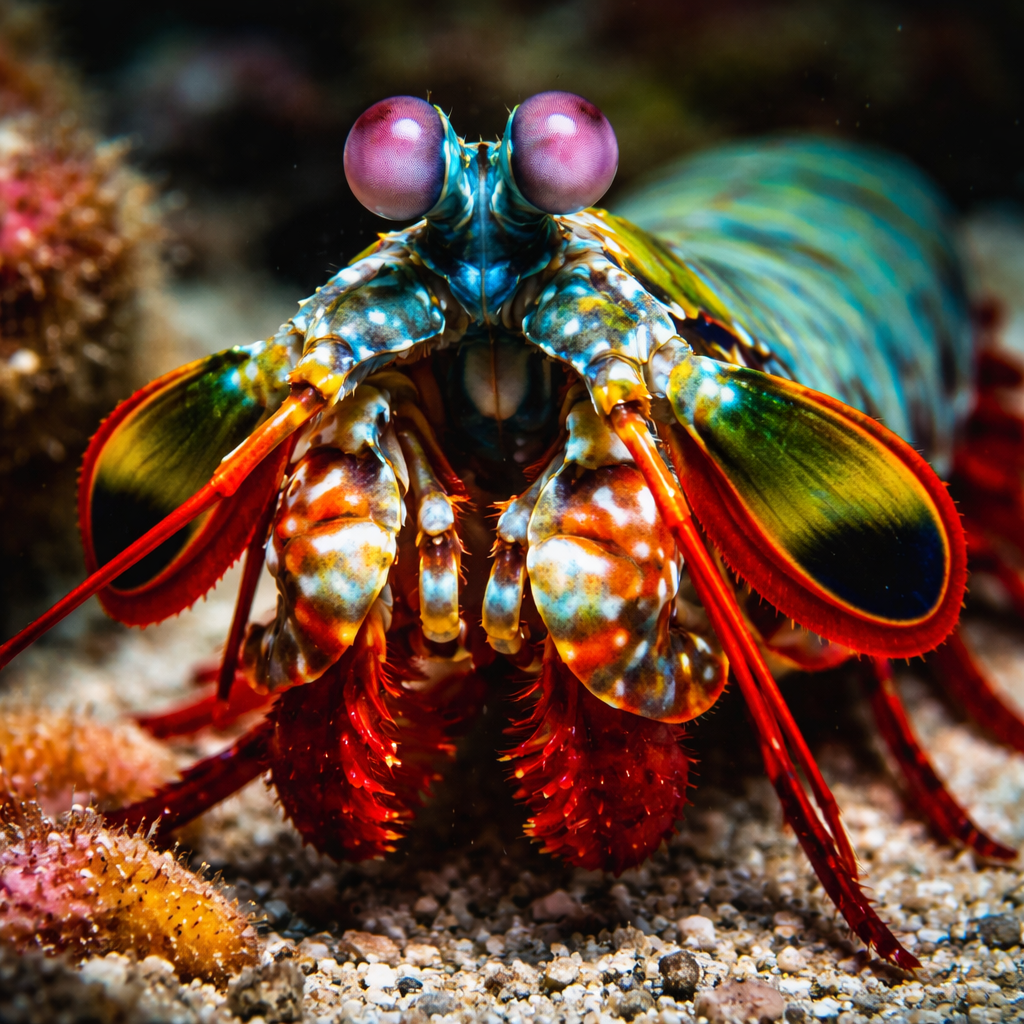
The mantis shrimp is often described as one of the most extraordinary animals in the ocean, not only because of its striking appearance, but because it challenges something we rarely question: how much of what we call “reality” is actually limited by the way we are built to perceive it?
It doesn’t just see more… it sees differently
Human vision is based on three types of color receptors, which allow us to interpret light and create a wide range of shades. It’s a system built on combination and interpretation.
The mantis shrimp, however, has between 12 and 16 different types of color receptors. At first glance, this sounds like it should allow it to see a richer, more detailed world than we do. Surprisingly, that’s not exactly how it works.
Instead of blending colors into countless subtle variations, the mantis shrimp detects specific wavelengths more directly, almost like a rapid scanning system. Rather than interpreting color, it identifies it.
What we experience as nuance, it processes as distinct signals.
Colors beyond human perception
Beyond the visible spectrum, mantis shrimp can detect ultraviolet light and polarized light, forms of visual information that humans simply cannot perceive.
This means there are details in the environment that are completely invisible to us, not because we’re inattentive, but because our biology doesn’t allow us to access them.
It’s one of those rare cases where it’s not just that we see less, it’s that we don’t even know what we’re missing.
Eyes that work independently
Each eye of the mantis shrimp can move and function almost independently, scanning different parts of the environment at the same time.
This gives it a highly efficient way to monitor its surroundings without needing to reposition its body, turning its vision into a constant, active detection system.
It’s not designed for beauty. It’s designed for survival.
A strike that leaves no time to react
If its vision is impressive, its physical abilities are just as remarkable. The mantis shrimp can deliver an incredibly fast strike using specialized front limbs, reaching speeds that create a phenomenon known as cavitation.
This process forms tiny bubbles in the water that collapse violently, producing a second impact in addition to the initial strike.
Because of this, the mantis shrimp is considered to have one of the fastest and most powerful strikes in the animal kingdom relative to its size.
In certain conditions, that force is strong enough to break hard shells and even crack thin aquarium glass.
Precision, not just power
What makes this creature truly effective is not just strength, but the combination of perception and timing. Its advanced visual system allows it to identify the exact moment to strike, and the speed of the attack leaves little chance for escape.
It is a rare example of perception and action working almost instantly together.
Encounters with humans
Mantis shrimp are not typically dangerous to humans, but they are not animals that should be handled carelessly. There have been instances where they caused injuries or damaged aquariums, usually as a defensive reaction rather than intentional aggression.
At the same time, they are widely admired and studied because of their unique biology and behavior.
A reminder of how limited our perception really is
What makes the mantis shrimp truly fascinating is not just how different it is, but what it reveals about us.
We tend to assume that the world we see is complete, that what we perceive represents reality as it truly is. But creatures like the mantis shrimp remind us that our experience is only a filtered version, shaped by the limits of our senses.
Somewhere beneath the surface, there are animals experiencing the same world in ways we will never be able to fully understand.