
If you ever spot an otter floating peacefully on the water, paws resting on its chest and expression relaxed, it’s easy to think you’re looking at one of the most playful and carefree animals in nature.
And in many ways, that impression isn’t wrong.
But beneath that seemingly simple behavior lies a level of intelligence and adaptability that makes otters far more complex than they appear.
One of the few animals that use tools
Otters are among the rare mammals that regularly use tools in the wild.
When feeding on shellfish like clams or mussels, they don’t rely on brute force. Instead, they select a rock and use it to crack open their food. Some even keep a favorite stone, storing it in a loose fold of skin under their arm, almost like a built-in pocket.
This isn’t random behavior.
It reflects learning, memory, and problem-solving—traits we usually associate with much larger or more “advanced” animals.
A bond that goes beyond instinct
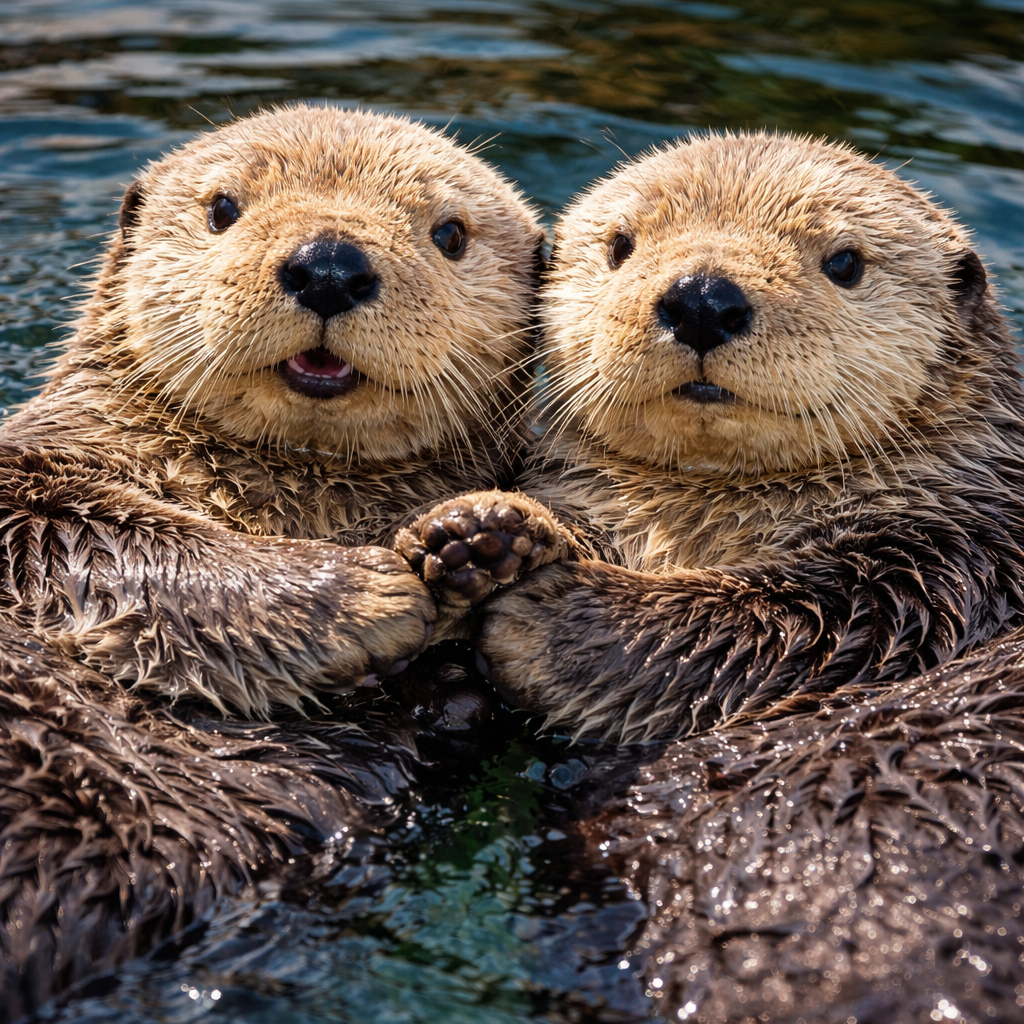
One of the most well-known behaviors of sea otters is the way they hold hands while resting on the water.
It may look like a touching, almost human gesture, but it serves a practical purpose.
In areas with currents, this helps them stay together and prevents them from drifting apart while they sleep. It also strengthens group cohesion and creates a sense of safety within the group.
It’s a small detail, but one that says a lot about how they interact.
Fur that replaces body fat
Unlike many marine mammals, otters don’t rely on a thick layer of fat to stay warm.
They depend on their fur.
And not just any fur—otters have one of the densest coats in the animal kingdom, with hundreds of thousands of hairs per square inch. This density traps air close to the skin, creating an insulating layer that protects them from cold water.
It’s highly effective, but also demanding.
Otters spend a significant amount of time grooming, because if their fur loses its insulating properties, their survival is at risk.
Encounters with humans – curiosity with limits
One of the most fascinating aspects of otters is how they sometimes interact with people.
In certain areas, wild otters have been observed approaching kayakers or divers, seemingly out of curiosity. There are even cases where they’ve brought objects like shells or stones, or lingered nearby longer than expected.
At first glance, these moments can feel almost like friendliness.
But they’re easy to misinterpret.
Otters are not seeking relationships with humans. They are wild animals—curious, observant, and responsive to their environment. When they become too accustomed to people or feel threatened, especially when protecting their young, their behavior can shift quickly.
There have been situations where otters became defensive or even aggressive when boundaries were crossed.
It’s not a contradiction.
It’s the natural balance between curiosity and instinct.
More than just a “cute” animal
What makes otters truly fascinating isn’t just their appearance or playful behavior.
It’s the combination of traits they bring together.
Intelligence, adaptability, social bonding, and a remarkable ability to use their environment to their advantage.
They may look simple.
But in reality, they are anything but.
A quiet form of intelligence
Otters don’t impress through size or strength.
They’re not the fastest, nor the most dangerous animals in the ocean.
But they are among the most finely adapted.
And maybe that’s what makes them so compelling.
Because sometimes, intelligence doesn’t need to be loud.
It can be subtle, efficient, and unexpectedly elegant.