
There’s a moment many people don’t recognize until it happens to them.
You lie down at night, everything around you is completely quiet, and yet the silence doesn’t feel like silence. Somewhere in the background, a faint sound appears—a ringing, a buzzing, or a soft, steady tone that doesn’t seem to come from the room at all.
Your first instinct is to look for a source. You check the environment, wondering if something is on or humming nearby, but after a few seconds it becomes clear that the sound isn’t coming from outside.
It’s coming from within.
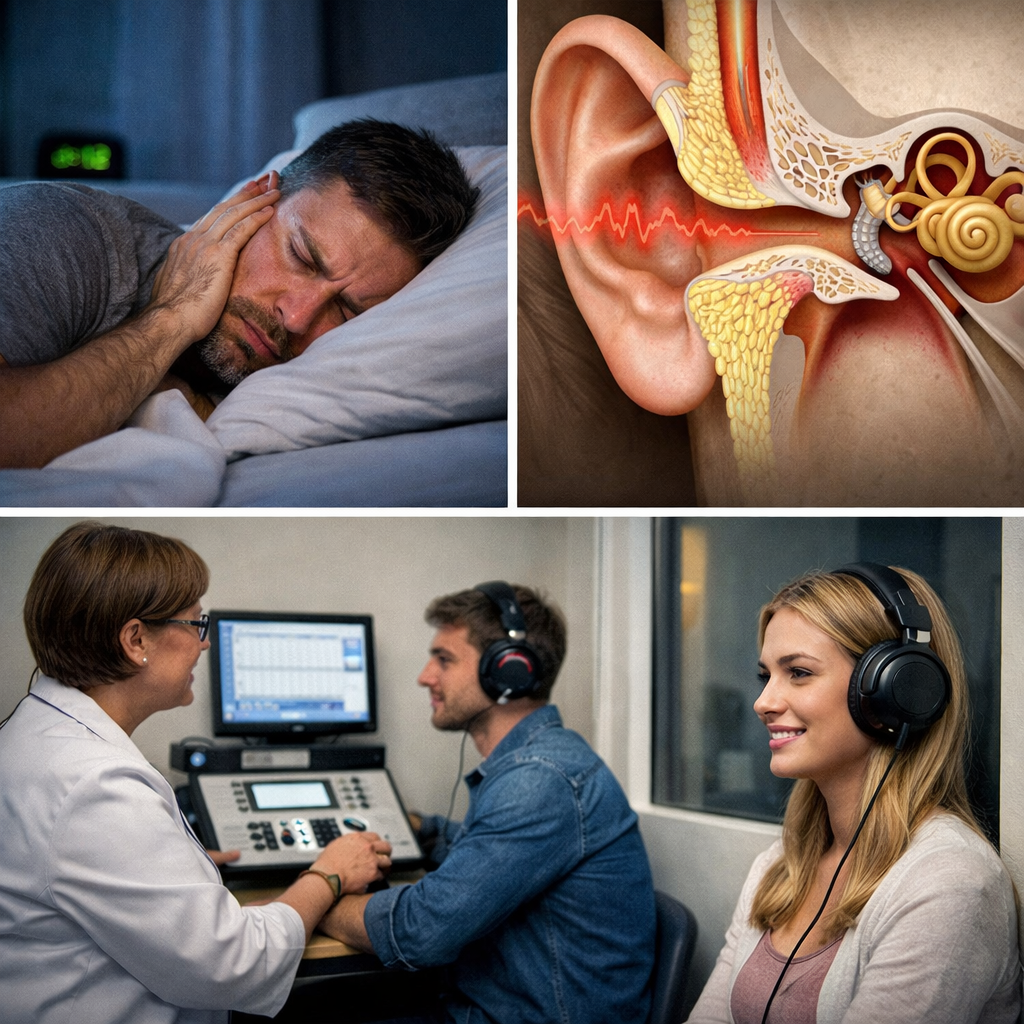
A sound that isn’t external, but feels completely real
Tinnitus isn’t a disease on its own. It’s a symptom, and it reflects how the brain interprets incomplete or altered signals from the auditory system.
Under normal conditions, sound waves are captured by the inner ear, where tiny hair cells convert vibrations into electrical signals. These signals travel to the brain, which then processes them into recognizable sounds.
When those hair cells are affected—whether from noise exposure, aging, or other factors—the signal becomes disrupted. In some cases, it’s distorted. In others, it’s partially missing.
The brain isn’t designed to tolerate gaps in sensory input.
So it compensates.
In doing so, it generates its own signals, which are perceived as sound even though there is no external source. That’s why the experience feels so real.
Why it’s often compared to a “phantom sound”
A helpful way to understand tinnitus is to compare it to what’s known as phantom limb sensation, where someone continues to feel sensations in a limb that is no longer there.
In tinnitus, the experience isn’t physical pain, but sound.
The brain is essentially “filling in” what it expects to hear.
This isn’t a malfunction in the usual sense.
It’s an adaptation—just one that becomes noticeable.
What can trigger tinnitus
Tinnitus can have multiple causes, and often more than one factor is involved. Common triggers include prolonged exposure to loud noise, whether through headphones, concerts, or certain work environments, age-related hearing changes, ear infections or blockages, and prolonged stress or fatigue.
Some medications can also contribute.
In many cases, tinnitus is associated with subtle hearing loss, even if the person isn’t immediately aware of it.
Why it feels louder in quiet environments
Many people notice that tinnitus becomes more noticeable at night or in quiet settings.
This doesn’t necessarily mean the sound itself is getting stronger.
It means there’s nothing else masking it.
During the day, the brain is busy processing external sounds, which makes the internal signal easier to ignore. In silence, attention shifts toward that internal noise, making it feel more prominent.
The role of stress and the brain
Tinnitus is not just about the ear.
It also involves how the brain processes attention and emotion.
Areas responsible for focus and emotional response can amplify how the sound is perceived. That’s why two people with similar tinnitus can experience it very differently.
For one, it may barely register.
For another, it can become distracting or exhausting, especially during periods of stress.
Stress doesn’t necessarily cause tinnitus, but it can make it more noticeable and harder to ignore.
Are there differences by age or sex?
Tinnitus becomes more common with age, particularly after 50 or 60, largely due to natural changes in hearing.
However, it is increasingly reported among younger individuals, especially those frequently exposed to high volumes through headphones or noisy environments.
When it comes to differences between men and women, studies suggest that men may be slightly more likely to develop tinnitus, possibly due to higher exposure to loud environments, while women tend to report a stronger emotional impact.
These are trends, not strict rules, but they appear consistently in research.
When should it be checked?
In most cases, tinnitus is not a sign of a serious condition, but it does indicate that something has changed in how the auditory system is functioning.
It’s important to seek medical evaluation if it appears suddenly, affects only one ear, is accompanied by dizziness or noticeable hearing loss, or becomes progressively worse over time.
Can it go away?
In some cases, yes.
If tinnitus is linked to a temporary cause, it may resolve on its own. In other situations, it may persist, but the brain gradually learns to tune it out through a process called habituation.
This means the sound is still present, but it no longer occupies your attention in the same way.
When silence changes
Perhaps the hardest part to understand is that the sound doesn’t come from the outside world, yet it feels entirely real.
It’s the result of the brain trying to maintain balance when incoming information is incomplete.
Not a failure.
But an adaptation.
And sometimes, silence doesn’t disappear.
It simply changes into something your brain eventually learns to place in the background.