
At some point, you may have tried to figure out whether your blood type makes sense compared to your parents’, maybe as a school exercise or simply out of curiosity when genetics started to feel less abstract and more logical. On the surface, everything seems straightforward: there are four main blood types — A, B, AB, and O — and the combination between two parents should lead to a predictable result.
And in most cases, it does.
Each of us inherits genetic information from both parents, and when it comes to blood types, this inheritance follows a set of fairly clear rules. There are three basic “instructions” involved — A, B, and O — and the way they combine determines the final outcome. If you receive A from both parents, your blood type will be A. If you receive A from one and B from the other, the result is AB. If you receive only O, your blood type will be O. And if the combination is A and O or B and O, the result will be A or B, because those traits are expressed more strongly than O.
Up to this point, everything feels simple and almost impossible to get wrong.
But real genetics is a little more nuanced than the label we see.
When someone has blood type A, that doesn’t tell the full story. That person may have inherited A from both parents, or A from one and O from the other. The same applies to blood type B. In contrast, blood type O only appears when both inherited “instructions” are O, while AB is the only case where A and B are both expressed together.
This small detail completely changes how you look at the results.
Because it explains situations that, at first glance, seem impossible.
For example, two parents with blood type A can have a child with type O, but only if both carry an “hidden” O in their genetic combination. From the outside, you only see A and A and expect A or AB, but the underlying genetics are more complex. Similarly, a parent with type A and one with type B can have a child with type O, even though that result often feels counterintuitive to someone unfamiliar with how inheritance works.
And this is where things can become misleading.
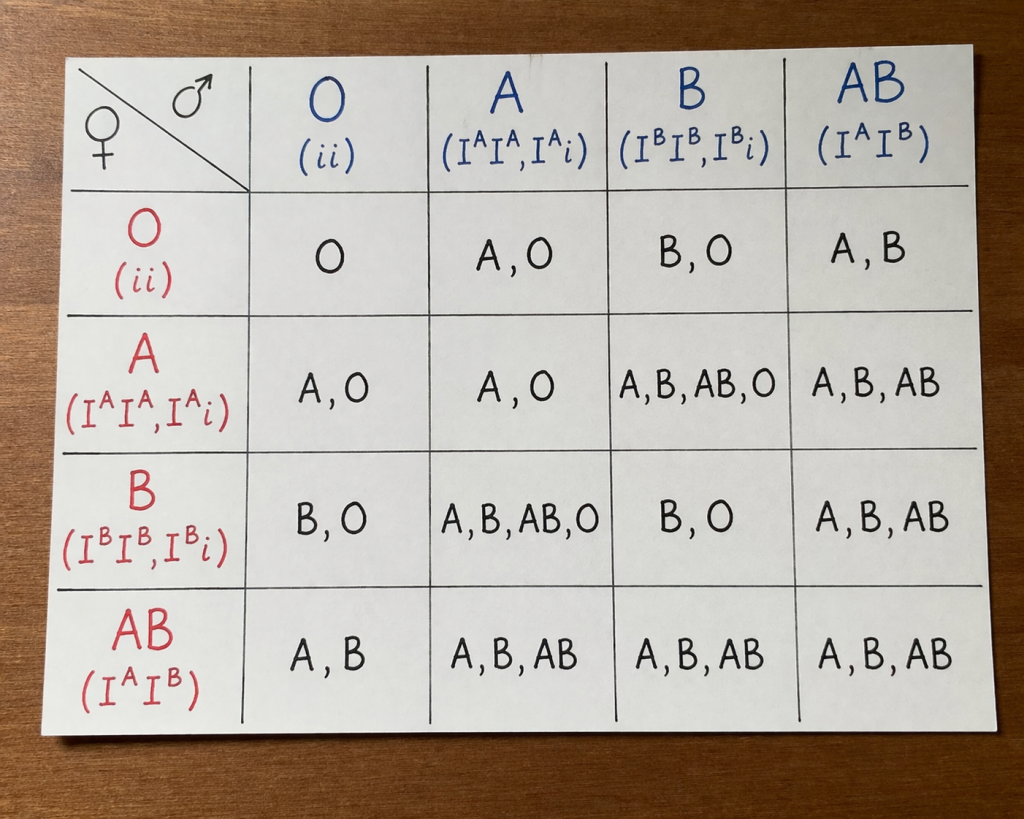
These rules are real, but they are often oversimplified, which leads people to draw strong conclusions from incomplete information. What we see — the letter of the blood type — is only the visible result, not the full genetic combination behind it.
This may also explain why so many ideas have circulated over time about blood types meaning more than they actually do. Some people remember hearing, even as children, that certain blood types were linked to personality or behavior, with labels that sounded oddly convincing at the time. In reality, blood type doesn’t define who you are. It doesn’t determine your character, your choices, or your behavior.
Still, these same simple rules can sometimes lead to uncomfortable questions.
Even so, there are clear limits. For example, two parents with blood type O cannot have a child with A, B, or AB, and this is one of the few situations where the rules are very strict. But even then, modern medicine does not use blood type as a definitive way to establish biological relationships, because there are rare cases where things don’t perfectly follow the expected patterns, whether due to unusual genetic variations or testing errors.
Beyond inheritance, blood type also plays a practical role in everyday medicine, even if we rarely think about it. For instance, type O is often referred to as a universal donor for red blood cells, while individuals with type AB can receive blood from any group, something that becomes critically important in emergency situations.
Alongside the ABO system, there is another factor that becomes especially important during pregnancy: the Rh factor.
This doesn’t change the blood type itself, but adds a positive or negative sign depending on whether a certain protein is present on red blood cells. If the protein is present, the blood type is Rh positive; if not, it is Rh negative.
Complications can arise when a mother is Rh negative and the baby inherits Rh positive from the father. In this situation, the mother’s immune system may recognize the baby’s blood as foreign and produce antibodies against it. In the past, this could lead to serious complications, particularly in later pregnancies.
Today, however, this risk is largely preventable. With the use of anti-D immunoglobulin during and after pregnancy, the immune response can be controlled effectively, and most pregnancies proceed without major issues.
When you look at the bigger picture, blood type is one of those things that seems simple and fixed, but actually reflects a complex and precise biological system, tied to inheritance and to the way the body distinguishes between what belongs and what doesn’t.
Perhaps the most interesting part is not that these rules exist, but how easy it is to believe we fully understand them, when in reality we are only seeing part of the story.
Because sometimes, your body knows exactly where it comes from.
It just doesn’t always reveal the whole story.