
If you were to look at it for the first time, you might not even realize what you’re seeing. Its body seems to shift, flicker, and dissolve into the background, as if it’s not entirely there.
And that’s exactly the point.
The cuttlefish is one of the most advanced masters of visual deception in the animal world—an animal that can mislead, distract, and even manipulate perception without ever needing to move.
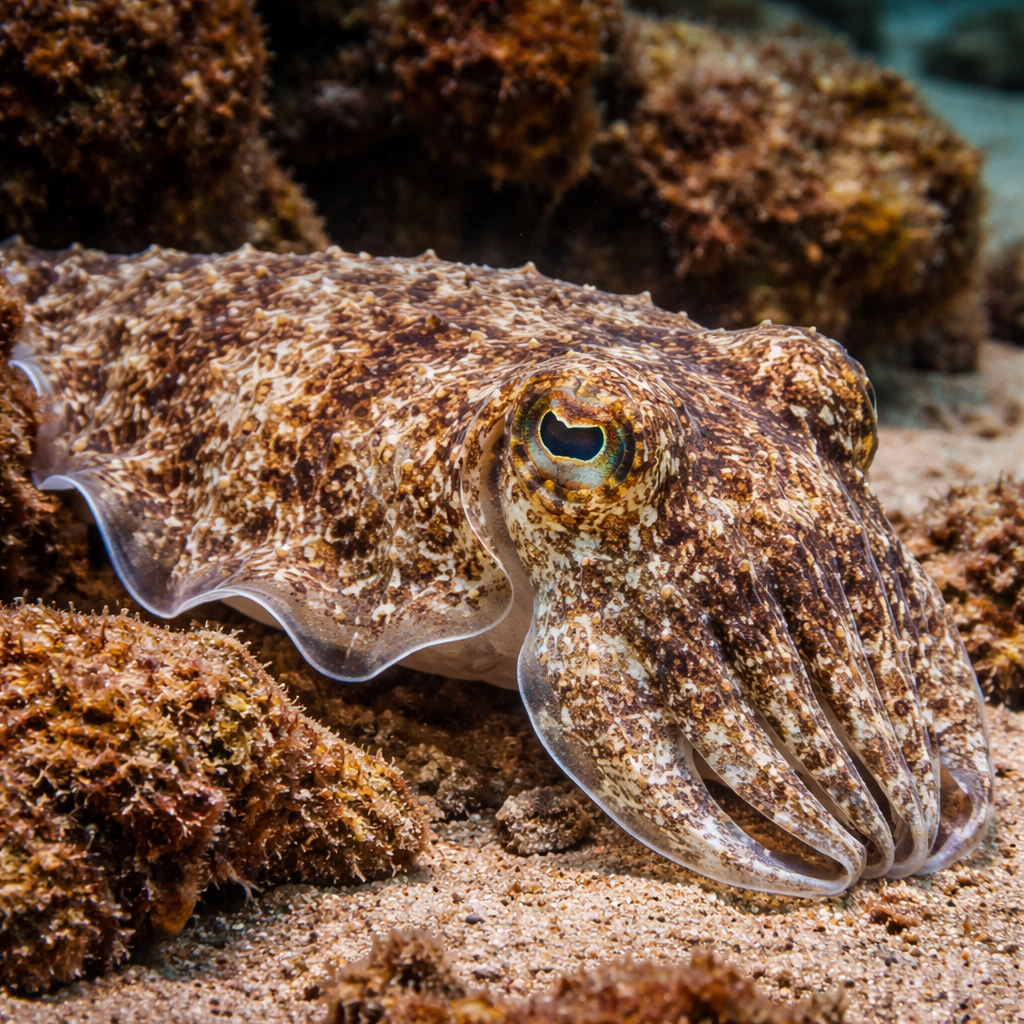
Skin that behaves like a living screen
Unlike most animals, the cuttlefish doesn’t rely on a fixed color or pattern. Its skin is dynamic, controlled by specialized cells called chromatophores, along with layers that reflect and scatter light.
The result is extraordinary.
It can change color, contrast, and texture almost instantly, blending perfectly with rocks, sand, or coral. But camouflage is only part of the story.
Cuttlefish can also generate moving patterns across their skin—waves, flashes, and shifting contrasts that look almost like animated visuals.
It’s not just hiding.
It’s actively controlling what others see.
The illusion that confuses prey
One of the most fascinating behaviors is how the cuttlefish hunts.
Instead of chasing its prey, it sometimes creates rhythmic patterns on its body—subtle pulses of light and dark that appear to move across its skin. These visual signals can confuse or overload the prey’s perception.
In some cases, small animals seem to hesitate, freeze, or misjudge distance.
That moment is enough.
The cuttlefish strikes with incredible speed.
Scientists still study exactly how effective this “hypnotic” display is, but the behavior is real and has been observed repeatedly in controlled and natural environments.
A vision system unlike anything else
What makes this even more remarkable is how the cuttlefish sees the world.
It is believed to be colorblind in the traditional sense, yet it can produce incredibly precise color matches with its environment.
Even more unusual, its pupils have a distinctive W-shape, which may help it detect contrast and polarization of light rather than relying purely on color.
In other words, it doesn’t see the world the way we do—but it manipulates visual reality better than most animals that do.
Communication through illusion
Cuttlefish don’t just use their abilities for hunting or hiding.
They also communicate.
Males can display complex patterns to attract females while simultaneously showing a completely different pattern on the other side of their body to deceive rival males.
It’s a form of split signaling—almost like running two different “visual messages” at the same time.
Few animals can do anything comparable.
Encounters with humans
Despite their abilities, cuttlefish are not dangerous to humans. They are generally shy and prefer to avoid interaction.
However, divers who encounter them often describe the experience as surreal, especially when watching the animal shift colors and patterns in real time.
It feels less like observing a fish and more like watching something… thinking.
A different kind of intelligence
Cuttlefish are part of the cephalopod family, alongside octopuses and squids, a group known for advanced nervous systems and complex behavior.
Their ability to adapt, deceive, and respond to their environment in real time suggests a level of processing that goes far beyond simple instinct.
The illusion is the reality
What makes the cuttlefish truly fascinating is not just its ability to hide.
It’s its ability to alter perception.
An animal that can create movement without moving, signal without sound, and manipulate what others see without ever being noticed.
Sometimes, the most powerful form of defense is not strength or speed.
It’s the ability to control the story others believe they are seeing.