
Most of the time, we don’t really stop.
We see an insect, label it quickly in our minds — bee, bumblebee, something that might sting — and move on. No curiosity, no second thought. Just a reflex.
And maybe that’s exactly why some moments stand out.
Not because they’re dramatic.
But because they don’t fit what we thought we knew.
One such moment began in the simplest way. A woman in Scotland, Fiona Presly, was working in her garden when she noticed a bumblebee on the ground. It wasn’t flying. It wasn’t trying to move.
It was just there.
When she picked it up, she understood why.
It had no wings.
For a bumblebee, that isn’t a minor issue. It’s essentially a death sentence. Without the ability to fly, it can’t reach flowers, can’t gather food, can’t function the way it’s meant to. Under normal circumstances, it wouldn’t survive long.
But that’s not what happened.
Instead of leaving it there, she did something simple. She offered it sugar water — a quick source of energy — and moved it somewhere safe. It was a small gesture, with no expectations attached.
But in the days that followed, things didn’t unfold the way you’d expect.
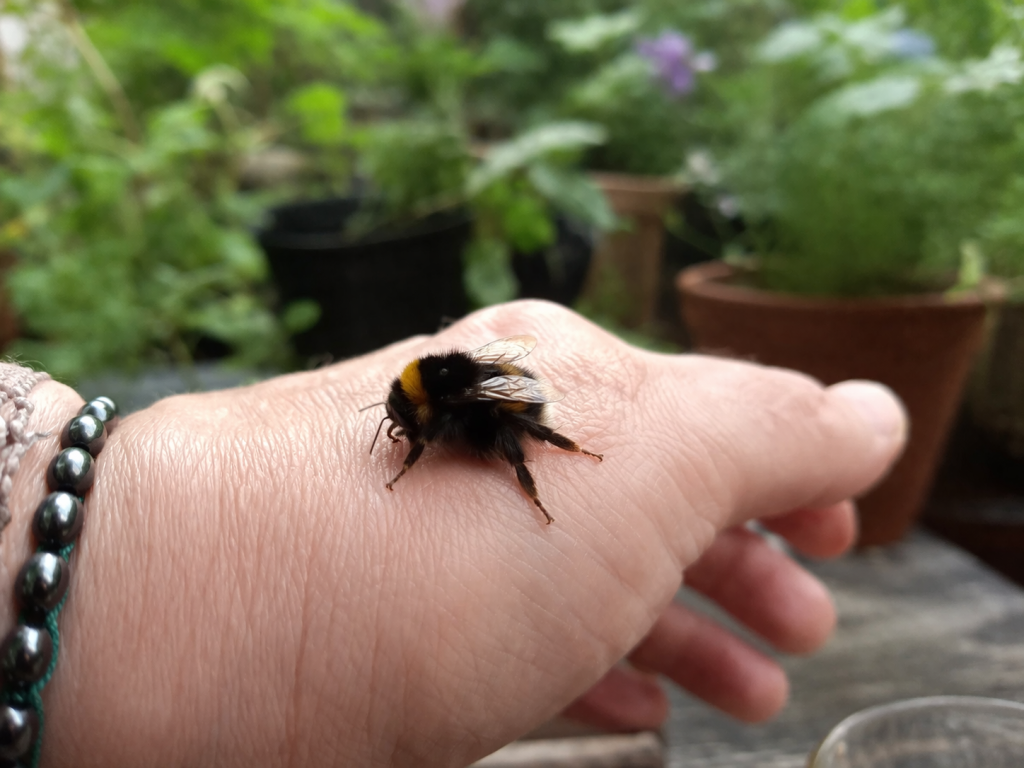
When an Insect Starts Coming Back
The bumblebee didn’t disappear.
It stayed nearby. And each time Fiona came to check on it, the same thing happened: it would emerge and move toward her. It would climb onto her hand and remain there.
No panic. No defensive reaction.
Just a quiet, repeated kind of tolerance.
Over time, the behavior became consistent. The bumblebee returned to the same place, reacted to her presence, and — within the limits of what it could do — seemed to choose proximity.
From the outside, it feels surprising.
From a scientific perspective, though, there are explanations — even if they’re not always intuitive.
What We Actually Know About Bumblebees
Bumblebees, part of the Bombus genus, are among the most important pollinators in both natural ecosystems and agriculture. While they’re often confused with honeybees, they differ in more ways than just appearance.
They are larger, rounder, and covered in dense hairs that give them that soft, fuzzy look. Those hairs aren’t just for show — they play a crucial role in collecting pollen, which sticks far more efficiently to their bodies.
Unlike honeybees, bumblebees live in smaller colonies, typically made up of dozens or a few hundred individuals rather than thousands. Their colonies are also seasonal: each year, a single queen survives the winter and starts a new colony from scratch.
Another remarkable trait is their ability to fly in cooler temperatures. By vibrating their flight muscles, they can generate heat, which allows them to stay active when many other insects cannot.
But perhaps the most fascinating aspect is how they pollinate.
Bumblebees use a technique known as “buzz pollination.” They grip a flower and vibrate their bodies to release pollen more effectively — a method essential for certain plants, including tomatoes and blueberries.
Memory, Learning, and Adaptation
Despite having very small brains, bumblebees are capable of surprisingly complex behavior.
They can learn from experience. They remember locations. They build efficient foraging routes and return to places where they’ve found food before. They can distinguish colors and patterns, and even subtle differences in shapes.
In controlled studies, bumblebees have shown the ability to solve simple tasks and even learn by observing other bees.
This means their behavior isn’t purely instinctive. It’s adaptable.
And in that context, what happened in Fiona Presly’s case becomes easier to understand.
The bumblebee didn’t form an emotional bond.
But it learned.
It associated her presence with food, safety, and the absence of threat.
So it stayed.
Why It Feels Like Something More
For us, interactions like this are easy to interpret emotionally.
We see repetition, proximity, a lack of fear — and we translate it into familiar terms: trust, attachment, even affection.
But the reality is more nuanced.
What’s happening is a combination of:
recognition
association
learning
And yet, the result is complex enough that it doesn’t feel purely mechanical.
That’s where the disconnect comes from.
A Small Story With a Bigger Meaning
What makes this story compelling isn’t that a bumblebee stayed close to a human.
It’s what that moment reveals about how we see the natural world.
We tend to divide things too simply: intelligent animals versus simple ones, complex behavior versus instinct.
But reality doesn’t always follow those lines.
Between automatic reactions and complex cognition, there’s a middle ground — one where learning, adaptation, and environment interact in ways we’re only beginning to understand.
And sometimes, it takes something as small as a wingless bumblebee — and a simple act of care — to remind us of that.
This isn’t a story about an insect becoming a pet.
It’s a story about how easily we underestimate the small things.
And how different they can seem, once we actually take the time to notice them.