
Most of the time, you don’t feel it happen.
There’s no sharp sting, no sudden pain, no clear moment that makes you stop and look. You might have been in a park, walking through grass, or just spending a few quiet minutes outdoors. Nothing about it seemed unusual.
And then, later, you notice it.
A tiny, dark spot attached to your skin.
That’s when the question starts to take shape—how serious can this actually be?
A tick is often dismissed as just another annoying insect, but that assumption is misleading. It isn’t even an insect. It’s a parasite from the arachnid family, and the way it survives makes it far more effective than it appears at first glance. It doesn’t jump or fly. It waits. It positions itself on grass blades or low vegetation and attaches to a host when something brushes past, guided by heat and carbon dioxide.
This is why you don’t have to venture deep into the wilderness to encounter one. Ticks can be found in parks, gardens, roadside vegetation, or any area with enough greenery. They reach these places through other animals—rodents, birds, deer, dogs, or cats—which makes their presence surprisingly common, even in familiar environments.
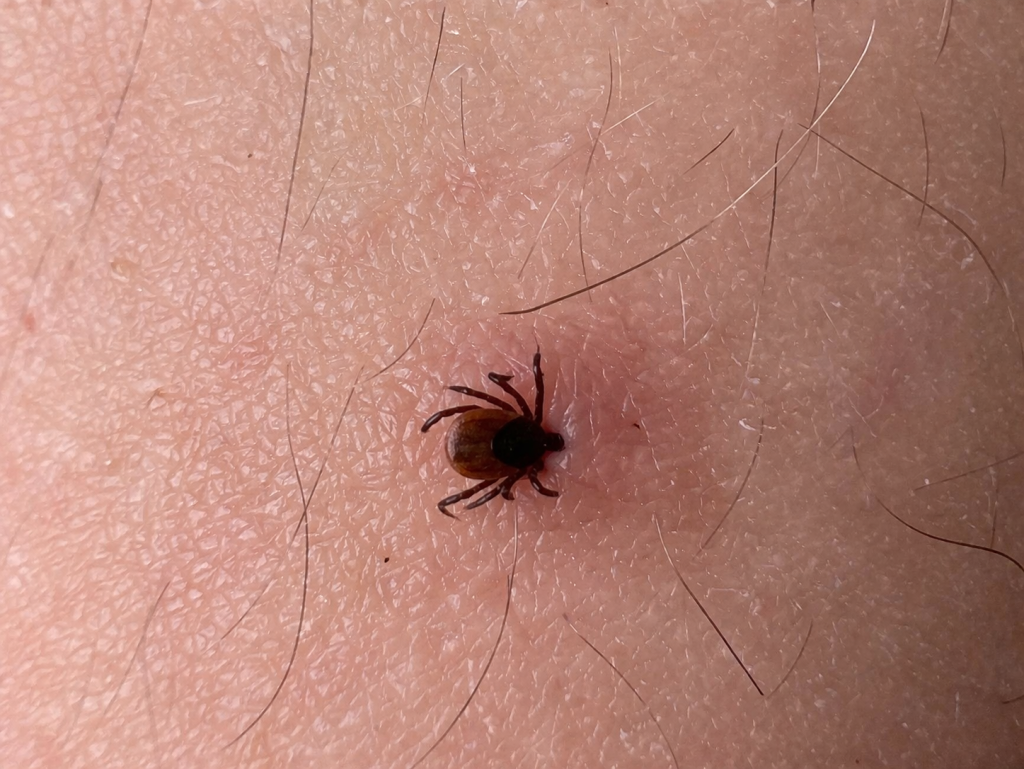
Once on the body, the tick doesn’t rush. It looks for a suitable spot, usually a warm, hidden area such as behind the knees, in the groin, under the arms, behind the ears, or along the scalp. In children, ticks are often found on the head, simply because they are closer to the height of surrounding vegetation.
What follows is not a typical bite. The tick attaches itself and begins feeding slowly, sometimes for hours or even days. During this process, it releases substances that reduce pain and inflammation, which is why many people don’t notice anything at first.
The real concern is not just the presence of the tick, but what it may transmit.
The most well-known condition is Lyme disease, caused by Borrelia bacteria. It can begin with a circular rash that gradually expands, but if left untreated, it may affect joints, the nervous system, and even the heart. Beyond Lyme, ticks can also transmit infections such as anaplasmosis, babesiosis, and ehrlichiosis, while in certain regions, tick-borne encephalitis is also a risk.
In the United States, certain species—such as the lone star tick—have been linked to unusual reactions, including the development of an allergy to red meat (known as alpha-gal syndrome). This has drawn increasing scientific attention because it changes how the immune system responds to common foods.
Not every tick attachment leads to illness, but there are signs worth paying attention to. Sometimes there is only a small, local redness that fades on its own. In other cases, symptoms may include unexplained fatigue, mild fever, muscle or joint pain, headaches, or the characteristic expanding rash. Some people also report bruising or swelling around the area, which can make the situation harder to interpret.
It’s important to understand that these infections are not contagious. They are not spread from person to person through normal contact, but only through the tick itself.
When it comes to removal, most ticks can be safely taken out at home, but the method matters. A fine-tipped pair of tweezers should be used to grasp the tick as close to the skin as possible, pulling steadily upward without twisting. Folk remedies like applying oil, alcohol, or heat before removal are not recommended, as they may increase the risk of transmission. After removal, the area should be cleaned and disinfected.
The idea of saving the tick for testing often comes up, but in practice, it is rarely useful. Even if the tick tests positive for a pathogen, it doesn’t confirm transmission, and medical decisions are usually based on symptoms and clinical evaluation rather than tick analysis.
The risk exists at any age, but young children and older adults may be more vulnerable, either because of increased exposure or because symptoms can be more difficult to recognize. At the same time, active adults who spend time outdoors are also frequently exposed.
What makes ticks different from many other risks is how quiet they are. There is no immediate reaction, no warning signal, no clear indication that something has happened.
And that is exactly why they are easy to overlook.
Behind that silence, however, is a real biological process that can have consequences if it goes unnoticed.
It’s not a constant danger.
But it often begins at the exact moment you don’t realize anything has changed.