
There are no bars.
No fences.
No distance between you and what’s coming.
You’re in the wild.
And it’s not slowing down.
In any other situation, your brain wouldn’t hesitate. This is the kind of moment where instinct takes over instantly. There’s no time to think, no room for interpretation.
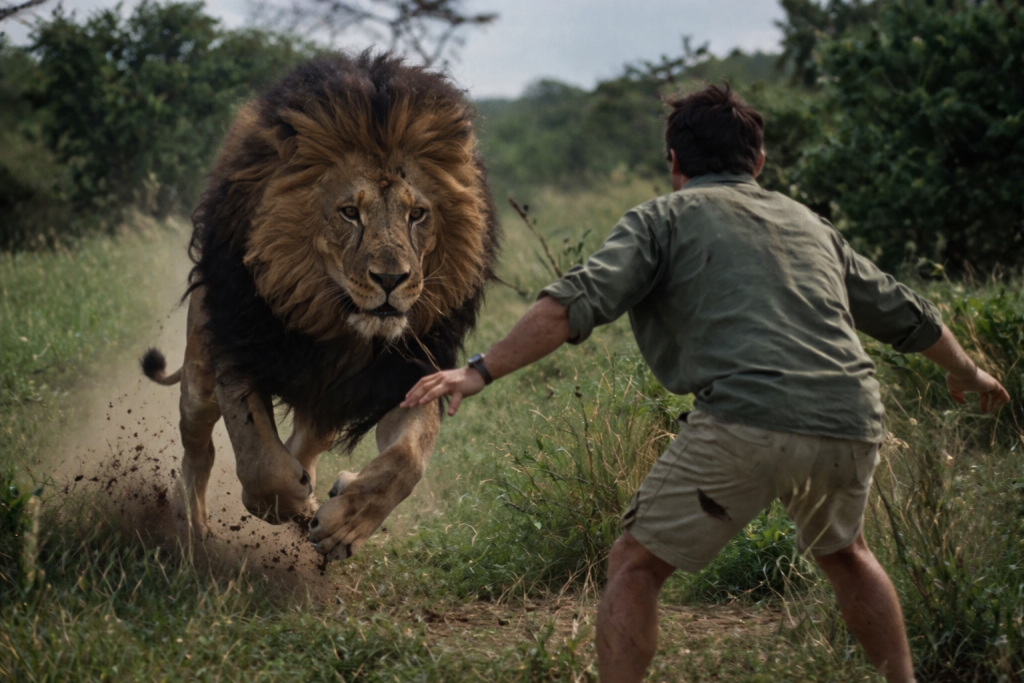
Just one clear signal: danger.
And yet, in this case, what happened next was the complete opposite.
This is the real story of Christian the Lion — one of the most well-known and documented cases of an unexpected bond between humans and a wild predator.
The story began in 1969, in a place that feels almost surreal by today’s standards: a department store in London.
Two young Australians, John Rendall and Anthony Bourke, came across a lion cub being sold there. They bought him and, for a time, raised him in the city — in an apartment and in spaces that were never meant for an animal like that.
At first, it worked.
He was small. Manageable. Easy to control.
But lions don’t stay small.
Within months, Christian began to grow rapidly, and with that growth came the reality of what he truly was: a top predator. It became clear that he couldn’t stay in that environment much longer.
To understand why, you have to understand what a lion actually is in the wild.
An adult male can weigh over 400 pounds and is built for power, control, and survival. Lions are not solitary hunters like many other big cats. They live in structured social groups called prides, where cooperation is essential.
Females do most of the hunting, working together with remarkable coordination. A hunt can involve long minutes of silent stalking, positioning, and patience — followed by just a few seconds of explosive force.
When they fail, they go hungry.
When they fail repeatedly, they don’t survive.
Cubs are fragile in the beginning. Many don’t make it through the early stages of life. As they grow, they learn through play, developing the skills they’ll need to hunt and compete. By the time young males reach around two to three years old, they’re pushed out of the pride and forced to survive on their own — often one of the most dangerous periods of their lives.
In the wild, a lion’s life typically spans around 10 to 14 years, shaped by constant competition, territory battles, hunger, and risk.
This is not an animal built for attachment in the way humans understand it.
And that’s exactly what makes this story so unusual.
In 1970, Rendall and Bourke made the difficult decision to take Christian to Kenya, where he was gradually reintroduced to the wild under the guidance of conservationist George Adamson. The process wasn’t immediate. It took months of careful transition, allowing him to adapt to a natural environment and eventually integrate with other lions.
Then, the connection ended.
Or at least, it was supposed to.
For about a year, they had no contact with him.
In 1971, they returned, hoping to find him again. They were warned that there was a real chance he wouldn’t recognize them — or worse, that he might see them as a threat.
Lions don’t wait.
They don’t look back.
They don’t hold onto relationships the way we do.
And yet, when Christian was finally located near a pride in the wild, something unexpected happened.
He saw them.
And he ran toward them.
The moment was captured on film and has since become one of the most iconic examples of human–animal interaction.
There was no hesitation.
No aggression.
Just a reaction that looked far closer to recognition than instinct.
So how is that even possible?
Lions are highly social animals. Members of a pride recognize each other through scent, sound, and repeated interaction. Their bonds aren’t emotional in a human sense, but they are stable and deeply ingrained.
Christian didn’t see strangers.
He recognized individuals from a time when they were part of his world — a time associated with safety, food, and social connection during a critical stage of development.
Those associations can be powerful.
But that doesn’t make this safe.
And it doesn’t make it repeatable.
A lion is still a lion.
Instinct doesn’t disappear.
The risk never goes away.
And maybe that’s exactly why this moment still fascinates people decades later.
Because it doesn’t rewrite the rules of nature — it simply reminds us that we don’t fully understand them.
Christian’s story doesn’t prove that wild animals can become “friends” in the way we imagine.
But it does suggest something more nuanced:
that experience can shape behavior more deeply than we expect.
And it leaves behind a question that still doesn’t have a clear answer:
how much of what we call instinct is fixed… and how much of it is memory?