
There’s a moment many cat owners know — but never fully accept.
A door is left open for just a few seconds.
A sudden noise startles her.
An unfamiliar place throws everything off.
And just like that, she’s gone.
At first, you expect her to come back.
Cats do that… don’t they?
But hours pass.
Then days.
And the silence starts to feel different.
For many people, that’s where the story ends.
But sometimes, it doesn’t.
Holly — A Return That Shouldn’t Have Been Possible
In 2012, a domestic cat named Holly went missing during a trip with her owners in Daytona Beach, Florida.
Her home was in West Palm Beach.
Over 200 miles away.
She was in a completely unfamiliar place.
No known territory.
No recognizable landmarks.
Her owners searched for days.
They put up flyers.
Contacted shelters.
Asked around.
Nothing.
Eventually, they had to leave.
For them, the story was over.
But not for Holly.
About two months later, she was found near their home in West Palm Beach.
Not right at the door.
Not in good condition.
She was severely dehydrated, underweight, and exhausted.
Veterinarians later confirmed that her condition was consistent with a long journey — not with being transported.
She had made it back.
On her own.
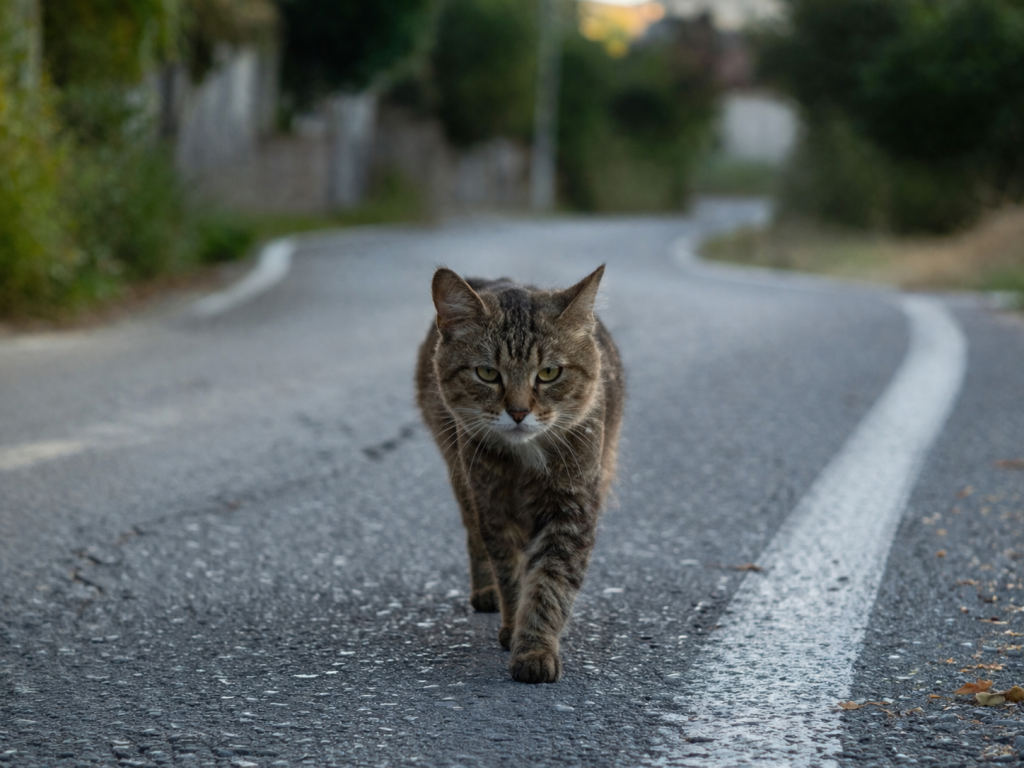
How Cats Actually Live — Independent, But Highly Adapted
To understand a story like this, you have to understand what a cat really is.
Domestic cats share ancestry with the African wildcat and were domesticated around 9,000–10,000 years ago.
But unlike dogs, they were never shaped to live in structured groups.
At their core, they remain solitary hunters.
That’s why they’ve kept:
– independence
– strong hunting instincts
– the ability to make decisions alone
They may live with us.
But they are still built to survive without us.
Territory — The Center of a Cat’s World
For a cat, “home” isn’t just a place.
It’s a territory.
A space mapped in detail through:
– scent
– sound
– movement
– memory
Cats constantly mark and update this invisible map.
When they’re removed from it, disorientation is immediate.
And yet, some find their way back.
How Cats Navigate — A System We Don’t Fully Understand
Cats don’t rely on just one sense.
They likely use a combination of:
– a highly developed sense of smell
– spatial memory
– visual landmarks
– environmental sounds
– and possibly sensitivity to the Earth’s magnetic field
This ability is often described as a “homing instinct.”
We don’t fully understand it.
But there are enough real cases to know it’s not random.
Scent — An Invisible Guide
For a cat, the world is built largely through scent.
They can recognize:
– places
– pathways
– subtle environmental differences
As Holly moved closer to familiar areas, those signals may have become stronger.
We don’t know exactly how she chose her direction.
But she wasn’t wandering aimlessly.
It’s Not Just Navigation — It’s Survival
Finding direction is only part of the story.
To make it home, Holly also had to endure the journey.
Over roughly two months, she had to:
– find food
– avoid danger
– adapt to unfamiliar environments
– keep moving
Even domestic cats retain highly effective survival skills.
They don’t disappear just because they live indoors.
What Cats Eat — And How They Cope
Cats are obligate carnivores.
Their bodies are designed for:
– animal protein
– hunting behavior
– small, frequent meals
In the absence of regular food, they may hunt:
– insects
– small rodents
– birds
This ability can sustain them in extreme conditions.
Lifespan and Development
A cat’s lifespan depends largely on its environment.
– indoor cats often live 12–18 years or more
– outdoor cats typically have shorter lifespans
Growth is rapid in the first year, then slows down.
But their instincts remain.
Why Not All Cats Make It Back
Not every cat has this ability.
It depends on:
– personality
– prior experience
– level of exploration
– sensitivity to surroundings
Some are highly oriented.
Others are not.
What We Still Don’t Fully Understand
Even today, there’s no complete explanation.
We have theories.
We have observations.
But not a full answer.
The Invisible Connection
For a cat, the journey isn’t just about direction.
It’s about returning to something familiar.
A place that makes sense.
And Then the Question Changes
It’s no longer just:
“How did she find her way back?”
But:
“What made her keep going?”
And Maybe the Most Important Part
To us, the journey seems impossible.
To her, it was the way back.
Not fast.
Not easy.
But clear enough that she didn’t stop.
Because somehow — in a way we still don’t fully understand —
she knew where she belonged.