
There’s a brief moment most people barely notice — a split second right before it happens.
The wax strip is already pressed against your skin.
The epilator is getting closer.
You already know what’s coming.
And then, in an instant, dozens of hairs are pulled out at once.
For you, it’s routine.
For your body, it isn’t.
That moment is registered as a controlled injury — and your skin reacts immediately, even if everything looks simple on the surface.
What a Hair Actually Is — And Why It Hurts When It’s Pulled
A hair isn’t just sitting on your skin.
Each strand is anchored deep inside a structure called a hair follicle, which is connected to tiny blood vessels and nerve endings.
Around every follicle, there are receptors that respond to pressure and, especially, to pulling.
So when you remove hair from the root — whether with wax, an epilator, or tweezers — you’re not just removing what you see. You’re pulling it out from a living structure.
The pain happens because:
– nerve endings are activated instantly
– signals travel quickly to the brain
– your body interprets it as a localized injury
That’s why the sensation feels sharp and immediate. It’s not just discomfort — it’s a real biological response.
The Immediate Skin Reaction: Inflammation Starts Within Seconds
The moment a hair is pulled out, your body doesn’t pause to “evaluate.”
It reacts.
A localized inflammatory response begins almost instantly.
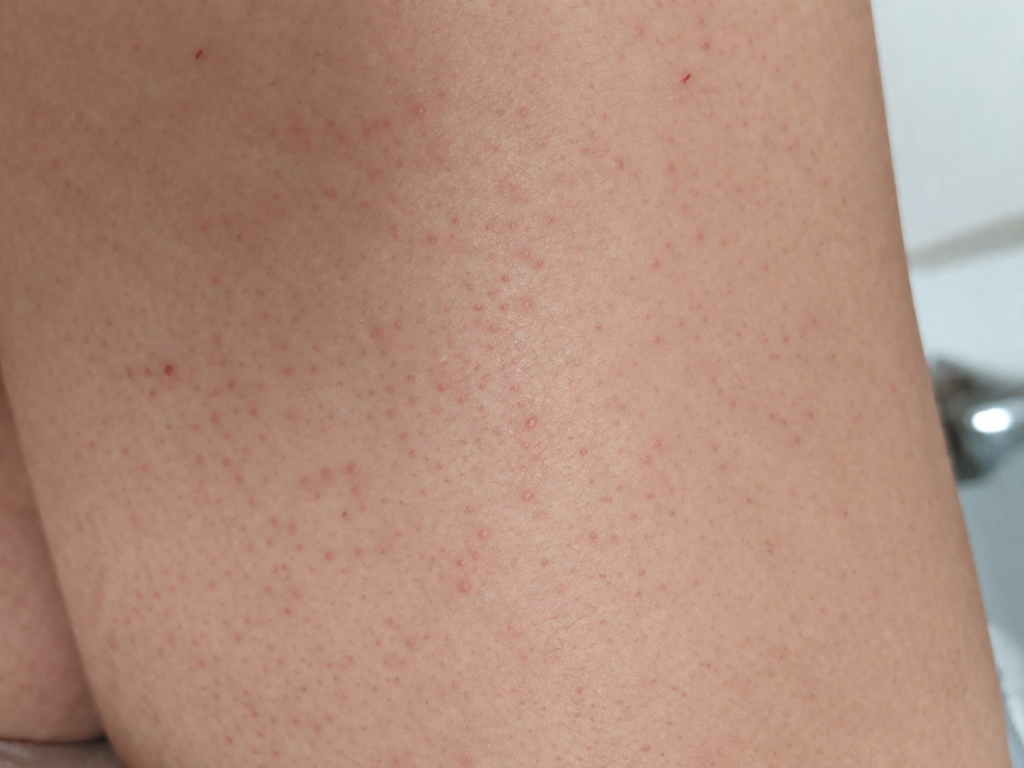
Blood vessels in the area expand, increasing blood flow. That’s why your skin turns red and feels warm. Your immune system also becomes active, sending cells to monitor and protect the area.
Those small red dots you sometimes see after hair removal aren’t random.
They’re signs that your body has started a repair process.
Invisible Micro-Injuries and the Skin Barrier
Even if your skin looks intact, tiny micro-injuries occur beneath the surface.
The follicle is temporarily left open, and the outer layer of your skin becomes slightly compromised. Your skin barrier — the layer that normally protects you from bacteria and prevents moisture loss — is briefly weakened.
That’s why right after hair removal:
– your skin may sting
– it feels more sensitive than usual
– certain products can irritate more than they normally would
It’s a short window, but a real one.
Why Ingrown Hairs Happen
After hair removal, the hair doesn’t disappear — it starts growing again.
Sometimes, instead of growing outward, it gets trapped under the skin or curls back into it.
Inflammation and dead skin buildup can block the follicle, making this more likely.
The result:
– small bumps under the skin
– redness
– sometimes pain or irritation
It’s not just cosmetic — it’s your skin reacting to a hair that can’t find its way out.
Does Hair Grow Back Thicker?
This is one of the most common myths.
If you shave, hair doesn’t actually grow back thicker. It just looks that way because the hair is cut straight across instead of tapering naturally at the tip.
If you remove hair from the root — with wax or an epilator — something different can happen over time.
Some follicles weaken, and hair may grow back:
– finer
– less dense
– sometimes lighter
It won’t disappear completely, but the change can be noticeable.
Why It Hurts Less Over Time
Many people notice that hair removal becomes more tolerable with repetition.
That’s not your imagination — your body adapts.
Several things contribute to this:
– hair often grows back finer
– not all hairs grow at the same time, so fewer are removed at once
– nerve endings become less reactive to repeated stimuli
– your brain processes the sensation differently over time
The pain doesn’t fully disappear, but it becomes easier to manage.
Different Methods, Different Effects on Your Skin
Not all hair removal methods affect your body the same way.
Shaving cuts the hair at the surface and doesn’t impact the follicle, so it doesn’t trigger the same level of inflammation.
Waxing and epilators remove hair from the root, activating both nerve endings and the local immune response.
Laser hair removal works differently. It targets the follicle using light energy, gradually reducing its ability to produce hair over time.
Even if the end result looks similar, your skin experiences each method very differently.
Why Some Areas Hurt More Than Others
Sensitivity isn’t random.
It depends on:
– how many nerve endings are in the area
– how thick or thin the skin is
– the type of hair
– blood supply in that region
That’s why the same method can feel mild in one area and intense in another.
Is Hair Removal “Natural” for the Body?
From a biological perspective, hair has functions:
– protection
– temperature regulation
– acting as a barrier
Removing it isn’t necessary for your body to function, but it’s not harmful by itself.
Problems usually appear when:
– the skin is irritated repeatedly without recovery time
– proper aftercare is missing
– inflammation or infection develops
Otherwise, your body adapts.
What You Don’t See After Hair Removal
On the surface, your skin looks smooth and clean.
But underneath, within minutes, your body has already gone through:
– nerve stimulation
– micro-injury
– inflammation
– immune activation
– the beginning of tissue repair
All of that happens every single time.
And maybe that’s the most interesting part.
Something as routine as hair removal triggers a complex, precise biological response — one you don’t fully see, but one your body handles every time.
Because your body doesn’t treat it as a cosmetic step.
It treats it as an intervention.
And it responds accordingly.