
If you were floating right now on the surface of the Black Sea, nothing would seem unusual. Calm water, familiar waves, maybe even dolphins in the distance. It looks like any other sea — predictable, alive, and easy to understand.
And yet, just a few hundred meters below you, something changes completely.
Not gradually. Not subtly. Completely.
At around 150–200 meters deep, the Black Sea crosses an invisible boundary where oxygen disappears. Beyond that point, the water becomes saturated with hydrogen sulfide, a toxic gas that makes life — at least as we know it — impossible. What’s even more striking is that this lifeless zone makes up roughly 85–90% of the sea’s total volume.
Most of the Black Sea cannot support life.
And from above, you would never know.
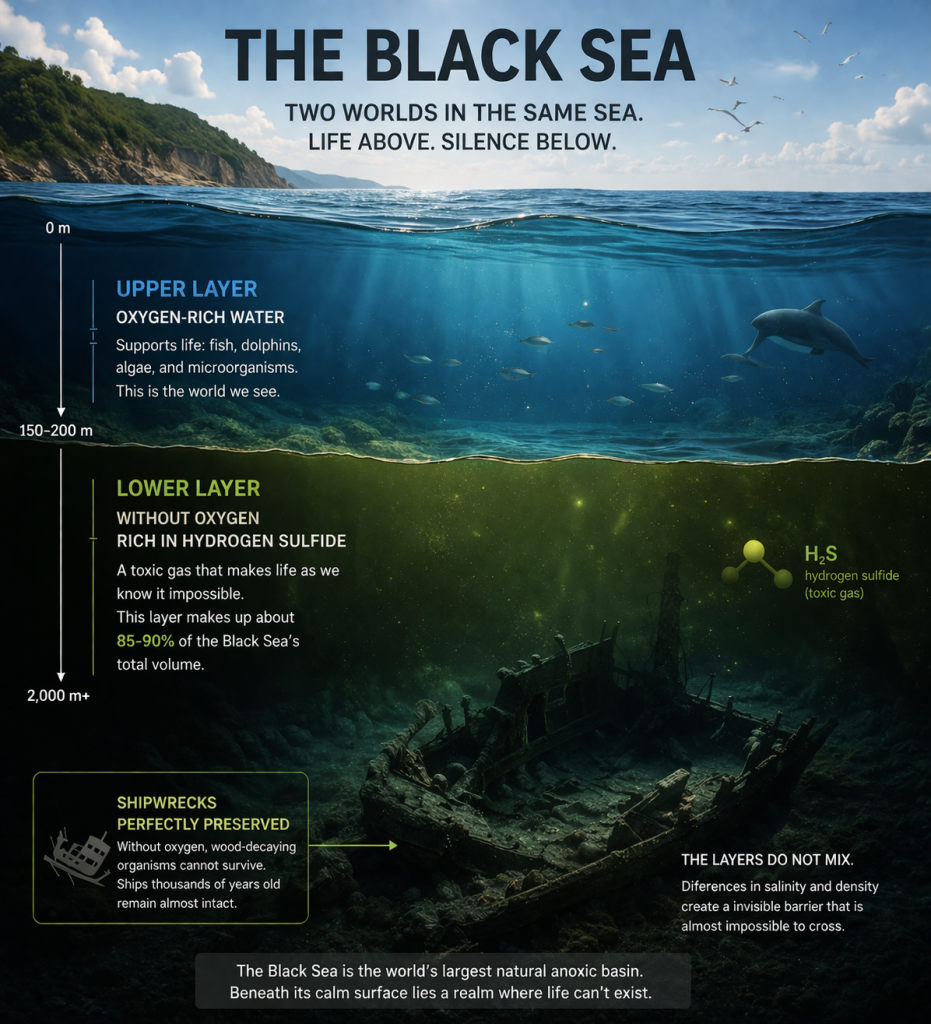
Two worlds that never meet
The upper layer, the one we interact with, is very much alive. It contains oxygen and supports fish, dolphins, algae, and countless microorganisms. It’s the sea we swim in, fish in, and recognize.
But below that thin boundary lies a completely different world.
The water becomes denser, saltier, and deprived of oxygen. In its place, hydrogen sulfide accumulates, produced by bacteria that thrive without oxygen. For complex life forms, this environment is simply uninhabitable.
These two layers remain separated, forming a stable, invisible divide between life and absence.
Why the layers don’t mix
This unusual structure is driven by differences in salinity and density. The Black Sea receives massive amounts of freshwater from rivers like the Danube, creating a lighter, less salty surface layer.
Beneath it sits a heavier, saltier layer that originates from the Mediterranean Sea through the Bosporus Strait.
Because of this density difference, vertical mixing is extremely limited. Oxygen from the surface cannot reach the deeper layers, allowing the anoxic environment to persist over thousands of years.
Is there really no life down there?
The common claim that “there is no life below 200 meters” isn’t entirely accurate — but it’s not far from the truth either.
There are specialized microorganisms that can survive in these extreme conditions. However, fish, plants, and other visible marine life cannot exist there. For all practical purposes, the ecosystem as we know it simply stops.
A natural time capsule
One of the most fascinating consequences of this environment is how well it preserves the past.
In oxygen-rich waters, wood and organic materials are quickly broken down by microorganisms. But in the Black Sea’s deep, oxygen-free layers, this process doesn’t occur.
As a result, ancient shipwrecks remain astonishingly intact, some dating back hundreds or even thousands of years. Entire wooden structures have been found preserved as if time had paused.
The Black Sea is not just unusual — it is one of the best-preserved underwater archives on Earth.
Not dangerous, but deeply misunderstood
Despite how dramatic this sounds, the Black Sea is not “dead,” nor is it dangerous at the surface. Life continues normally in the upper layer.
The real concerns today come from modern pressures — pollution, overfishing, and climate change — which can affect the already delicate balance of this ecosystem.
A familiar sea with an unfamiliar truth
What makes the Black Sea so unsettling isn’t just the existence of a lifeless zone, but how close it is.
This isn’t a remote abyss in the middle of an ocean. It’s a boundary just a few hundred meters below waters where people swim every day.
It looks familiar.
It feels safe.
But beneath the surface lies a reality that quietly challenges one of our most basic assumptions — that where there is water, there is life.