
There’s a moment most people never notice—the exact point when a cavity begins. Nothing hurts, nothing looks obviously wrong, and yet, deep at a microscopic level, your tooth has already started losing a quiet, ongoing battle. Tooth decay isn’t a sudden event. It’s a gradual process shaped by everyday habits, where each snack, each sip of something sweet, and each missed brushing subtly shifts the balance.
How a cavity actually starts
Your mouth is home to a complex ecosystem of bacteria. Some of them, especially Streptococcus mutans and certain Lactobacillus species, thrive on sugars and refined carbohydrates. When you eat or drink something containing fermentable carbs, these bacteria convert them into acids.
It’s not sugar itself that directly damages your teeth, but the acid produced as a byproduct of this process. Under normal conditions, your saliva acts as a powerful defense system. It helps wash away food particles, neutralizes acids, and delivers essential minerals like calcium and phosphate that can repair early damage.
The problem begins when acid attacks happen too often. If the pH in your mouth drops below about 5.5, your enamel—the hard outer layer of your tooth—starts to lose minerals. At first, this doesn’t create a visible hole. You might only see a faint white spot, if anything at all. At this stage, the process is still reversible, but it rarely gets noticed.
How it progresses inside the tooth
When demineralization continues, the enamel weakens enough to break down, forming a cavity. Once that protective layer is breached, bacteria move into the dentin underneath, which is softer and far more vulnerable.
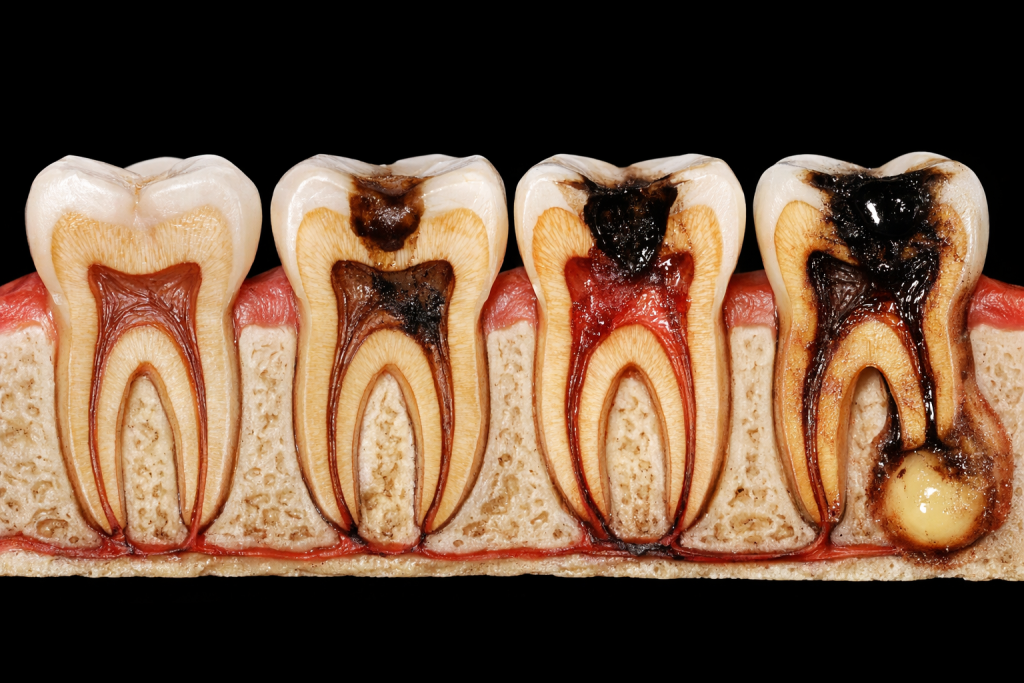
Dentin contains microscopic tubules that lead directly to the pulp, the inner part of the tooth where nerves and blood vessels are located. This is when sensitivity begins—discomfort when eating something cold, sweet, or even when biting down.
As decay advances, bacteria release toxins that trigger inflammation in the pulp. Pain becomes more intense, sometimes throbbing and persistent. If left untreated, the infection can spread beyond the tooth, forming an abscess and affecting surrounding tissues, and in more serious cases, even entering the bloodstream.
What this means for your body overall
Although a cavity starts locally, its effects don’t always stay confined to the tooth. Chronic dental infections can contribute to low-grade systemic inflammation. Research has linked poor oral health with an increased risk of cardiovascular disease, metabolic disorders, and complications during pregnancy.
Beyond that, dental pain changes behavior. It can affect how you eat, disrupt sleep, and increase stress levels. Over time, these indirect effects can influence your overall well-being more than most people realize.
Differences across age groups
In children, enamel is thinner and less mineralized, which allows cavities to progress much faster. What might take months or even years in an adult can develop in a matter of weeks in a child. Frequent exposure to sugary drinks, especially at night when saliva flow decreases, significantly increases risk.
Teenagers often face a different challenge. Diets high in sugar and inconsistent oral hygiene make them particularly vulnerable, especially in hard-to-clean areas between teeth.
In adults, cavities tend to develop more slowly but often appear in new patterns—between teeth or around existing dental work like fillings and crowns.
In older adults, the risk shifts toward the roots of the teeth. As gums recede, the root surfaces become exposed. These areas are not protected by enamel and are more susceptible to decay. Additionally, many medications reduce saliva production, weakening one of the body’s key natural defenses.
Differences between women and men
Epidemiological data suggest that women tend to experience slightly higher rates of cavities than men, and the reasons are multifactorial. Teeth typically erupt earlier in females, meaning longer lifetime exposure to the oral environment.
Hormonal fluctuations can also influence saliva composition and the balance of oral bacteria. Pregnancy, in particular, creates conditions that can increase the risk of tooth decay, due to changes in diet, oral acidity, and inflammation of the gums.
In men, while overall rates may be slightly lower, cavities are often diagnosed at more advanced stages. This is frequently linked to differences in oral hygiene habits and higher rates of risk behaviors such as smoking and alcohol use.
What the science says
According to the World Health Organization, more than 2.3 billion people worldwide have untreated cavities in permanent teeth, making tooth decay the most common chronic disease globally. The Centers for Disease Control and Prevention reports that the majority of adults in the United States will experience tooth decay at some point in their lives.
What matters most is understanding that cavities are not inevitable. They develop when the balance between demineralization and remineralization is repeatedly disrupted. In the early stages, this process can be stopped—and even reversed. But once the structure of the tooth is physically damaged, intervention becomes necessary.
In the end, what happens in your body when a cavity forms is not just the breakdown of a tooth. It’s the gradual loss of a delicate biological balance—one that, once you understand it, becomes far easier to protect than to repair.