
There are few moments in science that spark genuine emotion, and the story of Pluto is one of them. For decades, it held its place as the ninth planet, the distant edge of our Solar System, small but firmly part of the cosmic family. Then, almost overnight in the public eye, that identity changed. Pluto was no longer classified as a planet, but as a dwarf planet.
What makes this story remarkable is the timing. Just as Pluto lost its official status, it began to reveal its true nature. The more scientists learned, the clearer it became that this distant world was anything but simple. In many ways, it turned out to be more dynamic and intriguing than several of the planets we thought we understood better.
A Discovery Made Before We Could Truly See It
In 1930, astronomer Clyde Tombaugh identified Pluto after painstakingly comparing photographic plates of the night sky. It was not a moment of sudden revelation, but the result of careful, methodical work, tracking a faint point of light that shifted ever so slightly against the background stars.
Yet discovering Pluto did not mean understanding it. For decades, it remained little more than a distant blur, too far away for telescopes to reveal meaningful detail. Humanity knew it existed, but had no real sense of what it looked like, what it was made of, or how it behaved.
That gap between knowledge and understanding gave Pluto a certain mystique. It was imagined as a frozen, inactive world, quietly orbiting at the edge of the Sun’s influence.
When Science Redefined What a Planet Is
The turning point came in 2006, when the Uniunea Astronomică Internațională introduced a formal definition of what qualifies as a planet. By then, astronomers had identified numerous objects beyond Neptune, clustered in what is now known as the Centura Kuiper.
Pluto was no longer unique. It was one among many similar bodies, sharing its region rather than dominating it. Because it had not cleared its orbital neighborhood, it no longer met all the criteria required for full planetary status.
For the public, it felt like a loss. For science, it was a necessary refinement, a step toward a more accurate understanding of the Solar System.
A Surface That Defied Expectations
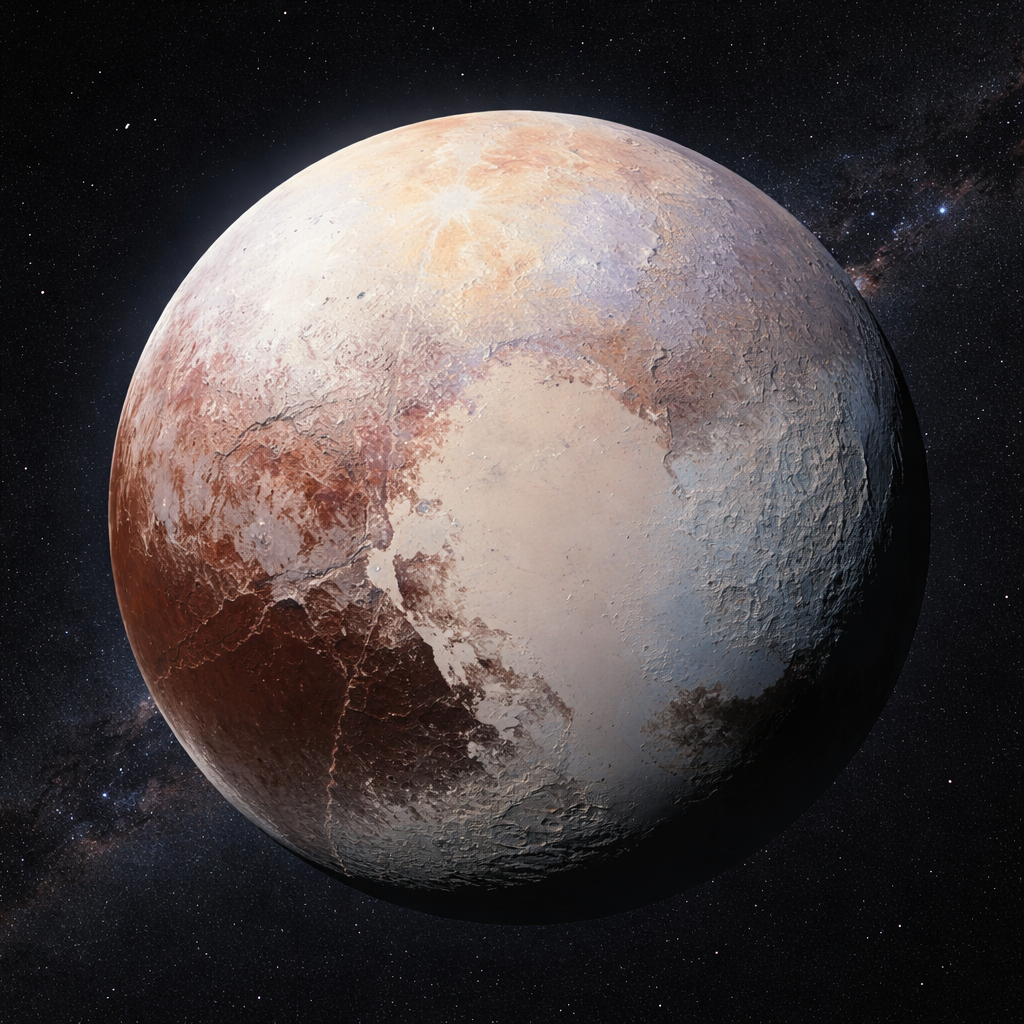
Everything changed in 2015, when the spacecraft New Horizons flew past Pluto and sent back the first detailed images of its surface. What had once been a distant dot suddenly became a real place, with texture, contrast, and complexity.
Instead of a uniform frozen sphere, Pluto revealed vast plains of nitrogen ice, slowly shifting in patterns that resemble glacial movement. Towering structures made of water ice rise like mountains, their solidity preserved by extreme cold that turns ice into something as hard as rock.
Rather than a dead world, Pluto appeared to be quietly active, shaped by processes that operate on timescales and conditions very different from those on Earth.
An Atmosphere That Comes and Goes
Pluto’s atmosphere is thin and fragile, composed mainly of nitrogen with traces of methane and carbon monoxide. What makes it truly extraordinary is its instability.
As Pluto travels along its elongated orbit, its distance from the Sun changes dramatically. When it moves closer, surface ices sublimate, forming a tenuous atmosphere. When it drifts farther away, temperatures drop so drastically that these gases freeze and fall back to the surface.
In effect, Pluto’s atmosphere can partially disappear and then re-form over time. It is a cycle unlike anything observed on the major planets, a reminder of how different the outer Solar System can be.
A System That Blurs the Line Between Planet and Moon
Pluto is not alone. Its largest companion, Charon, is so large relative to Pluto that the two bodies orbit a shared center of mass located outside Pluto itself. This makes their relationship more balanced than the typical planet-moon dynamic.
Surrounding them are smaller moons — Nix, Hydra, Kerberos, and Styx — each contributing to a complex gravitational system that continues to be studied in detail.
An Orbit That Breaks the Rules
Unlike the nearly circular, neatly aligned orbits of most planets, Pluto follows a tilted and elongated path. At certain points in its journey, it even comes closer to the Sun than Neptun.
Despite this, there is no danger of collision. Pluto and Neptune are locked in a stable orbital resonance, a gravitational balance that keeps their paths coordinated over immense spans of time.
Why Pluto Still Matters
Pluto’s story is not just about classification, but about how knowledge evolves. What once seemed certain can change when new evidence emerges, and those changes often lead to deeper understanding rather than loss.
Today, Pluto is no longer the ninth planet in the traditional sense. Yet it has become something arguably more important: a gateway to understanding the outer Solar System and the countless icy worlds that exist beyond the familiar planets.
In the end, Pluto did not lose its significance. It gained a new one.