
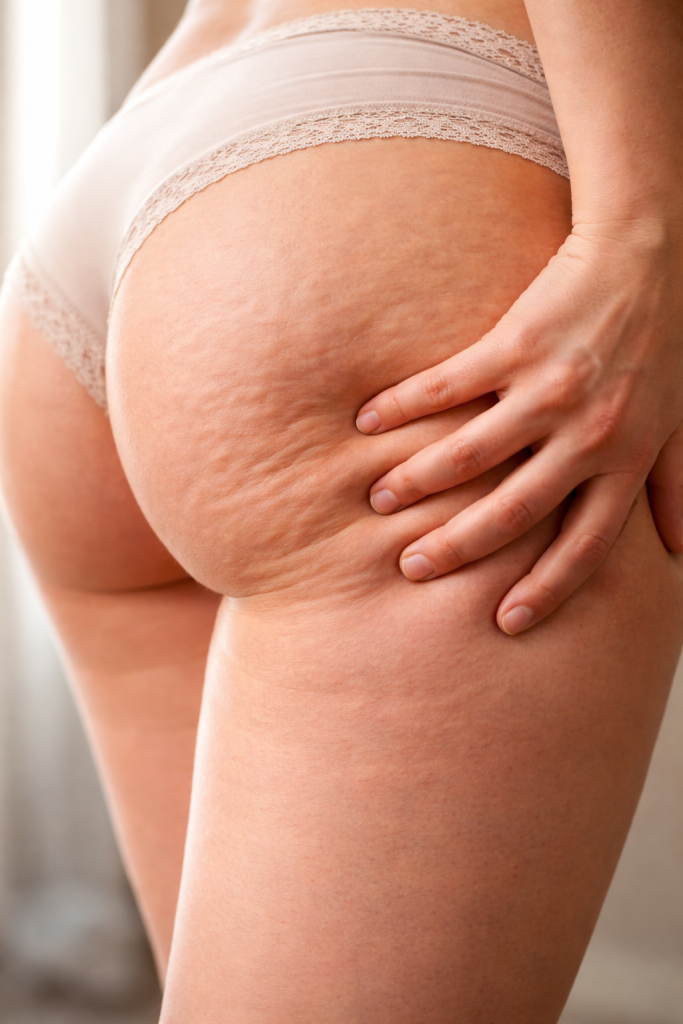
You might have noticed it in an ordinary moment—maybe in stronger light, or in a mirror you hadn’t really paid attention to before. Nothing major changed, nothing dramatic happened, and yet your skin suddenly looks a little different. Cellulite tends to show up exactly like that: subtle at first, but noticeable enough to make you wonder why it’s there, why it’s more visible in some people, and whether it can ever truly disappear.
Why some women have more visible cellulite
The answer isn’t about one single cause, but about how the body is built. Beneath the skin lies a layer of fat divided into small compartments by strands of connective tissue. In women, these fibers are arranged mostly in a vertical pattern, which allows fat cells to push upward more easily. That upward pressure creates the uneven, dimpled look associated with cellulite.
Hormones, especially estrogen, play a major role in this process. They influence how fat is stored, how elastic the skin remains, and how efficiently blood circulates in the area. That’s why cellulite often becomes more noticeable after puberty, during pregnancy, or as the body changes with age.
Circulation and lymphatic flow also matter more than they seem. When fluid movement slows down, small amounts of fluid can accumulate in the tissues, making the surface of the skin appear less smooth. At the same time, reduced oxygen delivery to the area can affect the overall structure of the skin.
Genetics adds another layer to the picture. Some people are simply more prone to this type of fat distribution and connective tissue structure, which explains why two individuals with similar lifestyles can have very different skin textures.
Different types of cellulite
Although it’s often talked about as a single condition, cellulite can present in different forms, depending on how the tissue behaves.
Soft cellulite is usually associated with less firm tissue. The skin may appear looser, and the dimpling becomes more noticeable in certain positions, such as when sitting.
Firm cellulite tends to be denser and is often seen in younger or more active individuals. The skin may look smooth at first glance, but irregularities become visible when the area is compressed.
Edematous cellulite is less common and involves fluid retention. The area can feel tender, sometimes even slightly painful, and circulation is often more affected.
There is also a progression in how visible cellulite becomes, ranging from forms that are only noticeable when the skin is pressed to those that are clearly visible even at rest.
What’s actually happening beneath the skin
At a microscopic level, cellulite is not simply “extra fat.” It’s the result of interactions between fat cells, connective tissue, and local circulation.
Fat cells expand and push upward, while the surrounding connective fibers pull the skin downward in certain spots. This contrast creates the uneven surface appearance.
At the same time, changes in blood flow and lymphatic drainage can lead to mild fluid buildup, which further accentuates the texture differences on the skin.
Why it appears even in slim individuals
One of the most frustrating aspects is that cellulite is not strictly linked to body weight. It can be clearly visible in people with a low body fat percentage, while others with higher levels of body fat may show very little.
The explanation lies in structure rather than quantity. The way fat is arranged and how connective tissue is organized has a greater impact on appearance than the total amount of fat.
Can cellulite actually go away?
This is where expectations often don’t match reality. In most cases, cellulite cannot be completely eliminated, because it is tied to the natural structure of the tissue.
However, its appearance can be improved. Reducing overall body fat may decrease the size of fat cells. Physical activity helps support muscle tone and improves circulation. Hydration and nutrition also play a role in maintaining the quality of connective tissue.
There are also aesthetic treatments that can temporarily reduce the visible appearance, but results vary and are not permanent.
The key idea
Cellulite is not a flaw—it’s a very common biological characteristic, especially in women. It reflects the way skin, fat, and connective tissue interact.
It doesn’t appear because you’ve done something wrong, and in most cases, it can’t be completely erased. It can be influenced and improved, but it remains part of a much more complex biological reality than it might seem at first glance.