
There are things we use every single day without ever stopping to think about what we call them. The place itself is obvious, familiar, almost invisible in its routine. But the name? That’s where things get surprisingly interesting.
What seems like a simple, universal concept actually carries a layered story—one shaped by history, language, culture, and even infrastructure. And depending on where you are in the world, you might ask for the same place using completely different words.
Before “WC”: how it all started
Long before modern plumbing, people still had to solve the same basic need—but the solutions looked very different. In ancient civilizations like the Roman Empire, public latrines were common. Stone benches lined up side by side, shared spaces with little privacy, and a constant flow of water beneath to carry waste away.
After the fall of Rome, much of Europe lost that level of organization. In medieval cities, sanitation became inconsistent at best. In castles across United Kingdom and beyond, what were called “garderobes” were essentially openings in the walls, allowing waste to drop outside. Practical, but far from what we’d consider hygienic today.
The turning point: “water closet”
The real shift came in the 18th and 19th centuries, especially in United Kingdom, where advances in plumbing and urban planning began to reshape daily life. This is where the term “water closet” appeared.
At the time, a “closet” meant a small, private room—not a wardrobe. Add running water to the equation, and you get a dedicated, enclosed space designed specifically for hygiene. It wasn’t just about function anymore; it was about privacy, cleanliness, and control over the environment.
As cities expanded and sanitation systems improved, the concept spread across Europe.
How “WC” became universal
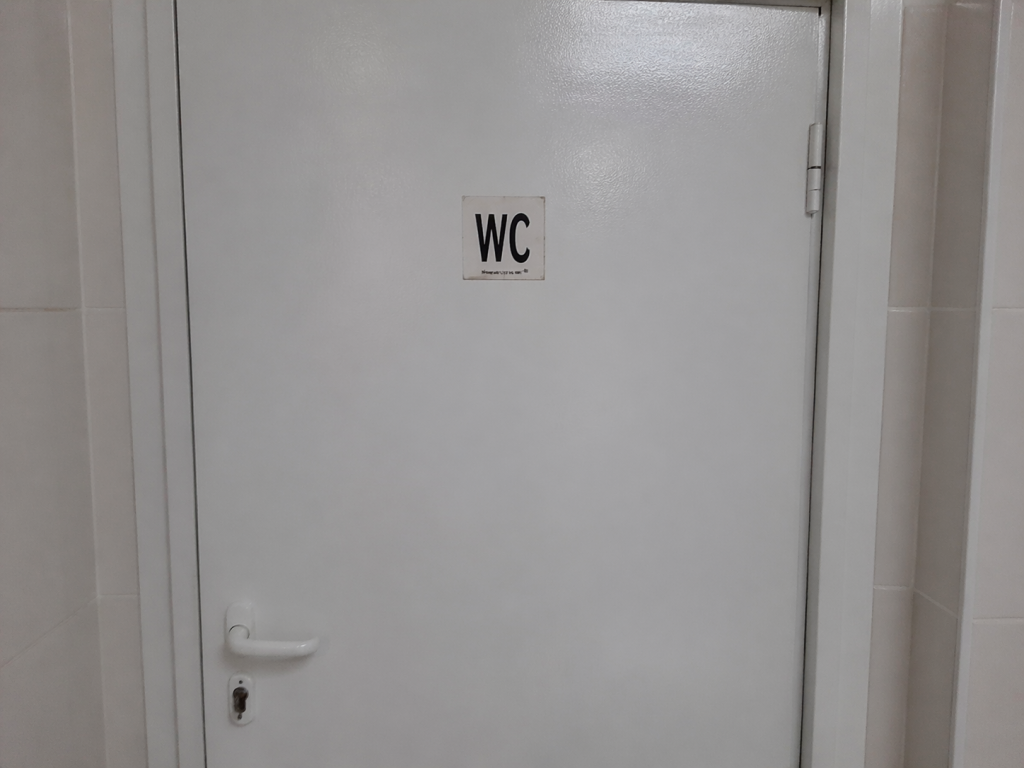
The full expression “water closet” didn’t travel well across languages, but its abbreviation did. “WC” became a kind of international shorthand—simple, recognizable, and easy to place on a door sign anywhere.
Interestingly, while the term originated in English, it’s rarely used in everyday conversation in the United States, where people prefer “bathroom” or “restroom.” Meanwhile, across Europe, “WC” remained a standard visual cue, even in countries where English isn’t spoken.
Different words, same place
English itself reflects this diversity. “Toilet” comes from French origins and is widely understood, but can feel more direct. “Bathroom” suggests a room with a bath, even when there isn’t one. “Restroom” softens the meaning entirely, focusing on comfort rather than function. And in the UK, “loo” is a casual, everyday term that feels natural in conversation.
Each word carries a slightly different tone, shaped by culture and context rather than strict definition.
The reality beyond modern systems
While modern indoor plumbing is often taken for granted, it’s not universal. In many rural areas around the world—including parts of Moldova, Ukraine, and even remote regions in the United States—outdoor toilets are still part of everyday life.
Organizations like World Health Organization and UNICEF estimate that billions of people globally still lack access to safely managed sanitation. In those contexts, the idea of a “WC” as a private, indoor, water-connected space is still more aspiration than reality.
Even in developed countries, you’ll find outdoor facilities in places like mountain cabins, campsites, or national parks—reminders that convenience depends heavily on infrastructure.
More than just a word
What looks like a simple label on a door is actually a small piece of global history. From ancient stone latrines to Victorian plumbing systems, from rural outhouses to modern restrooms, the evolution of this everyday space reflects how societies grow, adapt, and define comfort.
And the fact that we still use so many different words for the same place isn’t confusion—it’s a reflection of that journey.
Because sometimes, the most ordinary things carry the most unexpected stories.