
There’s a moment you can’t quite define — somewhere between being awake and being asleep. You don’t notice it most of the time. You just slide through it quietly.
Until one night, you don’t.
You’re lying there, your body loosens, your thoughts begin to fade… and suddenly it hits. A sharp sensation, like the ground just disappeared beneath you. For a split second, it feels real — like slipping, dropping, losing control.
Then your body jerks. You wake up. Your heart is racing, your breath slightly off, and you’re left wondering what just happened.
It feels strange, sometimes even unsettling. But it’s also something your body knows how to do surprisingly well.
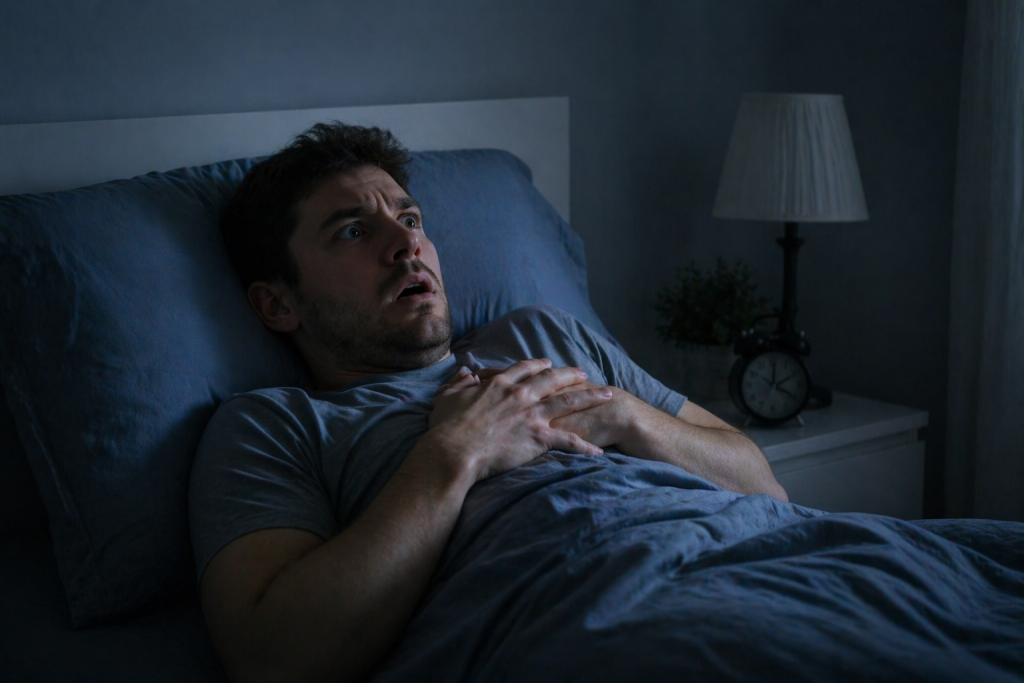
The moment your body lets go… but your brain doesn’t fully follow
This sensation happens during the transition into sleep — a stage scientists call the hypnagogic phase, part of the earliest sleep stage (N1).
At this point, your body begins to power down. Muscles relax, breathing slows, your heart rate drops. Everything is moving toward rest.
But the brain doesn’t always switch off at the same pace.
Part of it stays alert just a little longer, still scanning, still interpreting signals. And in that small mismatch between body and brain, things can get misread.
When relaxation feels like danger
As your muscles relax, the brain may interpret that sudden release of tension as something else entirely — a loss of balance, or even a fall.
It’s not a conscious thought. It’s a reflexive reaction, built into the deeper, older parts of the nervous system.
Instead of analyzing the situation, the brain reacts instantly.
It sends a rapid signal to your muscles — a kind of emergency reset.
What actually happens in that split second
That sudden jolt has a name: a hypnic jerk.
It’s brief, but a lot happens all at once:
– your muscles contract sharply
– your nervous system spikes in activity
– your heart rate may jump
– your breathing can momentarily change
– and often, your brain pairs it with a vivid sensation — usually falling
It’s not just physical. It feels like an experience.
Why the “falling” feels so real
At this stage of sleep, your brain has already started to produce dream-like imagery. Not full dreams, but fragments — quick, intense impressions.
So when your body reacts, your mind fills in the story.
That’s why it’s not just a twitch. It’s a fall, a slip, a sudden drop. Your brain creates the scene, and your body responds to it as if it were real.
Why it happens more at certain times
Although it’s completely normal, some factors can make these episodes more frequent or more intense.
Stress and anxiety keep your brain slightly on edge, even when your body is trying to rest. Extreme fatigue can make the transition into sleep more abrupt. Caffeine, late-night screen use, or irregular sleep patterns all add to that imbalance.
In simple terms, it happens more often when your body is ready to sleep… but your mind isn’t fully there yet.
Studies suggest that around 60–70% of people experience hypnic jerks at least occasionally.
Why it feels strangely familiar
There’s another detail that makes this even more interesting.
If that sudden jolt feels oddly familiar, there’s a reason.
Newborn babies have something called the Moro reflex — a built-in response to the sensation of losing support. When triggered, their arms fling outward and then pull back in, their whole body reacting instantly to what feels like a fall.
It’s one of the earliest protective responses of the nervous system.
In adults, what happens during that moment before sleep isn’t the same reflex — but it’s not entirely different either.
Both reactions are triggered by the same underlying idea: a sudden loss of stability.
The difference is that, for you, the “fall” isn’t real. It’s just how your brain interprets a perfectly normal process.
What this reveals about your body
What matters most isn’t the movement itself, but what it says about how your body works.
Even as you fall asleep, your brain doesn’t fully shut down. It continues to monitor, interpret, and react — sometimes a bit too quickly for its own good.
That brief moment of “falling” is not a failure of the system.
It’s a sign that it’s still trying to protect you.
Even when there’s nothing to protect you from.